Some US cities have begun rewarding careful drivers with fewer red lights
Advertisement
Read this article for free:
or
Already have an account? Log in here »
To continue reading, please subscribe:

Digital Subscription
One year of digital access for only $205*
- Enjoy unlimited reading on winnipegfreepress.com
- Read the E-Edition, our digital replica newspaper
- Access News Break, our award-winning app
- Play interactive puzzles
*First annual payment billed as $205.00 + GST for one year. This annual subscription will automatically renew at $233.00 + GST every 52 weeks (10% off the regular annual price of $259.35). Offer available to new and qualified returning subscribers only. Cancel any time.
To continue reading, please subscribe:
Add Free Press access to your Brandon Sun subscription for only an additional
$1 for the first 4 weeks*
- Enjoy unlimited reading on winnipegfreepress.com
- Read the E-Edition, our digital replica newspaper
- Access News Break, our award-winning app
- Play interactive puzzles
*Your next Brandon Sun subscription payment will increase by $1.00 and you will be charged $17.95 plus GST for four weeks. After four weeks, your payment will increase to $24.95 plus GST every four weeks.
Read unlimited articles for free today:
or
Already have an account? Log in here »
Officials struggled for years to curb high-speed crashes along a residential corridor cutting through Albuquerque, New Mexico, but simply punishing the lead-footed drivers didn’t seem to work.
What ultimately did was rewarding the law-abiding ones with fewer red lights.
The solution, which the city credits for a dramatic drop in crashes and injuries along one busy stretch of road, is a relatively novel version of a longstanding traffic safety concept commonly known as “rest in red,” in which traffic signals default to red until a vehicle approaches. But Albuquerque and Portland, Oregon, took it a step further by adding speed sensors that grant a much earlier green light to drivers traveling at or below the posted limit.
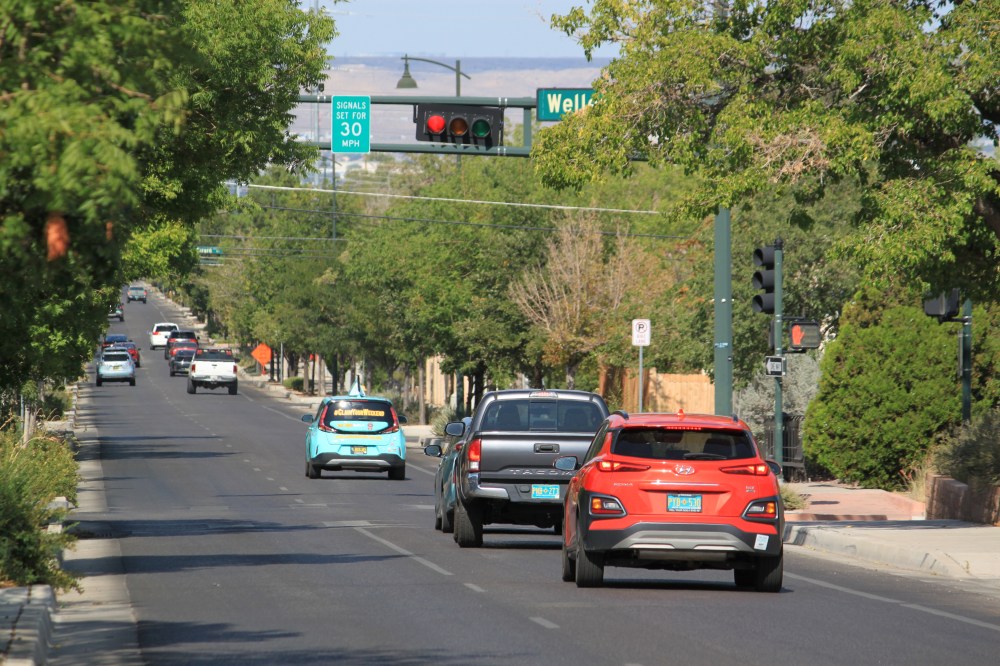
“We’re finding that the technology itself is kind of its best advertisement,” Jennifer Turner, Albuquerque’s director of municipal development, said of the strategy the city deployed on Lead and Coal avenues, parallel one-way streets. “If you come to Albuquerque right now and you’re driving that corridor, you will learn pretty quickly that if you are speeding, you stop.”
Isaac Romero, who lives along the corridor, said he has noticed a big difference. Before rest in red, he would sometimes wake up in the middle of the night to the sound of drivers racing to beat the traffic lights or one another. He saw cars that had crashed and flipped, including one that ended up in his neighbor’s yard.
“We had one accident where it’s even shaken the whole house because some guy slammed into a tree,” Romero said. “It’s a lot of change because now you don’t get as many people flying through there.”
Portland credits its ‘virtual speed bumps’
Portland recently rolled out the concept during the late-night hours on Southeast Powell Boulevard, a busy state highway with a long history of crashes, including fatal ones.
Peter Koonce, who manages signals and street lighting for the city, calls the new approach a “virtual speed bump” and said the early results are promising. At the first intersection tested, rest in red was able to lower the average speed from 39 mph (63 kph) to 30 mph (48 kph), which is the speed limit, he said.
Oregon State University researchers helped Portland choose its vehicle detection system for monitoring speeds, and now they’re assessing its performance. David Hurwitz, a professor of transportation engineering who leads the study, said it’s too early to draw sweeping conclusions.
“This choice that we are making to try to increase speed compliance seems like it’s working really well — seems like it has potential,” said Hurwitz, who stressed that further research is needed to ensure those gains aren’t offset by more drivers running red lights or other negative consequences.
Cities try to change driver behavior but avoid other problems
Potential negative consequences are also a primary concern of Jay Beeber, chief government affairs and policy officer for the National Motorists Association, a drivers advocacy group. Although he acknowledges that rest in red could be effective in certain places at specific times, he questions whether driver behavior can really change without a broad education campaign and believes there are simpler, less-intrusive solutions.
“I think it’s wishful thinking that drivers are aware enough and pay attention enough to really learn to change their speeds based on whether the light is gonna be red or not,” Beeber said. “I think people are going to end up at the light and just be frustrated. I don’t think they’re gonna know why.”
Many U.S. cities, including Albuquerque and Portland, have long used speed cameras to successfully prevent speeding. In fact, Albuquerque set up three near where it also deploys the rest in red approach, which has made that approach even stronger, according to officials.
LA briefly tried rest in red, but most cities haven’t
A few other cities including Boulder, Colorado, and Long Beach, California, implemented smaller targeted efforts to use the threat of more red lights to force speeders to slow down.
Rebecca Sanders, a national safety practice leader at the transportation consulting firm Fehr & Peers, led a 2019 report at Arizona State University and Toole Design looking at various strategies used across the country to manage speed. Of the cities surveyed, only Los Angeles was trying rest in red at the time, and it briefly experimented with using feedback signs to trigger a red light when a driver traveling too fast was detected.
Sanders said the concept seems to work best on roads built for high-capacity traffic during the day but much less congested — and therefore more conducive to speeding — at night.
A 2023 study on five rural and urban roads in North Carolina found a 43% reduction in total crashes after rest in red was implemented around the clock, said Aaron Moody, spokesperson for the North Carolina Department of Transportation. Unlike the systems being used in Albuquerque and Portland, this and other versions of the rest in red approach didn’t use speed sensors to turn lights green for law-abiding drivers, but instead kept lights red by default until vehicles approached, slowing them.
Despite their apparent effectiveness at deterring speeding, cities have been slow to embrace rest in red.
Romero said he’s visited enough neighborhoods through his home security business to know that the approach could work in many other places in Albuquerque and beyond. But it’ll take all drivers buying in, as the presence of just one speeder can trigger a red light.
“If everybody cruises to 30 calmly, I can promise you, you can get every single green light all the way down,” Romero said. “But the moment that one person is there, it changes that whole route for everybody.”