

Paving the way for a league of their own
Tweed a historic figure in Winnipeg’s women’s soccer scene
Advertisement
Read this article for free:
or
Already have an account? Log in here »
To continue reading, please subscribe:

Digital Subscription
One year of digital access for only $205*
- Enjoy unlimited reading on winnipegfreepress.com
- Read the E-Edition, our digital replica newspaper
- Access News Break, our award-winning app
- Play interactive puzzles
*First annual payment billed as $205.00 + GST for one year. This annual subscription will automatically renew at $233.00 + GST every 52 weeks (10% off the regular annual price of $259.35). Offer available to new and qualified returning subscribers only. Cancel any time.
To continue reading, please subscribe:
Add Free Press access to your Brandon Sun subscription for only an additional
$1 for the first 4 weeks*
- Enjoy unlimited reading on winnipegfreepress.com
- Read the E-Edition, our digital replica newspaper
- Access News Break, our award-winning app
- Play interactive puzzles
*Your next Brandon Sun subscription payment will increase by $1.00 and you will be charged $17.95 plus GST for four weeks. After four weeks, your payment will increase to $24.95 plus GST every four weeks.
Read unlimited articles for free today:
or
Already have an account? Log in here »
With Winnipeg’s Northern Super League club debuting next year, helmed by footy greats Desiree Scott and Rob Gale, the history of the beautiful game in the Keystone province has been put in the spotlight.
Or, rather, Tony’s legacy has been.
Anthony Tweed always had a love for the game. Born in Cambridge, England, it came naturally. Tweed even attended the 1966 FIFA World Cup where England beat West Germany 4-2 in extra time to claim the first and only title for the country that invented the world’s most popular sport.
SUPPLIED
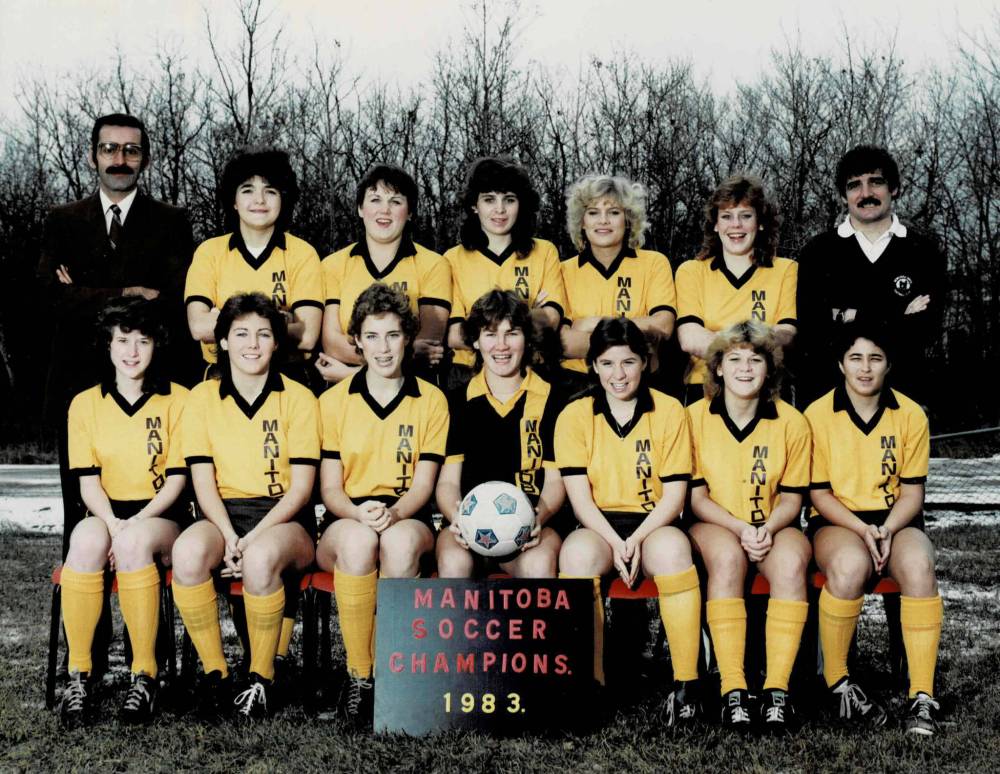
Coach Anthony (Tony) Tweed (top left) with the 1983 Manitoba soccer champions
“Like all Englishmen, I just loved the game,” Tweed said.
Tweed was a natural born leader in all that he did, including his career as a baker. He studied at Anglia Ruskin University in England before being recruited to Edmonton, Alta., in 1964. At the time, there were new technical institutes being opened across the country.
“They had to bring in a lot of their resources in terms of teaching from overseas, and I was one of them,” Tweed said, having been the baking instructor for the Northern Alberta Institute of Technology.
Moving to Winnipeg in 1972, he was hired for a similar job at the Canadian International Grains Institute.
“It was an organization to support the marketing of Canadian wheat and barley around the world. My talents were used to promote the merits of Canadian wheat and baking,” Tweed said. “I was — in one way — Canada’s head baker because I travelled the world demonstrating the merits of Canadian wheat.”
Though he was excelling at teaching the next generations of bakers, he also had his hand in teaching youth soccer. When he first moved to the city, he resided in Crestview where he coached the 12-year-old boy’s team. After living in that neighbourhood for a couple of years, he moved to Charleswood, where some would say he made history.
Along with coaching, he was also the convener at Charleswood, scheduling games, arranging referees, as well as allotting field time for about 20 teams.
In 1975, he realized there was a gap that needed to be filled.
“I knew the convener from Crestview, we were at a game one day and we got talking. The topic came up and I said, ‘Have you got any girls playing soccer?’” Tweed said.
At the time, any girls interested in playing soccer had to participate on the boys team. Tweed, with the Crestview convener, decided enough was enough and that they should rally the girls together to each make a team that could play against each other.
From there, the club became the Charleswood Tony’s Angels.
“That was the beginning of girls’ soccer,” Tweed said. “We did that for a year and the word must’ve gone around a little bit. The second year, I think we ended up with five teams playing.”
By 1977, there were approximately eight teams playing, the players averaging around 10 years old.
“And so it got established as a girls’ soccer program in Manitoba,” Tweed said.

SUPPLIED
Anthony (Tony) Tweed with daughters Karen (left) and Shelly.
As noted in the Free Press archives, on Oct. 4, 1980, approximately 800 girls were registered for soccer in the province.
Tweed continued to coach the Charleswood girls’ team, which became more competitive every year. The under-14 girls’ provincial championship started once there were enough teams in Manitoba to compete.
In 1979, Tweed’s team won the provincial title, punching a ticket to nationals.
“It carried on from there. We kept the team together; I kept the same core team as we moved on through the ages,” he said, with about nine players staying consistent throughout the years.
They continued to win the provincial championships when the players were in U16 and U18, earning spots in nationals once again.
“When we went to these national tournaments, we were absolutely the underdogs,” Tweed said, with the main reason being Manitoba’s playing season was shorter than the other provinces.
At nationals, there was usually a team from the Maritimes, as well as representatives from Quebec, Ontario and Alberta. Manitoba was referred to as the Prairie team and always played (and won) against neighbouring province Saskatchewan to advance.
The team was never able to defeat Ontario, but managed to score a goal against them — which became a highlight during the team’s decade long run.
“We didn’t get hammered. We would lose 4-1 or 4-0, but we played, we competed, we got strong as we went from (the) 14- to 16- to 18-year-old team,” Tweed said.
Unlike some of the other teams who had financial support from their province, Tweed’s team had to sell bacon to ensure they could cover the cost.
“The Maritime team was in a similar situation to us and it was beautiful because we played to a tie,” Tweed said.
Looking back at his core group, two names stood out in his memory: midfielders Karen Wakenshaw and Tracey Watson.
“We had a natural goal scorer who from Day 1 was the key to the whole team’s success,” Tweed said of Wakenshaw. “She was outstanding and ahead of her time. If she was doing what she did then today, she would be a top player.”
Both Wakenshaw and Watson were selected to participate in the first women’s national team training camp in 1986. The women had to play in hand-me-down men’s jerseys that reached to their knees. And where the national men’s team budget was sitting at $1.7 million, the women’s was $12,000.
SUPPLIED
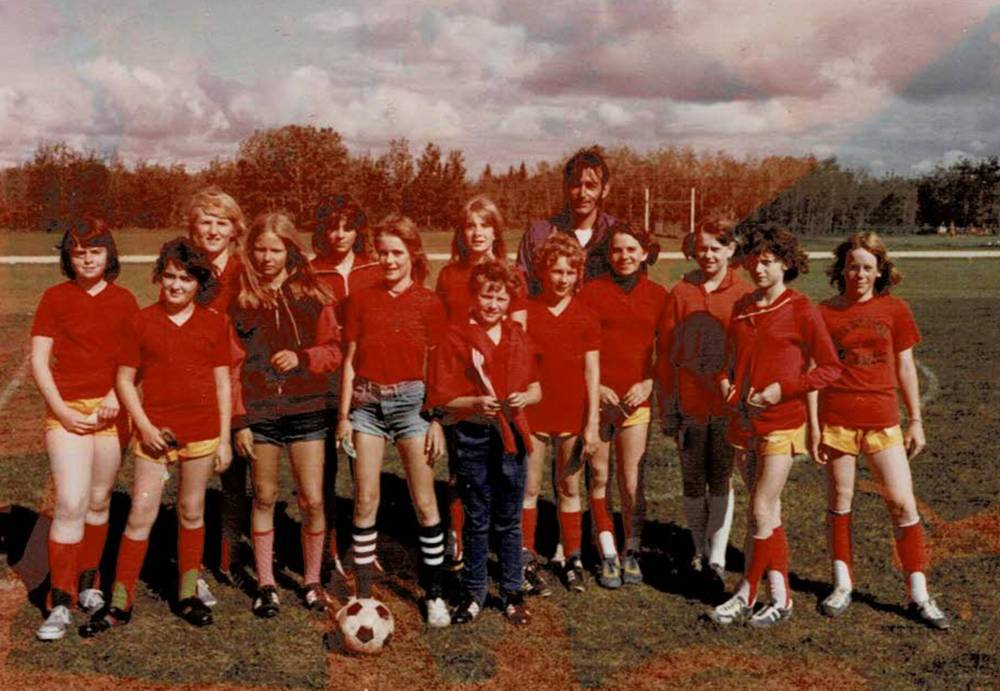
Coach Anthony (Tony) Tweed with the 1975 Crestview girls soccer team.
Regardless of their lack of resources, the 20 women on that squad became the first Canadian women’s team.
The beauty of this story is when Tweed’s team — women he had coached when they were as little as eight — aged out of the youth division, he hung up his whistle and clipboard. Tweed stayed loyal to his team and finished alongside them when he had nothing left to teach. He moved outside the city with his family to Oakbank until retiring as an instructor in 2012.
Looking back on his coaching career, he remarked that he truly loved teaching the girls more than boys.
“It was much more rewarding coaching girls. If you were teaching them simple basics, like how to throw the ball in correctly from a throw in, they would learn very quickly,” Tweed said.
“I simply explained to them: ‘(if) you’re playing on the wing for example (and) you want to collect a pass, is it easier to chase the pass out of the edge of the sideline or be on the sideline and run in and catch the pass?’ Simple as that, they learned. My winger was always running line, and when the pass came she ran on and back to the ball — off she went,” he said.
Although he modestly disagrees that he paved the way for women’s soccer in Manitoba, it’s no argument with the incoming NSL team that it had to start somewhere.

“The program, it was there for her to take advantage of,” Tweed said, regarding Scott having a female soccer program to grow up in.
Now in his 80s, Tweed’s fondest memory remains the family he made on the pitch.
“Seeing them stick together… Some of them were at school together but not all of them were in the same situation outside of soccer,” he said.
“It was the soccer that brought them from different backgrounds into one unit. I enjoyed teaching them because they wanted to play soccer and they wanted to learn.”
grace.penner@winnipegfreepress.com
Related Articles
Vancouver Whitecaps, CF Montreal open Canadian Championship semifinal with 1-1 draw









Advertisement Advertise With Us
Advertisement Advertise With Us