

Russia and North Korea open the first road link across shared border
Advertisement
Read this article for free:
or
Already have an account? Log in here »
To continue reading, please subscribe:
Digital Subscription
One year of digital access for only $1.44 a week*
- Enjoy unlimited reading on winnipegfreepress.com
- Read the E-Edition, our digital replica newspaper
- Access News Break, our award-winning app
- Play interactive puzzles
*Billed as $5.77 plus GST every four weeks. After 52 weeks, price increases to the regular rate of $19.95 plus GST every four weeks. Offer available to new and qualified returning subscribers only. Cancel any time.
To continue reading, please subscribe:
Add Free Press access to your Brandon Sun subscription for only an additional
$1 for the first 4 weeks*
- Enjoy unlimited reading on winnipegfreepress.com
- Read the E-Edition, our digital replica newspaper
- Access News Break, our award-winning app
- Play interactive puzzles
*Your next Brandon Sun subscription payment will increase by $1.00 and you will be charged $17.95 plus GST for four weeks. After four weeks, your payment will increase to $24.95 plus GST every four weeks.
Read unlimited articles for free today:
or
Already have an account? Log in here »
Russia and North Korea opened the first road bridge across their narrow stretch of border Monday, creating a new physical link between the two countries as they expand cooperation.
North Korea only shares a 17-kilometer (10.5-mile) border with Russia, a tiny part of its porous northern border that stretches more than 1,400 kilometers (870 miles) and is mostly shared with China. But Pyongyang and Moscow have hailed the bridge’s opening as yet another key moment in their booming ties.
Relations and exchange programs between Russia and North Korea have been flourishing, with North Korea supplying ammunition and troops to support Russia’s war against Ukraine in return for economic and military assistance.
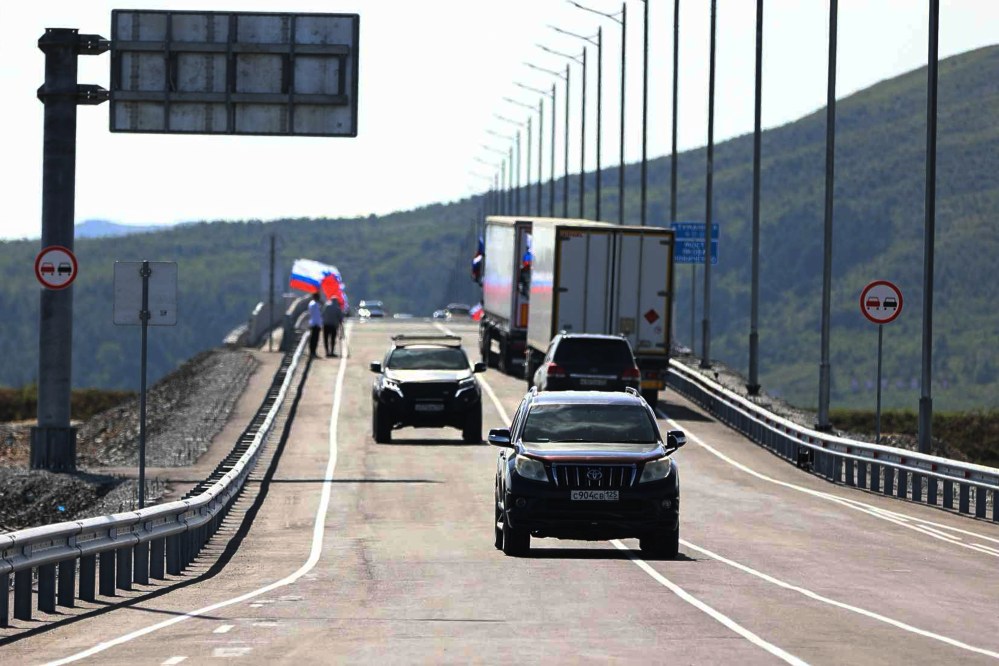
The bridge built over the Tumen River is 1-kilometer (0.6-mile) long and has two lanes, which will allow up to 300 vehicles a day to pass through a newly built border crossing point, the Russian government said in a statement. It was named after the late Soviet military officer Yakov Novichenko, who has been credited with protecting North Korean founder Kim Il Sung — the grandfather of current leader Kim Jong Un — from an assassination attempt in Pyongyang in 1946.
The bridge links North Korea’s Rason and Russia’s Khasan, border cities of the two countries. The bridge’s inauguration ceremony took place simultaneously in the two cities, with Russian Prime Minister Mikhail Mishustin and North Korean Premier Pak Thae Song attending via video link.
“I am convinced that the expansion of transport infrastructure near the border will give a powerful boost to the further development of trade, economic, technological, scientific and cultural cooperation between the Russian Federation and the Democratic People’s Republic of Korea,” Mishustin said.
Pak said the bridge’s completion is “a significant event adding a new dynamic movement to the overall bilateral cooperation,” according to North Korea’s official Korean Central News Agency.
While the bridge could accommodate a possible increase in small-scale freight transport and the movement of people, some experts say it’s still unclear how much that small bridge could expand traffic between the countries.
About 98% of North Korea’s external trade in 2025 was with China. The South Korean government said last year that there were at least 17 active road and rail links across the North Korea-China border.
There are also concerns that the new bridge could facilitate the movement of military equipment or trade in violation of U.N. resolutions against North Korea over its nuclear program. Vehicle traffic can be more difficult for satellites and other intelligence assets to monitor than the countries’ aging rail route, where cargo must be transferred between rail cars at the border, according to some experts.
North Korea and Russia, which are already served by a railway bridge and air service, agreed to construct the bridge in 2024. Construction began last year.
Tass, a state-run Russian news agency, said the existing 67-year-old railway route between the countries was “insufficient” to meet their growing transportation needs, and that the new road bridge would facilitate “year-round traffic.”