Benin bets on turning its cotton crop into clothes at home
Advertisement
Read this article for free:
or
Already have an account? Log in here »
To continue reading, please subscribe:

Digital Subscription
One year of digital access for only $205*
- Enjoy unlimited reading on winnipegfreepress.com
- Read the E-Edition, our digital replica newspaper
- Access News Break, our award-winning app
- Play interactive puzzles
*First annual payment billed as $205.00 + GST for one year. This annual subscription will automatically renew at $233.00 + GST every 52 weeks (10% off the regular annual price of $259.35). Offer available to new and qualified returning subscribers only. Cancel any time.
To continue reading, please subscribe:
Add Free Press access to your Brandon Sun subscription for only an additional
$1 for the first 4 weeks*
- Enjoy unlimited reading on winnipegfreepress.com
- Read the E-Edition, our digital replica newspaper
- Access News Break, our award-winning app
- Play interactive puzzles
*Your next Brandon Sun subscription payment will increase by $1.00 and you will be charged $17.95 plus GST for four weeks. After four weeks, your payment will increase to $24.95 plus GST every four weeks.
Read unlimited articles for free today:
or
Already have an account? Log in here »
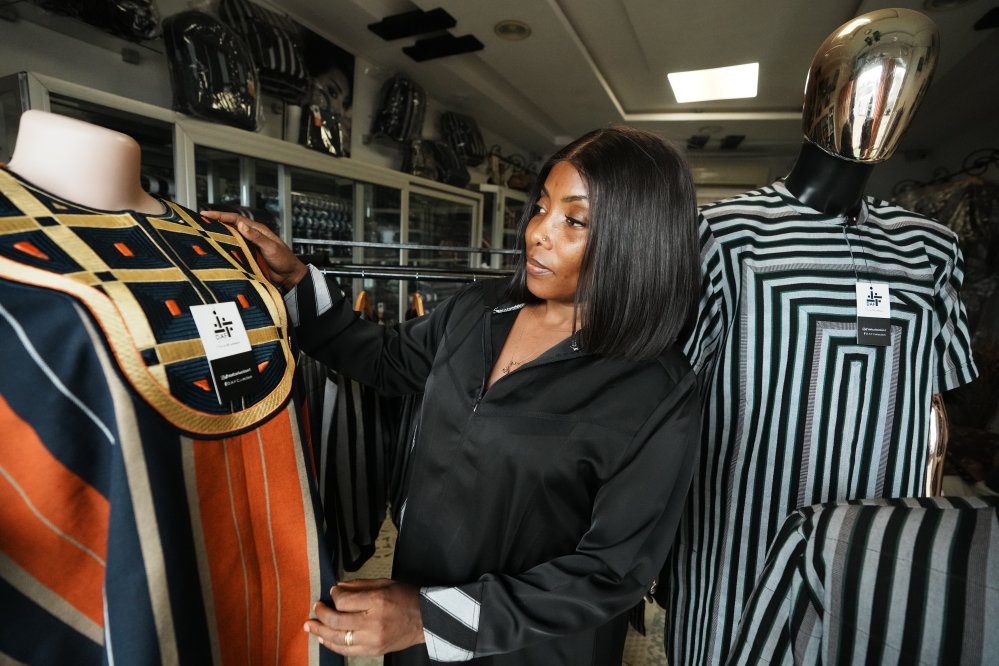
PARAKOU, Benin (AP) — The “Made in Benin” tags on Fatoumata Dosso’s fabrics represent an ambition much bigger than her fashion business: keeping more of the value of Africa’s largest cotton producer at home.
The founder of DAF Collection said that the tag means her country is trying to take full advantage of the abundant raw material produced in Benin. For her, there is also the opportunity to support more women in her community who hope to earn a living from cotton.
“I am more focused on promoting the traditional fabric of northern Benin,” she said inside her showroom in the northern city of Parakou. “What comes from elsewhere is already everywhere. I wanted to do something special.”
Betting on cotton for years to come
Dosso is responding to government policy that discourages the export of raw material and stipulates that the West African country must do more to export finished products — from pineapple juice to garments marketed by world-famous brands, but still marked with Benin.
Benin is Africa’s top cotton producer, according to data from the U.S. Department of Agriculture. Benin produced 1.15 million bales of cotton between 2025 and 2026, accounting for 0.9% of global production.
That sounds like a tiny share of the global market — by comparison, China produced 35.8 million bales in the same period — but cotton has long been the top cash crop for Benin, its primary export. The country is still betting on cotton for years to come, even as production has been in decline in eastern and southern Africa.
A hive of activity
Benin, which had been exporting almost all of its raw cotton to Bangladesh, moved toward value addition in 2020 with a private-public partnership involving the infrastructure developer Arise IIP.
The deal established the Glo-Djigbé Industrial Zone, or GDIZ, where young Beninese workers can be found processing pineapples, cashew nuts, ceramics and other export goods.
GDIZ processes about 40,000 tons of Beninese cotton to produce between 7 and 10 million garments annually. The expansion of the GDIZ and shifting exports toward finished products helped reduce Benin’s current account deficit — when a country sends more money for goods and services abroad than it receives back — from 6.2% of gross domestic product in 2024 to 5.7% in 2025, according to the African Development Bank.
GDIZ is located 45 kilometers (28 miles) from the Beninese commercial capital of Cotonou. Associated Press journalists recently toured the garment section, a hive of activity as station managers surveyed employees doing the work that goes into making garments: straightening collars, stitching buttons and pressing T-shirts with flat irons and folding them delicately. Garment makers like U.S. Polo Assn. and Kiabi were represented.
A grassroots network
A manager at GDIZ declined to answer questions, and laborers there weren’t allowed to speak to journalists. A brief tour of the hub showed the ambition of GDIZ, a small-city-like industrial hub set on about 16 square kilometers (6 square miles) of land.
Souhaïbou Gambari, executive secretary of a national association of cotton producers in Benin, told the AP that his federation — and Benin’s garment exports in general — rely “on a strong, well-structured grassroots network” of at least 183,746 producers organized in 2,206 village cooperatives across the country.
“Beyond farm operators alone, the cotton sector directly or indirectly supports the livelihoods of more than 2 million people in rural areas, making it the leading driver of social inclusion in Benin’s farming communities,” he said.
Cotton is an easy decision
Bales of cotton are ferried from far north, supplied by cooperatives of farmers who are united in the pursuit of strong prices and ease of access to farming supplies.
Growing cotton is an easy decision for smallholder farmers like Toussaint Bapetem. Although the price of a kilogram — 300 West African francs, or roughly $0.50 — has remained the same for years, Bapetem’s produce has a market guaranteed by price-setting authorities.
Cotton, unlike maize and other rain-fed crops, doesn’t attract thieves, he said, inspecting his offseason cotton plantation in a remote area near the Nigeria border.
With the help of about 18 workers, the father of four regularly plants three acres (more than a hectare) of his land with cotton, with another four acres (more than 1 1/2 hectares) reserved for corn. His last harvest yielded 3.8 tons of cotton.
“Cotton is more profitable” than corn, which fetches 120 West African francs (about $0.20) per kilogram, he said.
Repaying debts and ensuring education
His cotton earnings since 2024 helped him “take care of my family and ensure my children’s education,” he said. “With the money from cotton, I repaid a debt of 500,000 francs ($885) and purchased a motorcycle.”
Bapetem said that he knew that some of his cotton was used to make garments locally, including attire he buys at the nearby Bétérou market “once or twice a year.”
Locally available garments are increasingly made by homegrown entrepreneurs such as Dosso. Her DAF Collection retains the services of about a dozen women employed as weavers, who huddle over rickety contraptions tethered to rocks as they stitch yarns of cotton and polyester into pieces of fabric.
Beloved especially by Fulani herders, the fabric known as pagne in French is wrapped around the waist or worn as a headscarf, a thing of everyday fashion.
Quitting her job as the mayor’s secretary
“I was in a region where women were learning cotton weaving, but they didn’t have a market for their products,” said Dosso, who quit her job as a private secretary to the mayor of the northern town of Gogounou to focus solely on the fashion business that she started in 2016.
“That’s when I started to promote this skill,” she said.
She now advocates for “Made in Benin,” representing her country at international fashion shows and espousing the goal of having showrooms in all the major cities of Benin.
“My clients are all kinds of people. They are diverse and come from all social classes,” she said. “I can boast that I am one of the first in my field to talk about ‘Made in Benin.’”
‘It benefits us greatly’
One of Dosso’s contracted weavers, Chabi Baké, said that she understood the idea of making finished goods at home to be the appropriate one for Benin. The mother of five makes roughly $545 a month as a weaver, enough to encourage her to start building a house for her family.
“I am pleased with this thinking because it benefits us greatly,” she said. “It allows people to buy our products.”
___
For more on Africa and development: https://apnews.com/hub/africa-pulse
___
The Associated Press receives financial support for global health and development coverage in Africa from the Gates Foundation. The AP is solely responsible for all content. Find AP’s standards for working with philanthropies, a list of supporters and funded coverage areas at AP.org.