Alert-system operator asks CRTC to consider ‘device-based geofencing’ to avoid unnecessary weather warnings
Read this article for free:
or
Already have an account? Log in here »
To continue reading, please subscribe:

Digital Subscription
One year of digital access for only $205*
- Enjoy unlimited reading on winnipegfreepress.com
- Read the E-Edition, our digital replica newspaper
- Access News Break, our award-winning app
- Play interactive puzzles
*First annual payment billed as $205.00 + GST for one year. This annual subscription will automatically renew at $233.00 + GST every 52 weeks (10% off the regular annual price of $259.35). Offer available to new and qualified returning subscribers only. Cancel any time.
To continue reading, please subscribe:
Add Free Press access to your Brandon Sun subscription for only an additional
$1 for the first 4 weeks*
- Enjoy unlimited reading on winnipegfreepress.com
- Read the E-Edition, our digital replica newspaper
- Access News Break, our award-winning app
- Play interactive puzzles
*Your next Brandon Sun subscription payment will increase by $1.00 and you will be charged $17.95 plus GST for four weeks. After four weeks, your payment will increase to $24.95 plus GST every four weeks.
Read unlimited articles for free today:
or
Already have an account? Log in here »
The Weather Network’s parent company wants Canada to consider changes to how it warns the public about dangerous weather after Manitobans received a landslide of emergency alerts in the midst of a massive June thunderstorm.
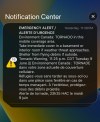
The recommendation comes after the Canadian Radio-television and Telecommunications Commission announced in August that it would be launching an investigation into what caused some Manitobans to receive more than 15 tornado warnings in the span of several hours during the severe thunderstorm June 9. Some of those warnings were sent to people who weren’t in the area described in the warning and advised them to seek shelter.
The Pelmorex Corp, which is the parent company of the Weather Network and the operator of the national Alert Ready system, was asked to respond to a series of questions from the CRTC, as were telecom companies Telus, Bell and Rogers, about what may have caused the windfall of alerts.
MIKE SUDOMA / FREE PRESS FILES Storm clouds over Highway 206 near Dugald on June 9. There were several severe weather warnings issued while storms moved across Manitoba that night.
Responses from Telus and Rogers were made public on the CRTC’s website Monday, while Pelmorex and Bell’s responses were published Tuesday.
In its response, Pelmorex pitched “device-based geofencing” as a possible long-term solution to over-alerting and geographic issues, which would broadcast the precise co-ordinates of alerts directly to phones, and the phone’s internal location data would then determine whether to display the alert, rather than do so automatically.

“Distributing more (targeted) alerts is an important part of improving the overall effectiveness of the (National Public Alerting System),” the report reads. “As such, Pelmorex recommends that the Commission and the Senior Officials Responsible for Emergency Management… consider establishing a formal regulatory and policy road map mandating (device-based geofencing) deployment across Canadian wireless networks.”
The storm dumped record rainfall and caused significant flooding across southern Manitoba. Two low-severity tornadoes touched down, near Ste. Anne and Dufrost.
Pelmorex called the event “the largest volume of emergency alerts, over a six-hour period, for a single event, since the launch of wireless public alerting in Canada.”
Alert Ready received 30 complaints from the public, and were told some residents received between 15 and 30 notifications that evening. A staff member at Environment and Climate Change Canada received 26 alerts on one phone and 14 on another connected to a different network.
“Per our logs, ECCC issued frequent updates as storm trajectories evolved, at times transmitting two successive alert messages within 30 to 60 seconds,” their report, signed by Pelmorex head of alerting Martin Bélanger, reads.
“Per our logs, ECCC issued frequent updates as storm trajectories evolved, at times transmitting two successive alert messages within 30 to 60 seconds.”
The alerts, Pelmorex said, were caused by a perfect storm of issues, including multiple storms with different warnings in overlapping areas, cell site restarts due to the weather and devices switching between different networks.
Environment Canada spokesperson Brandon Clim declined to comment further on the reports, citing the ongoing investigation by the CRTC, but said the federal body’s “goal is an alert system that will effectively keep people in Canada safe during instances of life-threatening weather.”
Bell, Telus and Rogers all said they received 133 alert requests targeted to Manitoba created by Environment Canada and forwarded by Pelmorex related to the storm.
Telus is in the process of procuring its own device-based geofencing capabilities, according to its report to the CRTC.

In July, Pelmorex and Environment Canada updated how it processes wireless alerts. While critical alerts are still broadcast immediately, other irrelevant updates are not sent to cell broadcasting centres.
That will make a difference in future fast-evolving weather events, Pelmorex said.
Last month, Environment Canada introduced a new thunderstorm and tornado warning system that uses “free-form polygons” to allow meteorologists to more accurately outline where a storm is headed and use that information to more accurately provide warnings.
In addition to the Weather Network, Pelmorex supplies weather maps to a number of Canadian newspapers, including the Free Press.
malak.abas@freepress.mb.ca

Malak Abas is a city reporter at the Free Press. Born and raised in Winnipeg’s North End, she led the campus paper at the University of Manitoba before joining the Free Press in 2020. Read more about Malak.
Every piece of reporting Malak produces is reviewed by an editing team before it is posted online or published in print — part of the Free Press‘s tradition, since 1872, of producing reliable independent journalism. Read more about Free Press’s history and mandate, and learn how our newsroom operates.
Our newsroom depends on a growing audience of readers to power our journalism. If you are not a paid reader, please consider becoming a subscriber.
Our newsroom depends on its audience of readers to power our journalism. Thank you for your support.
Related Articles
CRTC looking into high number of cellphone tornado alerts in Manitoba during June storm

History
Updated on Tuesday, September 15, 2026 6:10 PM CDT: adds thumbnail