

Wind and batteries the best bet
Advertisement
Read this article for free:
or
Already have an account? Log in here »
To continue reading, please subscribe:

Digital Subscription
One year of digital access for only $205*
- Enjoy unlimited reading on winnipegfreepress.com
- Read the E-Edition, our digital replica newspaper
- Access News Break, our award-winning app
- Play interactive puzzles
*First annual payment billed as $205.00 + GST for one year. This annual subscription will automatically renew at $233.00 + GST every 52 weeks (10% off the regular annual price of $259.35). Offer available to new and qualified returning subscribers only. Cancel any time.
To continue reading, please subscribe:
Add Free Press access to your Brandon Sun subscription for only an additional
$1 for the first 4 weeks*
- Enjoy unlimited reading on winnipegfreepress.com
- Read the E-Edition, our digital replica newspaper
- Access News Break, our award-winning app
- Play interactive puzzles
*Your next Brandon Sun subscription payment will increase by $1.00 and you will be charged $17.95 plus GST for four weeks. After four weeks, your payment will increase to $24.95 plus GST every four weeks.
Read unlimited articles for free today:
or
Already have an account? Log in here »
For years, Manitoba Hydro has claimed that we can’t rely on wind turbines during multi-day or even multi-week cold snaps. Although turbines can be equipped with cold-weather packages to operate down to –30 C, as at the St. Leon and St. Joseph wind farms, Hydro routinely warns of the possibility of a lengthy winter wind drought at the same time as electricity use peaks due to high heating demand.
This concern is largely why Hydro is pushing to build a 750 MW fossil gas-fired power plant in Brandon, rather than building more wind farms.
But new analysis by Alexander Hogeveen Rutter, a former energy modeller for Manitoba Hydro, shows that wind-generation reliability well exceeds assumptions and that, if combined with battery energy storage, it could meet even the most bullish load growth forecasts. (These findings were presented to the Public Utilities Board on Aug. 31, and the full report can be found on Climate Action Team Manitoba’s website.)
MIKAELA MACKENZIE / FREE PRESs fileS
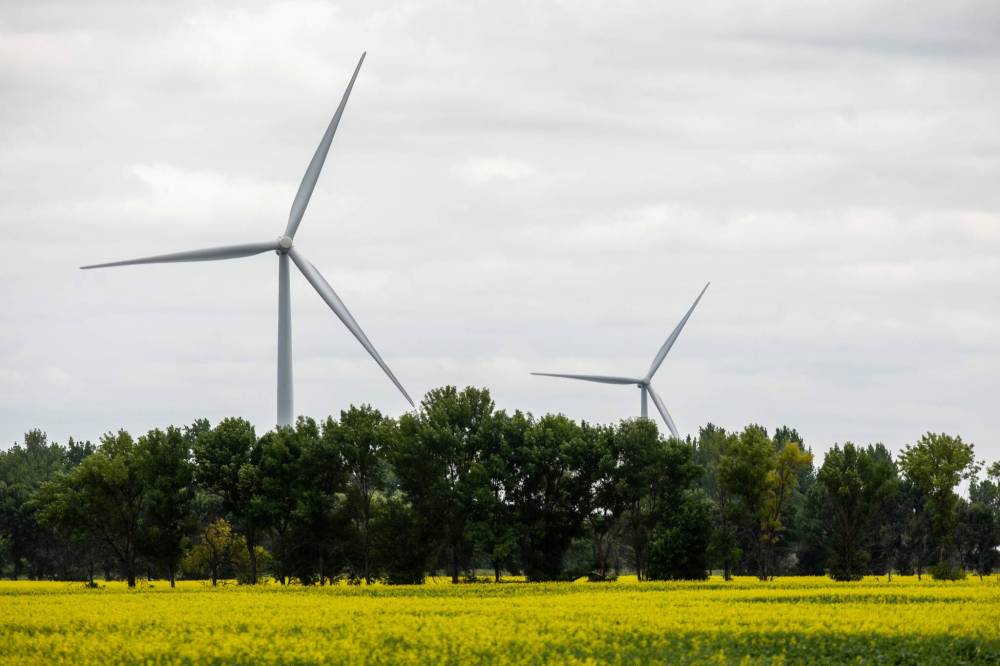
Wind turbines in southern Manitoba in July. New analysis shows wind-generation reliability exceeds expectations.
Hydro’s low estimate of wind generation stems from its erroneous assumption that all new wind farms will be built in the same locations as Manitoba’s two existing wind farms (St. Leon and St. Joseph). Because these two wind farms are only 100 kilometres apart, they have highly correlated wind speeds; when wind conditions are low at one site, they likely are at the other as well. This is not how new wind farms will be built in Manitoba. Instead, they will be located in different areas and use much taller turbines with higher generation potential than the existing wind farms.
As a result, this new modelling examined the reliability of new wind farms with modern turbines if they were hypothetically built at four different sites. These assumptions led to significantly higher wind reliability than Hydro’s models, as wind speeds at diversified wind farms are much less likely to experience simultaneous wind droughts.
If 1,080 megawatts (MW) of new wind farms are built at diverse locations with modern turbines, wind generation would almost fully cover nine of the top 10 peak load events reported by Manitoba Hydro between 2021 and 2026 — and with an additional 750 MW of demand added, too, to account for Hydro’s highest load growth forecast by 2031. Given that wind farms only take two to three years to develop, and that even Hydro has suggested that up to 600 MW could be installed per year, there’s no reason to think Manitoba can’t do this if it sets clear priorities. (To put 1,080 MW in perspective, North Dakota — population 800,000 — has about 5,000 MW of wind generation.)
While this modelling shows that wind farms can cover far more of winter demand than previously imagined, it also found that installing 750 MW of battery storage capacity is needed to ensure reliability. These batteries could be charged with new wind (and even solar) energy, meaning they can work together to provide reliable capacity even on the coldest nights and worst droughts.
Crucially, Manitoba Hydro’s analysis only considered batteries and renewables in isolation, rather than evaluating how they can work together.

The only real question with battery storage concerns duration, or how many hours of power it can provide each cycle. If Manitoba builds 1,080 MW of new wind generation, it would need only four hours of battery storage to meet necessary reliability thresholds. If the provincial government sticks to its current plan of 600 MW of new wind, it would need seven hours of battery storage. A combination of 600 MW of wind and 600 MW of solar would drop the requirement back down to four hours of storage. Any of these options would provide the same or even greater reliability than the proposed gas plant.
Building out wind farms, battery storage and even solar arrays might sound prohibitively expensive. But this analysis found that these three scenarios cost considerably less than the proposed gas plant when upfront capital costs and energy costs are totalled, even before clean energy tax credits and the rapidly rising costs of gas turbines were factored in. And unlike the proposed fossil gas plant, which Hydro expects to operate only 0.5 per cent to five per cent of the year, these alternatives would provide year-round value to the grid, including better optimization of hydroelectric generation and reduced transmission/distribution costs.
Wind, batteries and even solar can provide a reliable power supply for Manitoba. Given these findings, the Public Utilities Board — which is currently reviewing Hydro’s proposed plan to meet electricity needs for the next decade — should require Hydro to re-run its modelling using realistic assumptions about wind generation and synergies with battery storage.
And the provincial government should prepare to instruct Hydro to expand and accelerate the development of wind farms and batteries, rather than the proposed gas plant.
James Wilt is the policy development manager at Climate Action Team Manitoba.