North Atlantic right whales at greater risk of collision with boats at night: study

Advertisement

Advertise with us

HALIFAX - A recent study has found that critically endangered North Atlantic right whales are feeding closer to the ocean’s surface at night, increasing their risk of being struck by boats.

Read this article for free:


or

Already have an account? Log in here »

To continue reading, please subscribe:

Subscribe and receive a limited-edition Free Press branded hat or tote.

Digital Subscription

One year of digital access for only $205*

  • Enjoy unlimited reading on winnipegfreepress.com
  • Read the E-Edition, our digital replica newspaper
  • Access News Break, our award-winning app
  • Play interactive puzzles

*First annual payment billed as $205.00 + GST for one year. This annual subscription will automatically renew at $233.00 + GST every 52 weeks (10% off the regular annual price of $259.35). Offer available to new and qualified returning subscribers only. Cancel any time.

To continue reading, please subscribe:

Add Free Press access to your Brandon Sun subscription for only an additional

$1 for the first 4 weeks*

  • Enjoy unlimited reading on winnipegfreepress.com
  • Read the E-Edition, our digital replica newspaper
  • Access News Break, our award-winning app
  • Play interactive puzzles
Start now

*Your next Brandon Sun subscription payment will increase by $1.00 and you will be charged $17.95 plus GST for four weeks. After four weeks, your payment will increase to $24.95 plus GST every four weeks.

HALIFAX – A recent study has found that critically endangered North Atlantic right whales are feeding closer to the ocean’s surface at night, increasing their risk of being struck by boats.

The study, published earlier this month in the peer-reviewed journal PLOS One, documented nighttime surface feeding in North Atlantic right whales, providing new evidence that could be used to prevent deadly collisions between the whales and vessels. 

The paper’s lead author, Jay Kirkham, a PhD student at Dalhousie University in Halifax, said the research team worked with U.S.-based non-profit Ocean Alliance to tag 23 right whales in the Shediac Valley, an underwater valley in the southern Gulf of St. Lawrence.
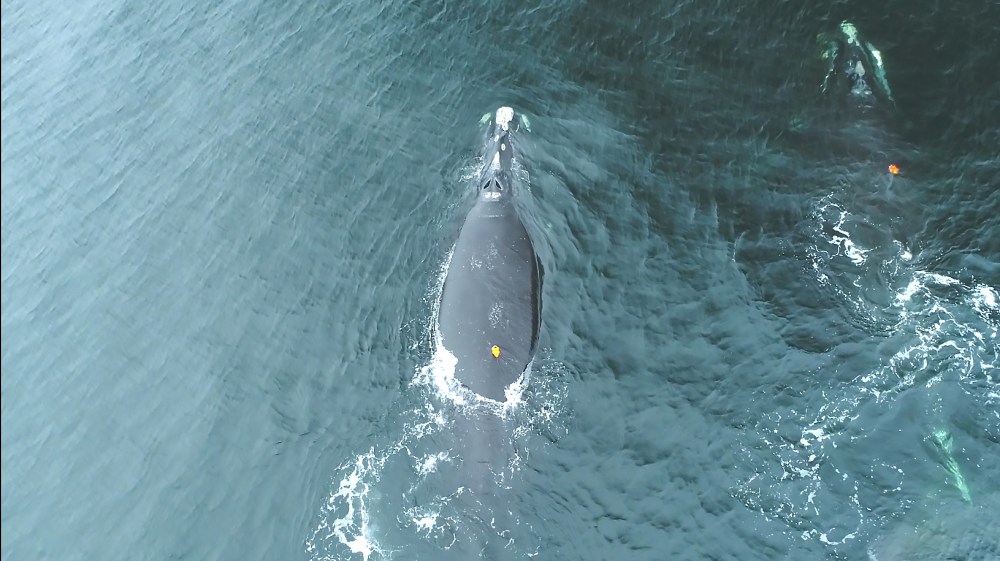
A tagged North Atlantic right whale in the Gulf of St. Lawrence is shown in this handout photo provided by Jay Kirkham, a PhD student at Dalhousie University. 
THE CANADIAN PRESS/Handout-Jay Kirkham
(Mandatory credit)
A tagged North Atlantic right whale in the Gulf of St. Lawrence is shown in this handout photo provided by Jay Kirkham, a PhD student at Dalhousie University. THE CANADIAN PRESS/Handout-Jay Kirkham (Mandatory credit)

A portion of the North Atlantic right whale population, which is estimated to be approximately 384 whales, gathers to feed in the Shediac Valley each summer. 

Kirkham said the tags recorded video footage along with data on how the whales moved and in which direction they swam. 

He said he used video footage to record right whale feeding behaviour during the day.

“When a right whale opens its mouth, it’s kind of like a big parachute opening on the front of their face … and that just slows them down an awful lot,” he said. “And so, they have to work harder, which they do by kicking their tail higher and faster.”

Kirkham said he used these observations to train a machine learning algorithm that could recognize a right whale feeding at night when he was unable to visually identify the behaviour.

This data revealed that whales are feeding within the same depth as large vessels at night, increasing the risk of collision, he said.

While right whales typically feed close to the seafloor during the day, Kirkham said the whales follow their food — zooplankton — higher up in the water column at night.

“These big ships that go through the gulf, they extend into the water maybe 10, maybe 15 metres,” he said. “The whales are in a sort of vertical overlap with that.” 

He said collisions with vessels and entanglements in fishing gear are the leading causes of death in the population and this study may help inform conservation measures for the whales.

Transport Canada and Fisheries and Oceans Canada currently oversee protection measures for the population.

In a statement to The Canadian Press, Fisheries and Oceans Canada said its measures focus on preventing whale entanglements in fishing gear and enforcing seasonal fishing closures.

The department said the study can help it develop “tailored management measures to protect North Atlantic right whales.” 

Transport Canada implements speed restrictions and enforces a vessel exclusion zone in the Shediac Valley during the summer to reduce the risk of collisions between boats and right whales in the area.

However, Kirkham said that the whales he and his team tagged spent approximately 25 per cent of their feeding time outside of the vessel exclusion zone, exposing them to ship traffic.

In a statement to The Canadian Press, Transport Canada said it has a right whale surveillance program to help protect the whales from collisions by using both visual and audio detection tools.

“Acoustic monitoring systems and other complementary technologies can support whale detection regardless of daylight conditions and help inform protective measures when whales are present,” the statement said.

The department also said it uses the latest scientific research, monitoring data and feedback from stakeholders to inform its protection measures.

This report by The Canadian Press was first published Sept. 27, 2026.
Report Error Submit a Tip

More Stories

North Atlantic right whales at greater risk of collision with boats at night: study

Tori Fitzpatrick, The Canadian Press 4 minute read Preview

North Atlantic right whales at greater risk of collision with boats at night: study

Tori Fitzpatrick, The Canadian Press 4 minute read Sunday, Sep. 27, 2026

HALIFAX - A recent study has found that critically endangered North Atlantic right whales are feeding closer to the ocean’s surface at night, increasing their risk of being struck by boats.

The study, published earlier this month in the peer-reviewed journal PLOS One, documented nighttime surface feeding in North Atlantic right whales, providing new evidence that could be used to prevent deadly collisions between the whales and vessels. 

The paper’s lead author, Jay Kirkham, a PhD student at Dalhousie University in Halifax, said the research team worked with U.S.-based non-profit Ocean Alliance to tag 23 right whales in the Shediac Valley, an underwater valley in the southern Gulf of St. Lawrence.

A portion of the North Atlantic right whale population, which is estimated to be approximately 384 whales, gathers to feed in the Shediac Valley each summer. 

Read
Sunday, Sep. 27, 2026

Legislation needed on vacant buildings

Editorial 4 minute read Preview

Legislation needed on vacant buildings

Editorial 4 minute read 2:00 AM CDT

There is something deeply backwards about a system that lets a property owner keep a building boarded up indefinitely while neighbours are left to live with the consequences.

In Winnipeg, as long as the owner pays the taxes, follows the city’s vacant-building rules and pays the required fees, there is no hard deadline for the building to be dealt with.

The building can remain a neighbourhood eyesore. It can attract drug use and crime. It can become a fire hazard. And the people living nearby can be left wondering how long they are expected to put up with it.

Yet when Premier Wab Kinew was asked Friday whether his government would change provincial legislation to give Winnipeg the power to impose a time limit on such properties, he declined to answer.

Read
2:00 AM CDT

Is another goalie on Jets’ wish list?

Ken Wiebe 7 minute read Preview

Is another goalie on Jets’ wish list?

Ken Wiebe 7 minute read Sunday, Sep. 27, 2026

Kevin Cheveldayoff and company are down to the short strokes.

With the opening-day roster due on Monday afternoon, the Winnipeg Jets took steps on the weekend to get down to the final number.

As it stood on Sunday, the Jets were down to 24 healthy players in training camp after centre Danny Zhilkin and defenceman Henry Thrun were placed on waivers.

With a maximum of 23 spots available, the only things left to determine are whether the Jets are interested in claiming a more experienced goalie to serve as the backup to Stuart Skinner and if centre Brayden Yager will break camp with the big club.

Read
Sunday, Sep. 27, 2026

Dealing now with increasing judicial dangers

Ben Wickstrom 5 minute read 2:00 AM CDT

For years, the Manitoba Association of Crown Attorneys (“MACA”) has been engaged in a dispute with the Manitoba government over the workload of its lawyers. That dispute is expected to come to a head at the end of November, when two weeks of grievance hearings are scheduled.

We remain hopeful that we can reach an agreement with our employer. But if we cannot, our union’s lawyers are prepared to make our case. As those hearings approach, we want to explain how we got here, what is at stake, and why this dispute matters beyond the working conditions of our members.

These problems are longstanding and predate the election of Manitoba’s current government. Our concern with the current government is not that it created these problems, but that it is now responsible for addressing them.

Despite the evidence before it, the government has not meaningfully addressed the workload concerns we have raised throughout its time in office.

Jets pick up netminder as relatively new 23-man roster announced

Mike McIntyre 7 minute read Preview

Jets pick up netminder as relatively new 23-man roster announced

Mike McIntyre 7 minute read Updated: Yesterday at 9:25 PM CDT

Let’s get the caveats out of the way: Nothing is set in stone, nor written in permanent ink, and what you see right now could change in the blink of an eye.

With that being said, allow us to introduce you to the 2026-27 Winnipeg Jets — where change is very much in the air.

The 23-man roster submitted to the NHL offices by Monday’s 4 p.m. deadline includes seven players who were not on the team at this time last year. In fact, there could be as many as 10 new faces in the opening-night lineup on Friday against Boston when you factor in three regulars didn’t start the 2025-26 campaign due to injury.

That’s a lot of turnover, which isn’t surprising for a team that finished 26th overall in the standings and was — to most fans and pundits — too old and too slow.

Read
Updated: Yesterday at 9:25 PM CDT

Province invests $3.8M in culinary arts training facility for francophone high school students

Kelly-Anne Riess 3 minute read Preview

Province invests $3.8M in culinary arts training facility for francophone high school students

Kelly-Anne Riess 3 minute read Sunday, Sep. 27, 2026

A new dedicated culinary arts training facility will give francophone high school students a place to learn the trade in French.

Read
Sunday, Sep. 27, 2026