North Atlantic right whales at greater risk of collision with boats at night: study

Advertisement

Advertise with us

HALIFAX - A recent study has found that critically endangered North Atlantic right whales are feeding closer to the ocean’s surface at night, increasing their risk of being struck by boats.

Read this article for free:


or

Already have an account? Log in here »

To continue reading, please subscribe:

Subscribe and receive a limited-edition Free Press branded hat or tote.

Digital Subscription

One year of digital access for only $205*

  • Enjoy unlimited reading on winnipegfreepress.com
  • Read the E-Edition, our digital replica newspaper
  • Access News Break, our award-winning app
  • Play interactive puzzles

*First annual payment billed as $205.00 + GST for one year. This annual subscription will automatically renew at $233.00 + GST every 52 weeks (10% off the regular annual price of $259.35). Offer available to new and qualified returning subscribers only. Cancel any time.

To continue reading, please subscribe:

Add Free Press access to your Brandon Sun subscription for only an additional

$1 for the first 4 weeks*

  • Enjoy unlimited reading on winnipegfreepress.com
  • Read the E-Edition, our digital replica newspaper
  • Access News Break, our award-winning app
  • Play interactive puzzles
Start now

*Your next Brandon Sun subscription payment will increase by $1.00 and you will be charged $17.95 plus GST for four weeks. After four weeks, your payment will increase to $24.95 plus GST every four weeks.

HALIFAX – A recent study has found that critically endangered North Atlantic right whales are feeding closer to the ocean’s surface at night, increasing their risk of being struck by boats.

The study, published earlier this month in the peer-reviewed journal PLOS One, documented nighttime surface feeding in North Atlantic right whales, providing new evidence that could be used to prevent deadly collisions between the whales and vessels. 

The paper’s lead author, Jay Kirkham, a PhD student at Dalhousie University in Halifax, said the research team worked with U.S.-based non-profit Ocean Alliance to tag 23 right whales in the Shediac Valley, an underwater valley in the southern Gulf of St. Lawrence.
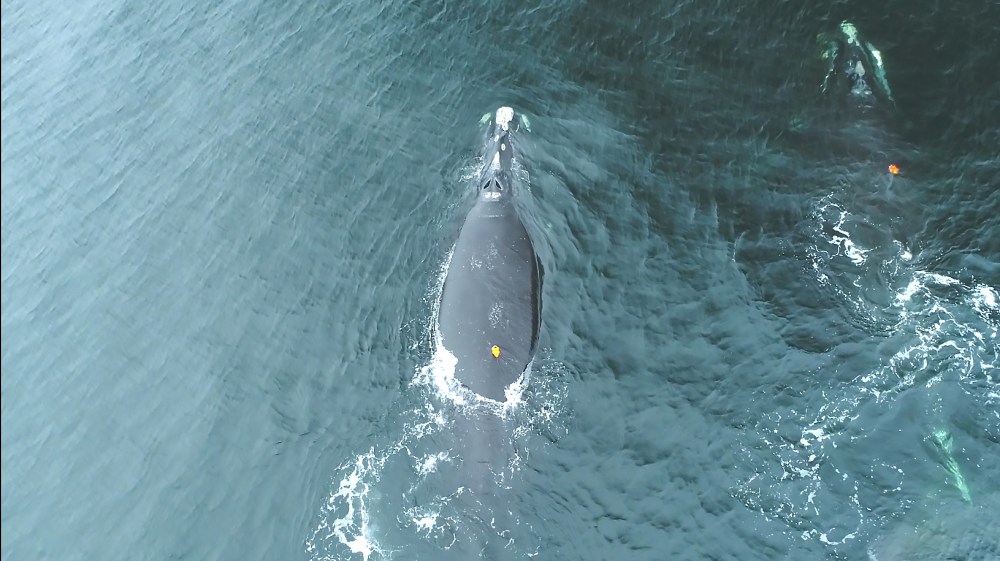
A tagged North Atlantic right whale in the Gulf of St. Lawrence is shown in this handout photo provided by Jay Kirkham, a PhD student at Dalhousie University. 
THE CANADIAN PRESS/Handout-Jay Kirkham
(Mandatory credit)
A tagged North Atlantic right whale in the Gulf of St. Lawrence is shown in this handout photo provided by Jay Kirkham, a PhD student at Dalhousie University. THE CANADIAN PRESS/Handout-Jay Kirkham (Mandatory credit)

A portion of the North Atlantic right whale population, which is estimated to be approximately 384 whales, gathers to feed in the Shediac Valley each summer. 

Kirkham said the tags recorded video footage along with data on how the whales moved and in which direction they swam. 

He said he used video footage to record right whale feeding behaviour during the day.

“When a right whale opens its mouth, it’s kind of like a big parachute opening on the front of their face … and that just slows them down an awful lot,” he said. “And so, they have to work harder, which they do by kicking their tail higher and faster.”

Kirkham said he used these observations to train a machine learning algorithm that could recognize a right whale feeding at night when he was unable to visually identify the behaviour.

This data revealed that whales are feeding within the same depth as large vessels at night, increasing the risk of collision, he said.

While right whales typically feed close to the seafloor during the day, Kirkham said the whales follow their food — zooplankton — higher up in the water column at night.

“These big ships that go through the gulf, they extend into the water maybe 10, maybe 15 metres,” he said. “The whales are in a sort of vertical overlap with that.” 

He said collisions with vessels and entanglements in fishing gear are the leading causes of death in the population and this study may help inform conservation measures for the whales.

Transport Canada and Fisheries and Oceans Canada currently oversee protection measures for the population.

In a statement to The Canadian Press, Fisheries and Oceans Canada said its measures focus on preventing whale entanglements in fishing gear and enforcing seasonal fishing closures.

The department said the study can help it develop “tailored management measures to protect North Atlantic right whales.” 

Transport Canada implements speed restrictions and enforces a vessel exclusion zone in the Shediac Valley during the summer to reduce the risk of collisions between boats and right whales in the area.

However, Kirkham said that the whales he and his team tagged spent approximately 25 per cent of their feeding time outside of the vessel exclusion zone, exposing them to ship traffic.

In a statement to The Canadian Press, Transport Canada said it has a right whale surveillance program to help protect the whales from collisions by using both visual and audio detection tools.

“Acoustic monitoring systems and other complementary technologies can support whale detection regardless of daylight conditions and help inform protective measures when whales are present,” the statement said.

The department also said it uses the latest scientific research, monitoring data and feedback from stakeholders to inform its protection measures.

This report by The Canadian Press was first published Sept. 27, 2026.
Report Error Submit a Tip

More Stories

Unhappy Dynacare staff refuse OT shifts; doors could be closed at clinics with Saturday hours

Carol Sanders 3 minute read Preview

Unhappy Dynacare staff refuse OT shifts; doors could be closed at clinics with Saturday hours

Carol Sanders 3 minute read Friday, Sep. 25, 2026

Some Winnipeg Dynacare sites normally open on Saturday were closed last week, and may continue to be because staff are refusing to pick up overtime shifts after they were forced back to work amid a labour dispute with the company.

Read
Friday, Sep. 25, 2026

Winnipeg Police Service recognizes, honours residential school survivors as Orange Shirt Day approaches

Malak Abas 3 minute read Preview

Winnipeg Police Service recognizes, honours residential school survivors as Orange Shirt Day approaches

Malak Abas 3 minute read Yesterday at 7:27 PM CDT

Winnipeg Police Service members lit a sacred fire outside of their North District Station in recognition of residential school survivors ahead of the upcoming Orange Shirt Day.

“We know that the relationship between policing and Indigenous communities has not always been one of trust,” WPS Chief Gene Bowers told visitors at a gathering outside of the station Sunday afternoon.

“We cannot change that history, but we can acknowledge it, we can learn from it, and we can take responsibility for how we move forward.”

The sacred fire, guided by elder Mike Calder, will burn for 24 hours at the Sinclair Street station, and then be allowed to extinguish naturally. It’s the second year the WPS has lit a sacred fire in recognition of residential school survivors — last year, the fire was lit outside of WPS headquarters on Smith Street.

Read
Yesterday at 7:27 PM CDT

Is a better Winnipeg on the horizon?

Tom Brodbeck, Rebecca Chambers, Niigaan Sinclair and Brent Bellamy 20 minute read Preview

Is a better Winnipeg on the horizon?

Tom Brodbeck, Rebecca Chambers, Niigaan Sinclair and Brent Bellamy 20 minute read Friday, Sep. 25, 2026

Four Free Press columnists weigh in on the challenges ahead and how the city can become better.

Read
Friday, Sep. 25, 2026

What’s open, what’s closed, what’s up in Winnipeg on National Day of Truth and Reconciliation Sept. 30, 2026

Free Press staff 4 minute read Preview

What’s open, what’s closed, what’s up in Winnipeg on National Day of Truth and Reconciliation Sept. 30, 2026

Free Press staff 4 minute read Yesterday at 10:38 AM CDT

The National Day of Truth and Reconciliation, or Orange Shirt Day, as it's known in Manitoba, happens Sept. 30 with many commemorative community events scheduled.

Read
Yesterday at 10:38 AM CDT

Positive anticipation is growing about major housing developments underway in Winnipeg’s downtown

Gabrielle Piché 10 minute read Preview

Positive anticipation is growing about major housing developments underway in Winnipeg’s downtown

Gabrielle Piché 10 minute read Friday, Sep. 25, 2026

If traffic is light and the wind is down, Somia Sadiq is able to hear the roar of Winnipeg Jets fans twice: first through her window, then on TV.

From her apartment view high above downtown, she can look out at Graham Avenue’s painted pedestrian landscape, see construction cranes and hear the heavy equipment at work as massive housing projects take shape at The Forks, at what used to be Portage Place shopping centre and at the former Hudson’s Bay building.

Sadiq has lived at 300 Main for 2 1/2 years, a few steps from the city’s famous, windy and reopened-to-pedestrians Portage Avenue intersection. At 42 storeys, it’s the tallest building in Winnipeg.

She is among 18,000 downtown residents who will soon be joined by thousands of others attracted to the city’s core by the new wave of major construction projects.

Read
Friday, Sep. 25, 2026

Four Jets clear waivers to join Moose

Ken Wiebe 3 minute read Preview

Four Jets clear waivers to join Moose

Ken Wiebe 3 minute read Saturday, Sep. 26, 2026

The Winnipeg Jets organizational depth has yet to take a hit on the waiver wire.

On Saturday afternoon, all four players exposed to waivers — defenceman Isaak Phillips and forwards Nikita Chibrikov, Noah Gregor and Parker Ford — cleared, which means they can be assigned to the Manitoba Moose of the American Hockey League.

Owing to injuries to captain Adam Lowry and winger Cole Perfetti, both Chibrikov and Ford started last season on the NHL roster but spent the bulk of last season with the Moose.

Chibrikov, chosen in the second round of the 2021 NHL Draft, has dealt with multiple lower-body injuries during the prior two seasons and is still working his way back to peak form.

Read
Saturday, Sep. 26, 2026