Canadian Dental Association report finds dental care program limits coverage
Advertisement
Read this article for free:
or
Already have an account? Log in here »
To continue reading, please subscribe:

Digital Subscription
One year of digital access for only $205*
- Enjoy unlimited reading on winnipegfreepress.com
- Read the E-Edition, our digital replica newspaper
- Access News Break, our award-winning app
- Play interactive puzzles
*First annual payment billed as $205.00 + GST for one year. This annual subscription will automatically renew at $233.00 + GST every 52 weeks (10% off the regular annual price of $259.35). Offer available to new and qualified returning subscribers only. Cancel any time.
To continue reading, please subscribe:
Add Free Press access to your Brandon Sun subscription for only an additional
$1 for the first 4 weeks*
- Enjoy unlimited reading on winnipegfreepress.com
- Read the E-Edition, our digital replica newspaper
- Access News Break, our award-winning app
- Play interactive puzzles
*Your next Brandon Sun subscription payment will increase by $1.00 and you will be charged $17.95 plus GST for four weeks. After four weeks, your payment will increase to $24.95 plus GST every four weeks.
Read unlimited articles for free today:
or
Already have an account? Log in here »
OTTAWA – The national dental care program has “transformed access to care for millions of patients” but claims are being denied without explanations and too many people are confused about what’s covered, says a new report from the Canadian Dental Association.
The association commissioned the report to assess the dental care program’s progress and make recommendations to the federal government on how it can be improved.
“We have a strong program, it’s got a good foundation, but continuous improvement is essential if the program is ever going to reach its potential,” said Dr. Kirk Preston, president of the Canadian Dental Association.
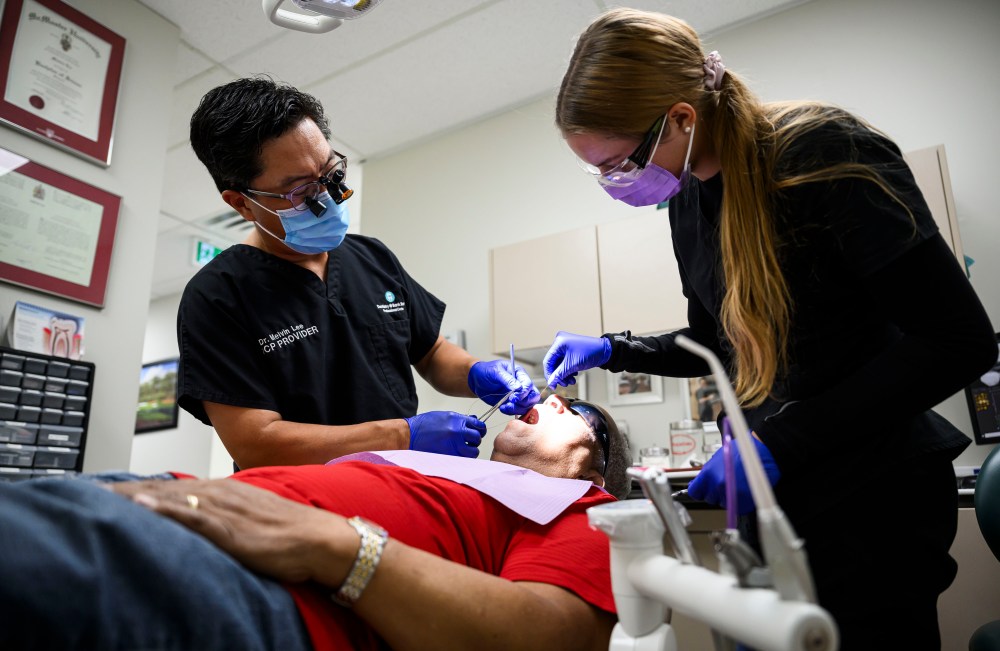
The program, which launched in 2022, was created as part of the supply-and-confidence agreement between the NDP and Justin Trudeau’s minority Liberal government.
The first phase offered coverage for seniors before the program was expanded to include adults with disabilities and children.
The final expansion, which was announced the day before Prime Minister Mark Carney called the 2025 election, opened coverage to all adults with a household income under $90,000 who do not have private insurance.
It’s been billed as the largest single expansion in public health care in decades, with an estimated nine million people eligible. Around 6.5 million have signed on to the program so far.
Colloquially, politicians have referred to the dental care program as free dental care — something that has created lasting confusion.
“I had a patient just last week that came in and he said, ‘I thought it was free,'” Preston said.
The program provides different levels of coverage depending on income. Those in the highest income bracket must cover 60 per cent of their fees.
Coverage is also based on set fees for services the CDA said are often below the cost of treatment.
That leaves many patients with unexpected bills, the report says.
Ondina Love, CEO of the Canadian Dental Hygienists Association, said confusion over what the plan covers has added to the administrative burdens on clinics.
“We are recommending enhanced public education and clear communications regarding what’s covered,” she said.
Preston said dentists’ biggest concerns are about pre-authorization.
Clinics need to submit treatment plans ahead of time for things like root canals, specialist services, or care above what the dental care plan typically covers. The insurance provider, Sun Life, determines if the care will be covered.
Those claims are denied half the time, the report said.
“It’s frustrating for dentists and patients because there’s no clear explanation in most cases as to why the claims are not approved,” Preston said.
The report said denials can lead to a manageable condition getting worse, forcing patients into more invasive and expensive care.
“It’s not consistent and I don’t understand what their guidelines are for approving or denying treatment in the pre-authorization process,” Preston said.
The CDA report calls for better education for care providers, more transparency and clear clinical criteria for pre-authorizations.
It also calls for fee increases to keep up with rising costs in dental clinics, along with better workforce planning to address shortages of dental hygienists and assistants.
Love said that last point is critical.
“We do know that in certain regions, there’s a sufficient supply — maybe even oversupply — and in other regions, there definitely is a shortage,” she said.
Health Minister Marjorie Michel said Tuesday the government is looking to work with the CDA on its recommendations.
“As we are moving forward and we are (getting) feedback, we are taking action,” she said.
The report noted that patients, especially seniors, have reported difficulties with reapplying for coverage each year. The income criteria can mean patients who had care one year might lose it the next.
Overall, patients report a high level of satisfaction with the program. The report includes surveys of both patients and dentists, commissioned by the CDA and carried out by Abacus Data.
More than half of the patients surveyed said they’ve been able to free up savings to spend on groceries and other essentials.
“This is a notable achievement for a program of such scale and ambition,” it said.
Notable, too, is the uptake from dentists themselves.
In early 2024, nearly 70 per cent of dentists told the CDA they were opposed to the program.
Its initial phases required providers to opt in, and uptake was so slow that government eliminated that requirement.
The new report says over 90 per cent of dentists are taking part in the program, and 70 per cent are supportive.
The CDA recommends the federal government commission an independent evaluation of the program’s effectiveness, and use that to decide whether it’s reaching the intended patients.
This report by The Canadian Press was first published Oct. 6, 2026.