Interpol crackdown on illegal mining, logging and wildlife trafficking leads to 233 arrests

Advertisement

Advertise with us

BOGOTA, Colombia (AP) — An international crackdown on environmental crime across Latin America and the Caribbean led to 233 arrests and uncovered links between large-scale Amazon deforestation and companies across several continents, the international police organization Interpol said Wednesday.

Read this article for free:


or

Already have an account? Log in here »

To continue reading, please subscribe:

Subscribe and receive a limited-edition Free Press branded hat or tote.

Digital Subscription

One year of digital access for only $205*

  • Enjoy unlimited reading on winnipegfreepress.com
  • Read the E-Edition, our digital replica newspaper
  • Access News Break, our award-winning app
  • Play interactive puzzles

*First annual payment billed as $205.00 + GST for one year. This annual subscription will automatically renew at $233.00 + GST every 52 weeks (10% off the regular annual price of $259.35). Offer available to new and qualified returning subscribers only. Cancel any time.

To continue reading, please subscribe:

Add Free Press access to your Brandon Sun subscription for only an additional

$1 for the first 4 weeks*

  • Enjoy unlimited reading on winnipegfreepress.com
  • Read the E-Edition, our digital replica newspaper
  • Access News Break, our award-winning app
  • Play interactive puzzles
Start now

*Your next Brandon Sun subscription payment will increase by $1.00 and you will be charged $17.95 plus GST for four weeks. After four weeks, your payment will increase to $24.95 plus GST every four weeks.

BOGOTA, Colombia (AP) — An international crackdown on environmental crime across Latin America and the Caribbean led to 233 arrests and uncovered links between large-scale Amazon deforestation and companies across several continents, the international police organization Interpol said Wednesday.

The two-month operation targeted illegal logging, gold mining and wildlife trafficking across nine countries, identifying some 60,000 hectares (148,000 acres) of illegally cleared forest — an area 10 times the size of Manhattan Island.

But investigators increasingly focused beyond the people cutting trees, mining gold or trafficking animals to the companies, financial networks and international buyers suspected of profiting from environmental destruction.
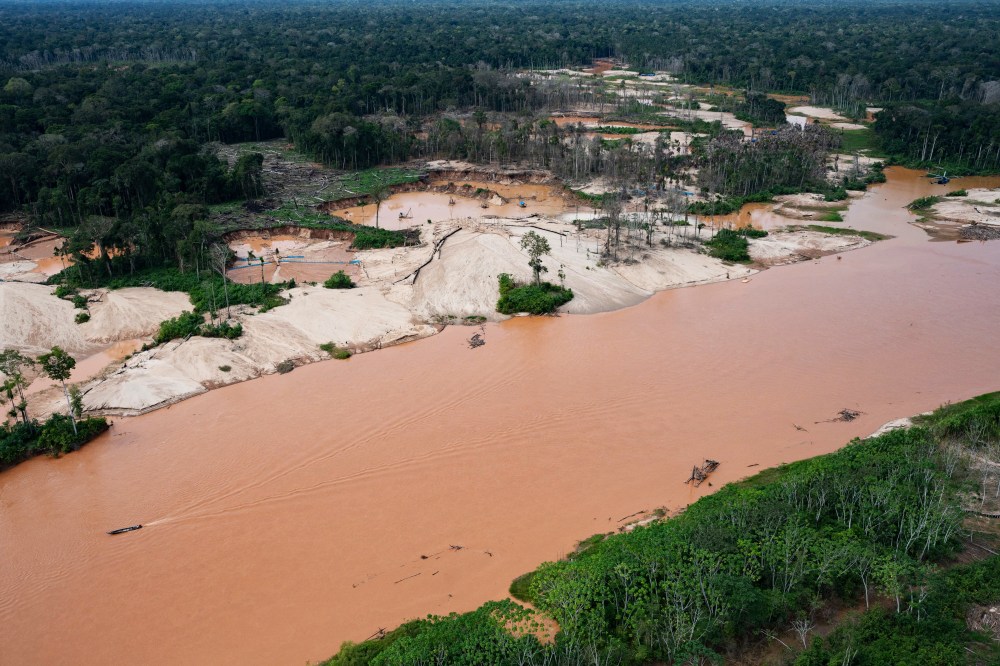
Deforestation from illegal mining borders the Malinowski River in the Tambopata National Reserve in Puerto Maldonado, Peru, Tuesday, Aug. 11, 2026. (AP Photo/Guadalupe Pardo)

In one investigation originating in Colombia, authorities had identified 11 foreign companies suspected of involvement in clearing more than 52,000 hectares (128,500 acres) of protected Amazon forest. Interpol said intelligence gathered during the latest operation uncovered links to another 161 companies and 65 people across several continents.

Investigators found suspected permit fraud and the alleged use of shell companies and foreign investment mechanisms, Interpol said. Colombian authorities arrested 16 people and seized digital evidence, while Interpol issued international notices seeking information or action involving suspects linked to the network.

“Following the money, whether from an illegal gold mine in Panama to a buyer in North America, Europe or Asia, helps a case move beyond the individuals physically harvesting the timber, handling the animal or extracting the gold,” Krandall Gullock, head of Interpol’s Regional Bureau for Central America, said in a statement.

Illegal gold mining fuels deforestation and pollution

Environmental crime has become increasingly intertwined with organized crime across Latin America, particularly in remote forest regions where illegal mining, logging and wildlife trafficking can exploit the same routes and financial networks used for other illicit commodities. Gold is particularly attractive to criminal groups because of its high value, portability and ease of sale. Illegal mining has expanded across parts of the Amazon as gold prices have risen, driving deforestation and contaminating rivers with mercury and other toxic substances.

In August, The Associated Press accompanied Peruvian security forces raiding illegal gold mines advancing into the Tambopata National Reserve in the Amazon. Authorities there are increasingly trying to target not only mining equipment but the financial networks behind the operations, as miners frequently return after raids.

Earlier this year, nearly 200 people were arrested in the first coordinated cross-border operation targeting illegal gold mining involving Brazil, French Guiana, Guyana and Suriname. Authorities seized gold, cash, mercury, firearms and mining equipment.

The latest Interpol operation underscored the scale of the chemicals feeding the trade. In Costa Rica, authorities seized about 4.6 metric tons of cyanide and 11 containers of mercury, both used in gold extraction. Mercury is highly toxic and can contaminate rivers, wildlife and people, while cyanide can also cause severe environmental damage if improperly handled or released.

Wildlife trafficking another focus of crackdown

The crackdown, known as Operation Madre Tierra VIII, ran from June 1 to July 31 and involved Colombia, Costa Rica, the Dominican Republic, El Salvador, Guatemala, Honduras, Mexico, Nicaragua and Panama. More than 330 cases were reported, with 312 people identified as suspected of involvement in environmental crimes.

It follows a similar Interpol operation last year that resulted in 225 arrests and uncovered more than 400 environmental crimes, including illegal logging, wildlife trafficking, mining and pollution.

Wildlife trafficking was another major focus this year. Authorities recovered more than 1,000 live animals, including endangered Bengal tigers, lions, jaguars, ocelots, parrots and macaws. Some were found along routes also used by criminal networks to move drugs and other illicit goods, Interpol said.

Authorities also seized 165 kilograms (364 pounds) of dried shark fins worth an estimated $280,000.

“These cases demonstrate the transnational nature of environmental crime, with biodiversity-rich countries increasingly targeted as sources of high-value commodities destined for illicit markets around the world,” said Thomas Ungerbuehler, Interpol’s assistant director of environmental security.

___

The Associated Press’ climate and environmental coverage receives financial support from multiple private foundations. AP is solely responsible for all content. Find AP’s standards for working with philanthropies, a list of supporters and funded coverage areas at AP.org.


Report Error Submit a Tip

More Stories

Longtime voice of the Blue and Gold marks major milestone

David Sanderson 8 minute read Preview

Longtime voice of the Blue and Gold marks major milestone

David Sanderson 8 minute read Yesterday at 12:52 PM CDT

Bob McGregor made his debut as the Winnipeg Blue Bombers’ public-address announcer on June 7, 1997, during a pre-season game at Winnipeg Stadium between the hometown Blue Bombers and their western rivals, the Calgary Stampeders.

McGregor will be behind the microphone again this Saturday, detailing the action on the field in addition to leading a boisterous Princess Auto Stadium crowd through what has become his signature call, “And that is another Winnipeg Blue Bombers first down!”

The Bombers’ final home date of the 2026 regular season will mark a major milestone for McGregor, and the former newscaster feels it’s only fitting the same two teams as 10,717 days ago — the Bombers and Stampeders — will be the ones butting helmets.

“I knew at the start of the season I was closing in on 300 games as the PA guy, only it wasn’t until I went through the schedule that I realized my 300th would be Winnipeg-Calgary, which struck me as kind of cool,” McGregor says, seated in a St. James breakfast nook, dressed in dark trousers and a blue-and-gold Blue Bombers golf shirt.

Read
Yesterday at 12:52 PM CDT

Dozens of Uber, Lyft drivers switched to cheaper insurance coverage: MPI probe

Erik Pindera 5 minute read Preview

Dozens of Uber, Lyft drivers switched to cheaper insurance coverage: MPI probe

Erik Pindera 5 minute read Thursday, Oct. 8, 2026

Ride-service drivers have been defrauding Manitoba Public Insurance by improperly insuring their vehicles as for personal use.

The public insurer and the City of Winnipeg, which regulates ride-hailing services like Uber and Lyft, discovered the widespread fraud after MPI conducted a review in December last year.

“When a driver changes their coverage from ride-share insurance to a personal vehicle coverage and continues to operate as a ride-share driver, that is fraud, plain and simple,” said MPI chief executive officer Satvir Jatana at a news conference Thursday.

MPI’s review looked at a random sample of 408 ride-hailing vehicles and found 108 were operating without the proper vehicle-for-hire insurance coverage. In order to register with the city as a ride-service driver, a vehicle must have such insurance and proof must be provided to the ride-booking company.

Read
Thursday, Oct. 8, 2026

Nature doesn’t waste its time

Russell Wangersky 7 minute read Preview

Nature doesn’t waste its time

Russell Wangersky 7 minute read 2:01 AM CDT

Sixteen months in and the black burn from a forest fire somehow transitions from the foreground to the background. I’m not sure if it actually softens, if it really changes, or if is just that your eyes, now used to the background, start seeing less of it.

One thing’s for certain: nature doesn’t waste any time taking its opportunities. In the sheltered ground behind where the shed over our Newfoundland root cellar used to be, a forest of sorrel has arisen, its dark-green leaves with their distinctive double horns at their base crowding in tight amongst each other.

It’s no surprise: sorrel is new beginnings, often the first plant I see recultivating abandoned gardens or disturbed ground and I’m happy to have it around always. Its distinctive lemony bite is a fine addition to salads, though we’re not likely to choose it from that particular root cellar patch. Not with the way the asphalt roof shingles burned right around there. I shovelled up the heavy pats of congealed black tar last spring, right after the fire, bringing them up from inside the cellar in big plastic buckets to send to safe disposal. But there’s probably plenty of tar still in the ground and out of sight — hardly an appetizing thought.

From other areas, maybe we will eventually sample sorrel: it depends on how close they were to the house or shed or anything else that burned. And so very much burned. The province has said gardens are safe from contamination by fire-retardant chemicals as nothing has shown up in tests. But we know what way the wind was blowing — what burned, and where, is always part of the equation. It’s a strange calculation to make: I’m just glad our house wasn’t heated with fuel oil, was too old to contain asbestos, and didn’t have indoor plumbing for decades.

Read
2:01 AM CDT

Alberta’s gopher museum closed until further notice as owners find new facility

Daniela Germano, The Canadian Press 3 minute read Preview

Alberta’s gopher museum closed until further notice as owners find new facility

Daniela Germano, The Canadian Press 3 minute read Updated: Yesterday at 12:54 PM CDT

A quirky Alberta roadside attraction that has delighted travellers for decades with its stuffed rodents in tiny costumes is closed until further notice.

The World Famous Gopher Hole Museum, located in Torrington, a hamlet about 120 kilometres north of Calgary, made the announcement online earlier this week.

Laural Kurta, museum director, said she was forced to close the doors because the two historical buildings that house the exhibits need to be replaced.

"We have done every patch repair, staple, spackle, everything we could possibly do, and it is just at its end," Kurta said in an interview Tuesday.

Read
Updated: Yesterday at 12:54 PM CDT

PCs renew calls for CFS inquiry

Carol Sanders 6 minute read Preview

PCs renew calls for CFS inquiry

Carol Sanders 6 minute read Thursday, Oct. 8, 2026

The Progressive Conservatives renewed calls to put Manitoba’s child and welfare system under the microscope Thursday, tabling a motion that urged the province to appoint a commissioner to lead a public inquiry.

Families critic Jodie Byram’s opposition day motion, which was ultimately defeated by the NDP majority, reiterated demands for an inquiry into the systemic failures of Child and Family Services, more than 20 years after the death of Phoenix Sinclair first prompted demands for answers.

“We have seen far too many children die under the care of CFS, and we need to determine where the gaps are in the system in order to make the system a safer place for children,” Byram told reporters before the motion was defeated in the legislature.

Families Minister Nahanni Fontaine said in an interview that her department, CFS agencies and authorities are “doing good work” and won’t call an inquiry.

Read
Thursday, Oct. 8, 2026

Protein crests current appetite wave

Laura Rance-Unger 5 minute read Preview

Protein crests current appetite wave

Laura Rance-Unger 5 minute read 2:01 AM CDT

Holiday feasts often reflect the latest fads and trends influencing how we eat.

This Thanksgiving’s table is likely to feature more Canadian content than it might otherwise as a point of national pride.

In the recent past, the carb-free craze has made cauliflower a substitute for the mashed potatoes on some family spreads. Some have gone meatless, while others have added more. Still others offer gluten-free, dairy-free or fat-free alternatives.

Nowadays, it seems consumers can’t get enough protein. Desmond Sobool, deputy chief economist Farm Credit Canada, told a recent economic update for the agri-food sector there are two converging influences in play.

Read
2:01 AM CDT