

Italy’s parliament gives final approval to Meloni’s electoral reform
Advertisement
Read this article for free:
or
Already have an account? Log in here »
To continue reading, please subscribe:

Digital Subscription
One year of digital access for only $205*
- Enjoy unlimited reading on winnipegfreepress.com
- Read the E-Edition, our digital replica newspaper
- Access News Break, our award-winning app
- Play interactive puzzles
*First annual payment billed as $205.00 + GST for one year. This annual subscription will automatically renew at $233.00 + GST every 52 weeks (10% off the regular annual price of $259.35). Offer available to new and qualified returning subscribers only. Cancel any time.
To continue reading, please subscribe:
Add Free Press access to your Brandon Sun subscription for only an additional
$1 for the first 4 weeks*
- Enjoy unlimited reading on winnipegfreepress.com
- Read the E-Edition, our digital replica newspaper
- Access News Break, our award-winning app
- Play interactive puzzles
*Your next Brandon Sun subscription payment will increase by $1.00 and you will be charged $17.95 plus GST for four weeks. After four weeks, your payment will increase to $24.95 plus GST every four weeks.
Read unlimited articles for free today:
or
Already have an account? Log in here »
ROME (AP) — Italy’s parliament gave final approval Thursday to a sweeping overhaul of the country’s electoral system, handing Premier Giorgia Meloni a key political victory while setting up a likely constitutional battle over the reform.
The new law — dubbed by supporters as “Stabilicum”and by critics as “Melonellum” — is widely viewed as an attempt to strengthen Italy’s political system while improving the electoral prospects of the center-right coalition led by Meloni, which last month celebrated its record as Italy’s longest-serving government since World War II.
Supporters say the law is designed to produce clearer election winners and more stable governments in a country known for frequent changes of administration. But the center-left opposition dubbed it “scam law,” arguing the reform is unconstitutional. It has pledged to challenge it and bring it in front of Italy’s Constitutional Court once it takes effect.
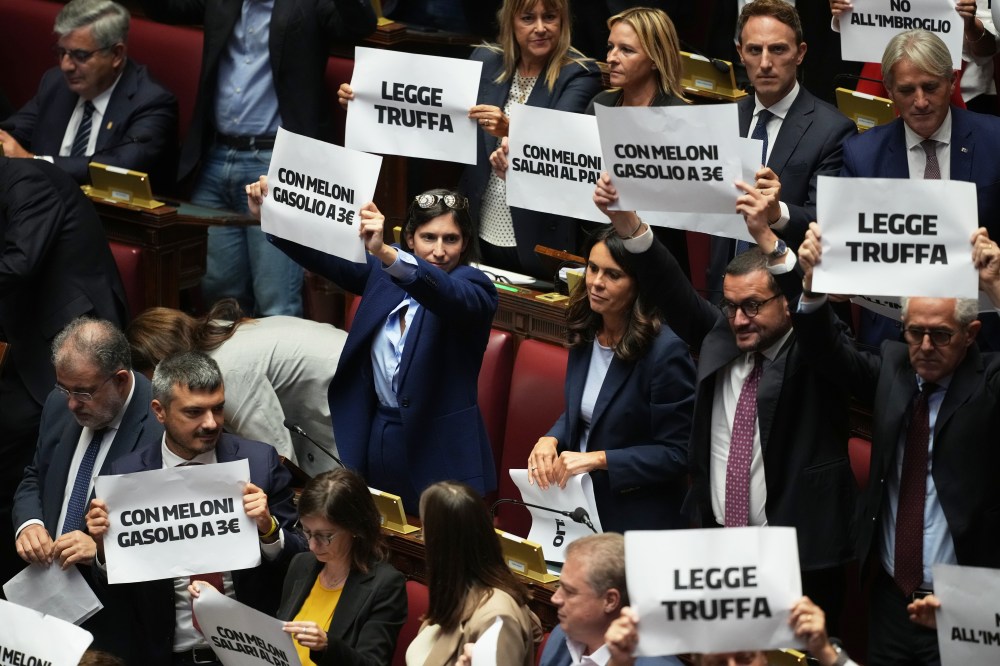
The Chamber of Deputies approved the measure in a secret ballot by 227 votes to 164, giving definitive parliamentary approval to the legislation after months of heated debate.
Meloni hailed the reform as a step toward greater voter choice, saying “Italians would be able to vote for a party, coalition, governing program, prime ministerial candidate and, once again, their own lawmakers.”
The reform introduces a big majority prize that will award bonus parliamentary seats in both houses of parliament to the winning preelection alliance, provided it wins at least 42% of the national vote.
Critics contend that such a “majority prize” distorts voter representation and could conflict with previous court rulings that struck down elements of earlier electoral laws. A successful challenge could force Meloni’s conservative government to revise the system before the next general election.
The new law abolishes Italy’s current mixed electoral system, in which about one-third of parliamentary seats are elected in first-past-the-post constituencies, and replaces it with a fully proportional system.
Meloni’s coalition says the changes will make it easier for voters to identify a governing coalition before elections and reduce the postelection bargaining that has often produced fragile governments. To qualify for the majority prize, parties will have to agree on a common prime ministerial candidate and political platform before the election.
The reform puts additional pressure on the divided center-left opposition, where tensions between the Democratic Party and the populist Five-Star Movement have complicated efforts to build a unified alliance capable of challenging the government in next year’s election.
Meloni had made the vote on the electoral law a test of coalition unity, warning lawmakers from her Brothers of Italy party and coalition partners Forza Italia and the League that the government could face a crisis if the reform were defeated.
Yet resistance to the law has emerged within Meloni’s own coalition.
Some lawmakers fear the measure could ultimately backfire as support for former general Roberto Vannacci’s nationalist National Future party threatens to siphon votes from the governing bloc, potentially making it harder for it to reach the 42% threshold required to secure the majority bonus.
Others have criticized provisions they say would increase campaign costs for individual candidates and reduce women’s representation in parliament.
The vote marks Meloni’s latest attempt to reshape Italy’s institutional framework after voters earlier this year rejected her proposed overhaul of the justice system in a constitutional referendum.