

China sanctions officials in Paraguay and Belize over their countries’ ties with Taiwan
Advertisement
Read this article for free:
or
Already have an account? Log in here »
To continue reading, please subscribe:

Digital Subscription
One year of digital access for only $205*
- Enjoy unlimited reading on winnipegfreepress.com
- Read the E-Edition, our digital replica newspaper
- Access News Break, our award-winning app
- Play interactive puzzles
*First annual payment billed as $205.00 + GST for one year. This annual subscription will automatically renew at $233.00 + GST every 52 weeks (10% off the regular annual price of $259.35). Offer available to new and qualified returning subscribers only. Cancel any time.
To continue reading, please subscribe:
Add Free Press access to your Brandon Sun subscription for only an additional
$1 for the first 4 weeks*
- Enjoy unlimited reading on winnipegfreepress.com
- Read the E-Edition, our digital replica newspaper
- Access News Break, our award-winning app
- Play interactive puzzles
*Your next Brandon Sun subscription payment will increase by $1.00 and you will be charged $17.95 plus GST for four weeks. After four weeks, your payment will increase to $24.95 plus GST every four weeks.
Read unlimited articles for free today:
or
Already have an account? Log in here »
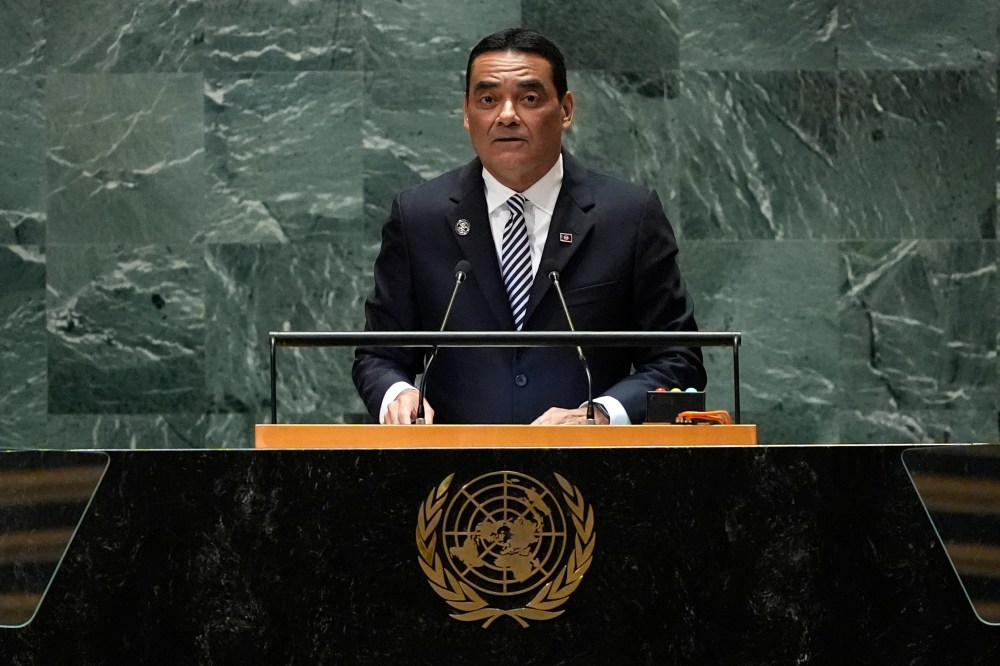
TAIPEI, Taiwan (AP) — China sanctioned Paraguay’s communications minister and Belize’s foreign minister on Monday over ties with Taiwan, the island democracy Beijing claims as its own.
The sanctions against Gustavo Villate of Paraguay and Francis Fonseca of Belize serve to safeguard China’s “national sovereignty, security, and development interests, and to oppose separatist acts seeking ‘Taiwan independence,’” the Chinese Foreign Ministry said on its website.
“Certain politicians in Paraguay and Belize have willingly served as pawns of the Taiwan authorities in their attempts to seek Taiwan independence by soliciting external forces,” said Foreign Ministry spokesperson Mao Ning.
She added that the foreign officials had visited Taiwan and received visits by “Taiwan independence separatists,” as well as “spread disinformation about Chinese cyberattacks to smear and attack China, creating a seriously negative international impact.”
Paraguay and Belize are among the last 12 remaining diplomatic allies of Taiwan, an island democracy China sees as its own territory, to be annexed by force if necessary.
In recent years, Beijing has increased its military pressure on the island, sending warplanes and military ships near it almost daily. It has also ramped up a campaign of winning over its diplomatic partners. Countries including Nauru, Honduras and Nicaragua have switched allegiances from Taiwan to Beijing in recent years.
Taipei’s remaining diplomatic allies are mostly smaller countries in Central America, the Caribbean and South Pacific, along with Eswatini in southern Africa and Vatican City.
The sanctions against Villate and Fonseca are mostly symbolic, as officials from countries that have ties with Taiwan do not generally travel to China. The curbs include freezing any assets the officials might have in China; denial of visas and entry into China; prohibiting any Chinese individuals and organizations from cooperating with them.
The governments of Belize and Paraguay did not immediately react to the sanctions.
In July, Paraguay and the U.S. Embassy in its capital, Asunción, said cybersecurity attacks linked to the Chinese government had compromised Paraguay’s state systems. China vehemently denied the accusations.
The U.S. State Department condemned China’s sanctions on Tuesday.
“The Trump Administration opposes coercion and aggression by China against countries in our hemisphere for exercising their sovereign rights,” department spokesperson Tommy Pigott said.
Taiwanese Premier Cho Jung-tai on Tuesday told reporters that the island democracy is a sovereign country and that China has no right to interfere in its internal affairs or influence its foreign relations.
He said Taiwan would continue working with its allies and other democracies to uphold freedom and democracy, maintain regional peace and security, and resist “any expansion of hegemonic or authoritarian forces.”
China and Taiwan have been governed separately since 1949, when a civil war brought the Communist Party to power in Beijing. Defeated Nationalist Party forces fled to Taiwan. The island has operated with its own government since then.
Taiwan’s Deputy Foreign Minister Chen Ming-chi also criticized China’s moves, noting that Taiwan’s international visibility is growing.
“Are they going to sanction the entire world?” he said.
___
Associated Press video producer Liu Zheng in Beijing contributed to this report.