

What to know about France’s high school student protests
Advertisement
Read this article for free:
or
Already have an account? Log in here »
To continue reading, please subscribe:

Digital Subscription
One year of digital access for only $205*
- Enjoy unlimited reading on winnipegfreepress.com
- Read the E-Edition, our digital replica newspaper
- Access News Break, our award-winning app
- Play interactive puzzles
*First annual payment billed as $205.00 + GST for one year. This annual subscription will automatically renew at $233.00 + GST every 52 weeks (10% off the regular annual price of $259.35). Offer available to new and qualified returning subscribers only. Cancel any time.
To continue reading, please subscribe:
Add Free Press access to your Brandon Sun subscription for only an additional
$1 for the first 4 weeks*
- Enjoy unlimited reading on winnipegfreepress.com
- Read the E-Edition, our digital replica newspaper
- Access News Break, our award-winning app
- Play interactive puzzles
*Your next Brandon Sun subscription payment will increase by $1.00 and you will be charged $17.95 plus GST for four weeks. After four weeks, your payment will increase to $24.95 plus GST every four weeks.
Read unlimited articles for free today:
or
Already have an account? Log in here »
PARIS (AP) — France has seen thousands of arrests, hundreds of injuries, and schools set on fire as the new school year descended into nationwide student protests that are influencing France’s presidential election campaign and drawing international attention.
It’s the latest challenge to Emmanuel Macron’s presidency in a country beset by crises, both foreign and domestic.
The majority of protesters have been peaceful, but violence on the fringes is having an impact, with a daily menu of fireworks thrown at police and volleys of tear gas fired at high school pupils.
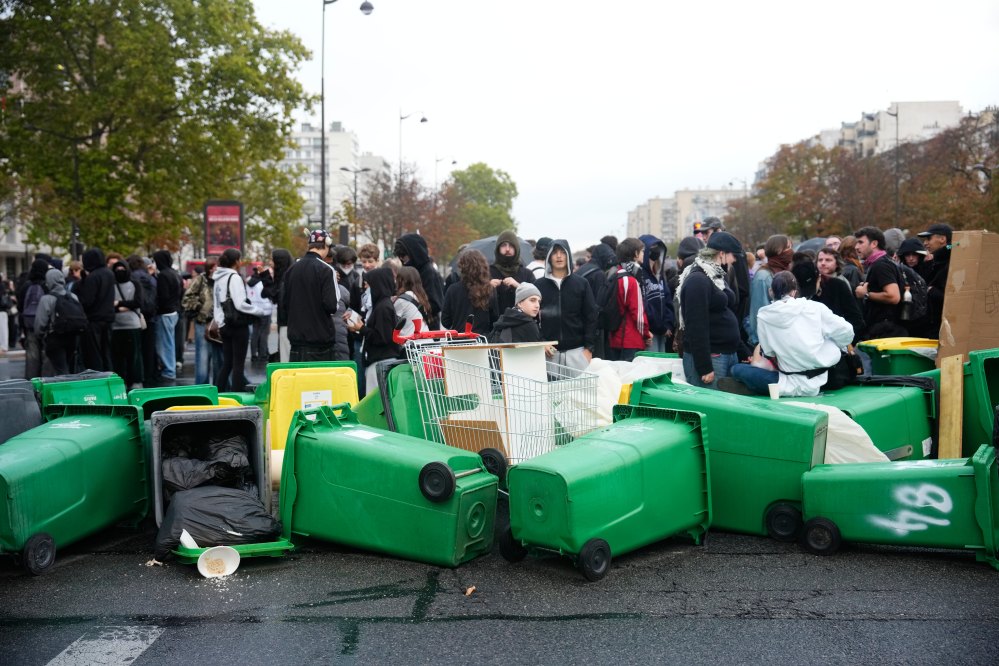
On Tuesday, climate and social justice activist Greta Thunberg joined students at a high school in the Paris suburb of Saint-Denis, as France faced a new day of nationwide marches and strikes on top of the blockades at schools.
Here is what to know about the movement:
The protests started in a Paris suburb
Demonstrations first erupted last month in a high school in Creteil southeast of Paris over a lack of staff. From there, class strikes, blockades and demonstrations spread to other Paris suburbs and then nationwide, even in smaller towns. Hundreds of schools had to close because of damage or attacks on staff.
High schoolers are expressing broad grievances over schools that are under-resourced, with dilapidated facilities and insufficient staff, notably in lower-income neighborhoods. French media have shown videos of scampering rats, collapsed ceilings, leaks, broken furniture and other woes in dilapidated schools.
Some students also complain that during summer heat waves, they roast in classrooms without air-conditioning, while in winter they freeze. They say school days, which often run from 8 a.m. to 6 p.m., are too exhausting and the university entrance system is complex and unfair. Some university students have also joined the protests.
There have been broader concerns in France that the country’s education system is losing ground to other countries and failing in its mission to enable children from disadvantaged backgrounds to move up the social ladder. Scores in reading comprehension and mathematics have plunged, according to the latest PISA report, which evaluates students worldwide.
A muscular police response has drawn criticism
Riot police have liberally used tear gas and wielded their batons to disperse crowds. Police made more than 6,600 arrests nationwide as of last week, an unusually high number for a French protest movement.
A police tear gas grenade shattered a 14-year-old’s jaw and many of his teeth. A 15-year-old lost a hand in an incident involving a police stun grenade. Other adolescents have also suffered life-changing injuries blamed on police weaponry during protests.
Macron’s government has repeatedly said that it respects the right to peaceful protest, but it has also issued written orders for police to break up protests that block access to schools and to rapidly put a stop to violence and vandalism.
Police and school staff have been targeted with powerful fireworks and other injury-causing projectiles. The interior ministry says acid has been hurled in some cases, and that people intent on destruction and looting have grafted themselves onto the high schoolers’ movement.
Presidential candidates are seizing the moment
Candidates campaigning to succeed Macron in a coming presidential election in April and May have seized on the demonstrations as a political issue. Macron is constitutionally barred from seeking a third consecutive term.
Far-left candidate Jean-Luc Mélenchon has positioned himself firmly on the side of the students and has decried police actions. His party invited high school activists on stage at a rally Sunday, then proposed lowering the voting age to 16 and scrapping selective admissions at universities.
Meanwhile, far-right leader Marine Le Pen has called for broader police powers against rioters. Conservative former Prime Minister Edouard Philippe, one of Le Pen’s main challengers for the presidency, has condemned those who “break things, burn things or assault people.”
Some other European countries have seen unrest
Taking grievances to the streets is hardly unusual in the country that spawned the French Revolution of 1789. To name just a few, there were mass student protests in 1968, weeks of suburban unrest in 2005, yellow vest protests in 2018-2019, and demonstrations in 2023 against raising the retirement age.
But some other countries have also seen some student unrest.
In neighboring Belgium, some schools closed in Liege, a day after violence in the city and arrests there.
Several Italian cities also saw student protests last week, though on a smaller scale than in France and focused on a broader set of domestic grievances.