

Trump administration asks Supreme Court to lift halt on Big Bend border wall
Advertisement
Read this article for free:
or
Already have an account? Log in here »
To continue reading, please subscribe:
Digital Subscription
One year of digital access for only $1.44 a week*
- Enjoy unlimited reading on winnipegfreepress.com
- Read the E-Edition, our digital replica newspaper
- Access News Break, our award-winning app
- Play interactive puzzles
*Billed as $5.77 plus GST every four weeks. After 52 weeks, price increases to the regular rate of $19.95 plus GST every four weeks. Offer available to new and qualified returning subscribers only. Cancel any time.
To continue reading, please subscribe:
Add Free Press access to your Brandon Sun subscription for only an additional
$1 for the first 4 weeks*
- Enjoy unlimited reading on winnipegfreepress.com
- Read the E-Edition, our digital replica newspaper
- Access News Break, our award-winning app
- Play interactive puzzles
*Your next Brandon Sun subscription payment will increase by $1.00 and you will be charged $17.95 plus GST for four weeks. After four weeks, your payment will increase to $24.95 plus GST every four weeks.
Read unlimited articles for free today:
or
Already have an account? Log in here »
WASHINGTON (AP) — The Trump administration asked the Supreme Court on Wednesday to let it resume building a border wall project through the Big Bend region of Texas.
The government filed an emergency appeal asking the justices to lift a lower court decision halting construction. That ruling marked a setback to one of President Donald Trump’s signature projects.
The administration has been racing forward with construction on a border wall and other infrastructure from the Pacific Ocean to the Gulf of Mexico.
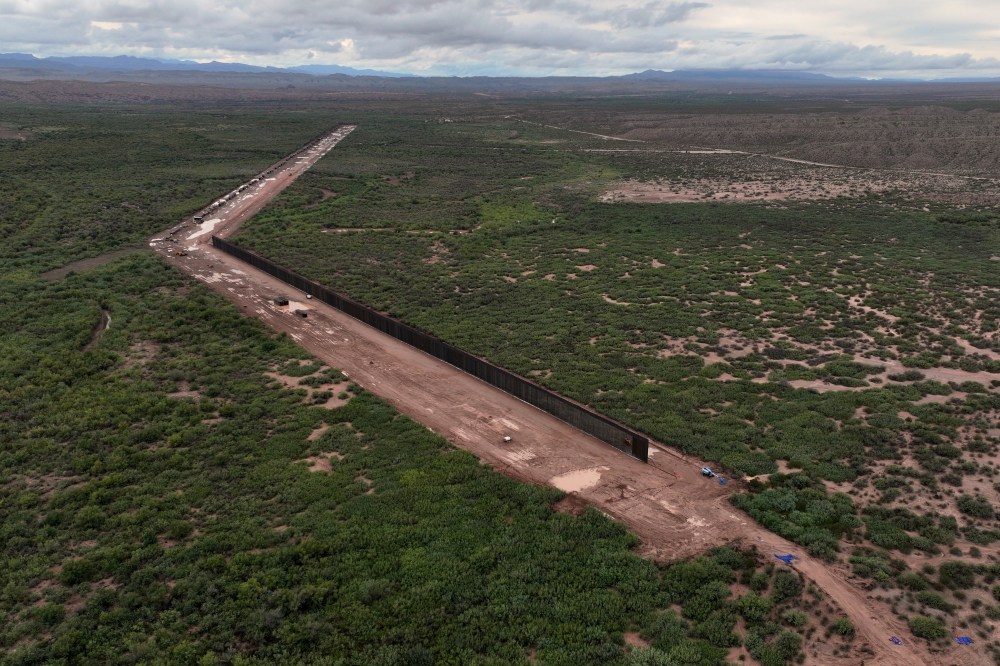
But in the Big Bend region, the administration has run into opposition from ranchers, residents, business owners and environmentalists who argue the projects are a waste of money in an area of historically low illegal immigration and that construction could harm the region’s scenic landscapes.
Opponents have filed numerous lawsuits seeking to stop the project, which in the Big Bend consists of a mixture of walls, vehicle barriers and surveillance technology.
Ruling in one of those cases, Judge Kathleen Cardone on Oct. 2 ordered the government to stop construction across the roughly 500-mile project area while the case plays out in the courts. It was a major victory for the bipartisan opposition.
The case hinges on sweeping waivers signed by the secretary of Homeland Security that allow U.S. Customs and Border Protection to bypass environmental and other regulations that would otherwise slow down construction of such a major project.
The government argued that the Big Bend sector is an area of high illegal entry, and said legislation dating back to 1996 explicitly gives the secretary these far-reaching powers as necessary to build physical barriers or roads near the border to stop people from crossing illegally.
Opponents disagreed, arguing that Congress gave that power to waive regulations specifically in areas of “high illegal entry.” They said Big Bend, a remote and rugged region, doesn’t fit that description.
Cardone sided with the opponents.
“The Court finds that Plaintiffs are likely to succeed on the merits of their major questions doctrine claim that the Big Bend Waivers were issued in excess of the Secretary’s authority,” she wrote.
Trump has long vowed to build a border wall along the roughly 2,000-mile length of the southwest border. Last summer, Republicans in Congress allocated Homeland Security $46 billion to finish the project, which will be a mixture of 30-foot-tall steel bollard walls, vehicle barriers and surveillance technology.
The opposition in Texas’s Big Bend region had been brewing for months, but it escalated in August when bulldozers were spotted clearing land in Big Bend National Park.
The preliminary injunction filed by Cardone stops construction there as well as land up and downriver from the park that is owned by private landowners or the state.
The government has argued that if this region is one of the only areas left without a wall or other border infrastructure, illegal immigration could end up funneling to the Big Bend. But opponents have argued that other forms of infrastructure such as drones or surveillance towers are just as effective and a lot less expensive than the wall plans.