Almost all coral reef ecosystems face risk of collapse in 50 years, study warns

Advertisement

Advertise with us

The world’s coral reef ecosystems almost all face a high risk of collapse in the next 50 years, mostly due to warming oceans and heat waves, according to a global assessment released Thursday.

Read this article for free:


By clicking the button above, an account will be created and you will begin to receive some of our recommended newsletters. You may opt out of any newsletter by visiting your Email and Communication Preferences page or by clicking "unsubscribe" at the bottom of any email.

or

Already have an account? Log in here »

To continue reading, please subscribe:

Digital Subscription

One year of digital access for only $1.44 a week*

  • Enjoy unlimited reading on winnipegfreepress.com
  • Read the E-Edition, our digital replica newspaper
  • Access News Break, our award-winning app
  • Play interactive puzzles

*Billed as $5.77 plus GST every four weeks. After 52 weeks, price increases to the regular rate of $19.95 plus GST every four weeks. Offer available to new and qualified returning subscribers only. Cancel any time.

To continue reading, please subscribe:

Add Free Press access to your Brandon Sun subscription for only an additional

$1 for the first 4 weeks*

  • Enjoy unlimited reading on winnipegfreepress.com
  • Read the E-Edition, our digital replica newspaper
  • Access News Break, our award-winning app
  • Play interactive puzzles
Start now

*Your next Brandon Sun subscription payment will increase by $1.00 and you will be charged $17.95 plus GST for four weeks. After four weeks, your payment will increase to $24.95 plus GST every four weeks.

The world’s coral reef ecosystems almost all face a high risk of collapse in the next 50 years, mostly due to warming oceans and heat waves, according to a global assessment released Thursday.

It’s the latest dose of bad news for coral reefs, which are critical sources for seafood and tourism and often serve as buffers from coastal erosion and storms. Sometimes dubbed “rainforests of the sea,” they have some of the world’s richest biodiversity. They support a quarter of marine species as well as coastal communities and businesses.

Some 96% of shallow-water reef systems are already critically endangered and could disappear by 2075, the International Union for Conservation of Nature announced on the sidelines of a U.N. biodiversity conference in Albania.
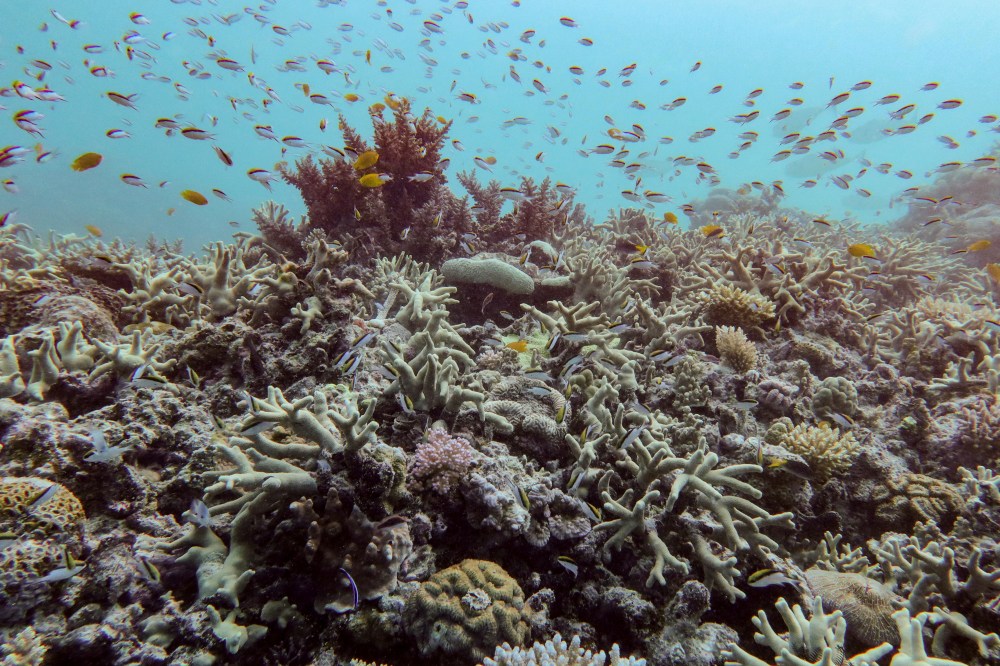
FILE - A diverse coral assemblage is seen after a 2024 bleaching event at Pompey Reef in the northern Great Barrier Reef, far North Queensland, Australia, on Jan. 1, 2025. (Australian Institute of Marine Science via AP, File)

Most of the world’s famous reef systems — including the Great Barrier Reef in Australia, the Coral Triangle in the Western Pacific Ocean and Southeast Asia, the Mesoamerican Barrier Reef System and the Red Sea coral reefs — are all critically endangered, the highest level of threat.

“The risk of coral reef collapse is escalating, but this must be a wake-up call rather than a cause for despair,” said Mishal Gudka, the scientific lead of the global IUCN Red List of Coral Reef Ecosystems assessment, the first of its kind.

“Coral reefs have shown a remarkable ability to bounce back from devastating bleaching events,” he said. “Pockets of surviving, resilient coral reefs can still remain in the future, so we must do everything within our reach to set them up for success.”

When a reef collapses, hard corals disappear and are replaced by algae, rubble and sponges. As a result, the reef no longer supports a diverse ecosystem that can include everything from tiny invertebrates to reef fish like grouper.

“Coral reefs are one of the clearest vital signs of the ocean’s health,” Grethel Aguilar, the IUCN director general, said in a statement.

The assessment, spanning 127 tropical and subtropical ecoregions, and encompassing 72,726 square miles (188,362 square kilometers) of coral reefs globally, called climate change the “single most consistent threat driving coral reef decline worldwide.”

A week ago, another study in the journal Nature by the IUCN found that nearly 44% of reef-building coral species face an elevated risk of extinction due to climate change. A year ago, a survey found that harmful bleaching of the world’s coral has grown to include 84% of the ocean’s reefs — the most intense of its kind in recorded history.

The year 2024 was Earth’s hottest on record, and much of that is going into oceans. The average annual sea surface temperature of oceans away from the poles was a record 69.57 degrees Fahrenheit (20.87 degrees Celsius).

Beyond combating rising global emissions, experts said efforts to reduce pollution, overfishing and coastal development can help reefs survive.

“We know what is needed: ambitious emissions reductions, stronger protection and restoration efforts, and sustained investment in resilient coastal ecosystems and the communities that depend on them,” Aguilar said.

Andrew Baker, director of the Coral Reef Futures Lab at the University of Miami, sought to inject some hope after reviewing the assessment. He said stopping global warming and pollution isn’t the only way to save corals.

“It means finding new ways to restore corals using emerging technology and innovative approaches,” he said, “that can throw a lifeline to struggling reefs and buy us critically needed time to make these transitions.”

Report Error Submit a Tip

More Stories

Almost all coral reef ecosystems face risk of collapse in 50 years, study warns

Michael Casey, The Associated Press 3 minute read Preview

Almost all coral reef ecosystems face risk of collapse in 50 years, study warns

Michael Casey, The Associated Press 3 minute read Thursday, Oct. 22, 2026

The world’s coral reef ecosystems almost all face a high risk of collapse in the next 50 years, mostly due to warming oceans and heat waves, according to a global assessment released Thursday.

It's the latest dose of bad news for coral reefs, which are critical sources for seafood and tourism and often serve as buffers from coastal erosion and storms. Sometimes dubbed “rainforests of the sea,” they have some of the world’s richest biodiversity. They support a quarter of marine species as well as coastal communities and businesses.

Some 96% of shallow-water reef systems are already critically endangered and could disappear by 2075, the International Union for Conservation of Nature announced on the sidelines of a U.N. biodiversity conference in Albania.

Most of the world’s famous reef systems — including the Great Barrier Reef in Australia, the Coral Triangle in the Western Pacific Ocean and Southeast Asia, the Mesoamerican Barrier Reef System and the Red Sea coral reefs — are all critically endangered, the highest level of threat.

Read
Thursday, Oct. 22, 2026

Jets players glad to have Hellebuyck trade behind them

Mike McIntyre 6 minute read Preview

Jets players glad to have Hellebuyck trade behind them

Mike McIntyre 6 minute read Saturday, Oct. 24, 2026

Relief? Regret? Rage?

How are the Winnipeg Jets feeling following Friday’s Connor Hellebuyck trade — particularly those with deep roots and strong bonds with the franchise goaltender who now finds himself a member of the New Jersey Devils?

“It was a bit of a cloud hanging over our heads,” captain Adam Lowry admitted on Saturday. “It’s nice we can look forward now. We don’t have to keep talking about it. We’ve got guys that want to be here.”

That was a bit of a common theme around the room following an outdoor practice at Princess Auto Stadium ahead of Sunday’s Heritage Classic game against the Montreal Canadiens.

Read
Saturday, Oct. 24, 2026

Lula’s historic Brazilian election victory

Peter McKenna 5 minute read Preview

Lula’s historic Brazilian election victory

Peter McKenna 5 minute read 2:01 AM CDT

This was supposed to go down as one of the closest presidential elections in Brazilian history — until it wasn’t. In the end, 80-year-old leftist President Luiz Inácio (Lula) da Silva of the Workers Party bested (by some four million votes) Flávio Bolsonaro, the hard-right Liberal Party leader and senator, by a lopsided 3.5 per cent of the popular vote.

Speaking of Brazilian history, it rarely happens that the second-place finisher in the first round ends up winning the second, run-off contest in such a decisive manner. More significant, Lula has now won an unprecedented (non-consecutive) fourth term as an elected Brazilian president.

While Bolsonaro has waffled on making a concession speech (like his father in 2022), the writing on the wall shows clearly that he lost badly. He has evidently taken issue with a ruling by a justice of the Supreme Court that extended polling hours country-wide by an additional two hours in light of high voter turnout and other interruptions.

Flávio’s supporters, many galvanized around the “never Lula” camp, were desperate for change — even if it meant the kind of change that could turn Brazil on its head. So Lula resorted to one of the oldest political tricks in the campaign handbook — namely, using fear of an anti-democratic Bolsonaro to swing voters to his side (along with a host of last-minute announcements involving financial incentives to Brazilians). With a right-leaning Congress, voters were understandably worried that Flávio would go about systematically dismantling Brazil’s democratic ethos and institutions.

Read
2:01 AM CDT

Ceramic artist brings double-edged works to exhibition

AV Kitching 5 minute read Preview

Ceramic artist brings double-edged works to exhibition

AV Kitching 5 minute read 2:00 AM CDT

Drawing on her Afro-Jamaican and Red River Métis heritage, Winnipeg-based ceramic artist PJ Anderson’s richly ornamented sculptural works explore adornment as a form of protection, resistance and self-definition.

Her pieces are currently being shown in the After the Island: Caribbean Canadian Ceramics exhibition at the Gardiner Museum in Toronto.

The exhibition is a collaboration between the museum, Black Artists’ Networks in Dialogue (BAND) and the Museum of the African Diaspora (MoAD) in San Franciso, resulting in two shows presented concurrently at the Gardiner and MoAD.

Anderson is the only artist featured in both shows who was not born in the Caribbean.

Read
2:00 AM CDT

Express the merry widow you truly are

Maureen Scurfield 5 minute read 2:00 AM CDT

DEAR MISS LONELYHEARTS: My husband died a while back, and I don’t miss him! He had grown old in a strange and cranky way, and I’m a cheerful person by nature. It was hard to hear him shoot down every idea I had to go out and do things together.

He wasn’t physically ill — just finished with having any fun. He had gotten depressed and wouldn’t take anti-depressants, although he was fine with getting drunk and critical towards me.

He was particularly negative about seeing friends and relatives, and living the active way we used to — always the first to get tickets to concerts and encouraging other friends to go with us for dinners at new restaurants. We also went to a lot of sports games, and visited friends and relatives. We arrive with lots of good food and drink.

So now when people ask me in that pitying voice used for widows, “Poor darling, how are you doing?” I respond, “He was miserable towards the end, and it was a relief when he died.” They look shocked, but it’s the truth, and they know it.

Letters, Oct. 27

7 minute read 2:01 AM CDT

Time for ranked ballots?

Re: Get out and exercise your franchise (Editorial, Oct. 24)

Declining turnout is indeed a threat to our democracy and, while I am grateful that the editorial mentioned proportional representation, the issue on the municipal level can be solved far more simply — using ranked-choice voting.

In the last Winnipeg municipal election, the mayor “won” the election with only 27 per cent of the vote. Multiply that by the turnout of 37.5 per cent and the mayor’s positive mandate — the portion of the electorate that voted for him as mayor — drops to a paltry 10 per cent. That number should shock us into an awareness that the single-mark ballot has failed us miserably.