Almost all coral reef ecosystems face risk of collapse in 50 years, study warns

Advertisement

Advertise with us

The world’s coral reef ecosystems almost all face a high risk of collapse in the next 50 years, mostly due to warming oceans and heat waves, according to a global assessment released Thursday.

Read this article for free:


By clicking the button above, an account will be created and you will begin to receive some of our recommended newsletters. You may opt out of any newsletter by visiting your Email and Communication Preferences page or by clicking "unsubscribe" at the bottom of any email.

or

Already have an account? Log in here »

To continue reading, please subscribe:

Digital Subscription

One year of digital access for only $1.44 a week*

  • Enjoy unlimited reading on winnipegfreepress.com
  • Read the E-Edition, our digital replica newspaper
  • Access News Break, our award-winning app
  • Play interactive puzzles

*Billed as $5.77 plus GST every four weeks. After 52 weeks, price increases to the regular rate of $19.95 plus GST every four weeks. Offer available to new and qualified returning subscribers only. Cancel any time.

To continue reading, please subscribe:

Add Free Press access to your Brandon Sun subscription for only an additional

$1 for the first 4 weeks*

  • Enjoy unlimited reading on winnipegfreepress.com
  • Read the E-Edition, our digital replica newspaper
  • Access News Break, our award-winning app
  • Play interactive puzzles
Start now

*Your next Brandon Sun subscription payment will increase by $1.00 and you will be charged $17.95 plus GST for four weeks. After four weeks, your payment will increase to $24.95 plus GST every four weeks.

The world’s coral reef ecosystems almost all face a high risk of collapse in the next 50 years, mostly due to warming oceans and heat waves, according to a global assessment released Thursday.

It’s the latest dose of bad news for coral reefs, which are critical sources for seafood and tourism and often serve as buffers from coastal erosion and storms. Sometimes dubbed “rainforests of the sea,” they have some of the world’s richest biodiversity. They support a quarter of marine species as well as coastal communities and businesses.

Some 96% of shallow-water reef systems are already critically endangered and could disappear by 2075, the International Union for Conservation of Nature announced on the sidelines of a U.N. biodiversity conference in Albania.
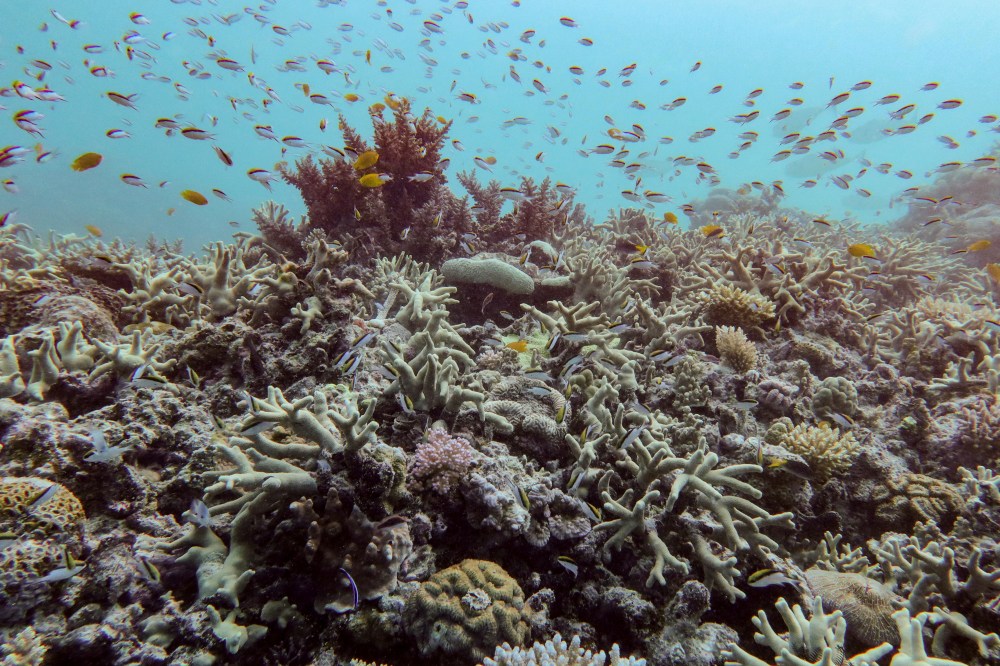
FILE - A diverse coral assemblage is seen after a 2024 bleaching event at Pompey Reef in the northern Great Barrier Reef, far North Queensland, Australia, on Jan. 1, 2025. (Australian Institute of Marine Science via AP, File)

Most of the world’s famous reef systems — including the Great Barrier Reef in Australia, the Coral Triangle in the Western Pacific Ocean and Southeast Asia, the Mesoamerican Barrier Reef System and the Red Sea coral reefs — are all critically endangered, the highest level of threat.

“The risk of coral reef collapse is escalating, but this must be a wake-up call rather than a cause for despair,” said Mishal Gudka, the scientific lead of the global IUCN Red List of Coral Reef Ecosystems assessment, the first of its kind.

“Coral reefs have shown a remarkable ability to bounce back from devastating bleaching events,” he said. “Pockets of surviving, resilient coral reefs can still remain in the future, so we must do everything within our reach to set them up for success.”

When a reef collapses, hard corals disappear and are replaced by algae, rubble and sponges. As a result, the reef no longer supports a diverse ecosystem that can include everything from tiny invertebrates to reef fish like grouper.

“Coral reefs are one of the clearest vital signs of the ocean’s health,” Grethel Aguilar, the IUCN director general, said in a statement.

The assessment, spanning 127 tropical and subtropical ecoregions, and encompassing 72,726 square miles (188,362 square kilometers) of coral reefs globally, called climate change the “single most consistent threat driving coral reef decline worldwide.”

A week ago, another study in the journal Nature by the IUCN found that nearly 44% of reef-building coral species face an elevated risk of extinction due to climate change. A year ago, a survey found that harmful bleaching of the world’s coral has grown to include 84% of the ocean’s reefs — the most intense of its kind in recorded history.

The year 2024 was Earth’s hottest on record, and much of that is going into oceans. The average annual sea surface temperature of oceans away from the poles was a record 69.57 degrees Fahrenheit (20.87 degrees Celsius).

Beyond combating rising global emissions, experts said efforts to reduce pollution, overfishing and coastal development can help reefs survive.

“We know what is needed: ambitious emissions reductions, stronger protection and restoration efforts, and sustained investment in resilient coastal ecosystems and the communities that depend on them,” Aguilar said.

Andrew Baker, director of the Coral Reef Futures Lab at the University of Miami, sought to inject some hope after reviewing the assessment. He said stopping global warming and pollution isn’t the only way to save corals.

“It means finding new ways to restore corals using emerging technology and innovative approaches,” he said, “that can throw a lifeline to struggling reefs and buy us critically needed time to make these transitions.”

Report Error Submit a Tip

More Stories

Brown to rescue

Taylor Allen 6 minute read Preview

Brown to rescue

Taylor Allen 6 minute read Saturday, Oct. 24, 2026

Don’t let the final score fool you.

The Winnipeg Blue Bombers clinched a playoff berth with a 34-10 victory over the B.C. Lions on Friday night in Vancouver, but it was anything but pretty.

Had they not been facing a lineup loaded with second- and third-stringers, the Bombers might be preparing for the off-season instead of another game right now.

Luckily for them, they survived three horrendous quarters to prevail. A loss would have ended their season and handed a playoff spot to the Calgary Stampeders instead.

Read
Saturday, Oct. 24, 2026

Opening of Portage and Main shows even seemingly insurmountable impasses can be overcome

Jason Syvixay 10 minute read Preview

Opening of Portage and Main shows even seemingly insurmountable impasses can be overcome

Jason Syvixay 10 minute read Saturday, Oct. 24, 2026

There are places in a city that become more than places. Portage and Main is one of them. For generations of Winnipeggers, the intersection has represented downtown, traffic, development and civic identity. Its reopening to pedestrians in 2025, after 46 years of closure, was about more than crossing a street. It was a reminder that decisions made by one generation can shape the choices available to another — and that even seemingly permanent decisions can be reconsidered.

I have spent much of my professional life thinking about Winnipeg as a planner, working in public, private and non-profit settings. My PhD research gave me an opportunity to examine Portage and Main differently: not simply as a debate about cars and pedestrians, but as a window into how power operates in a city. I reviewed 569 archival documents spanning the 1960s to the present, interviewed 48 planners with experience in Winnipeg, and mapped the relationships between planners, politicians, developers, engineers, residents, businesses and advocacy groups.

What emerged was a story about how planning decisions become embedded in a city’s institutions, agreements, infrastructure, professional practices and political expectations — shaping not only what gets built, but who gets to influence what gets built.

The closure of Portage and Main in 1979 did not remain a decision confined to a particular political moment. Over time, it was reinforced by development agreements, physical infrastructure, property relationships, traffic-engineering practices, administrative routines, and public narratives about mobility and downtown revitalization. The people who made many of those original decisions eventually left office. The arrangements they created remained. Later planners inherited them.

Read
Saturday, Oct. 24, 2026

B.C. Conservative’s Lorne Doerkson sets out urgent priorities to govern

Wolfgang Depner, The Canadian Press 7 minute read Preview

B.C. Conservative’s Lorne Doerkson sets out urgent priorities to govern

Wolfgang Depner, The Canadian Press 7 minute read Updated: Yesterday at 6:05 PM CDT

VANCOUVER - British Columbia's premier-designate Lorne Doerkson's long to-do list includes lowering taxes, while reviewing the provincial finances, working with Alberta and the federal government on the proposed Pacific Link pipeline and repealing Indigenous legislation.

Doerkson laid out his priorities at a news conference Sunday, just hours after his party was elected with about two-thirds of the province's 93 seats in the legislature.

He said he has spoken to the lieutenant-governor and named Kim Henderson, a former deputy to the premier to previous Liberal governments, to lead his transition team.

"We are going to do this properly, and we are going to do it with obviously some urgency," he said. "When this government is sworn in, it will be ready on Day 1, and it will hit the ground running."

Read
Updated: Yesterday at 6:05 PM CDT

First Crumbl cookie shop opens in Winnipeg

Gabrielle Piché 3 minute read Preview

First Crumbl cookie shop opens in Winnipeg

Gabrielle Piché 3 minute read Friday, Oct. 23, 2026

The early birds got their cookies.

Klaudia and Jayson Ballantyne were the first in line for the grand opening of Winnipeg’s first Crumbl location at 1570 Regent Ave. West, arriving at 2 a.m. Friday — six hours before the cookie chain was set to open.

The brother and sister brought their lawn chairs and blankets and hunkered down.

Roughly 90 minutes later, by their count, the next customers arrived.

Read
Friday, Oct. 23, 2026

Almost all coral reef ecosystems face risk of collapse in 50 years, study warns

Michael Casey, The Associated Press 4 minute read Preview

Almost all coral reef ecosystems face risk of collapse in 50 years, study warns

Michael Casey, The Associated Press 4 minute read Thursday, Oct. 22, 2026

The world’s coral reef ecosystems almost all face a high risk of collapse in the next 50 years, mostly due to warming oceans and heat waves, according to a global assessment released Thursday.

It's the latest dose of bad news for coral reefs, which are critical sources for seafood and tourism and often serve as buffers from coastal erosion and storms. Sometimes dubbed “rainforests of the sea,” they have some of the world’s richest biodiversity. They support a quarter of marine species as well as coastal communities and businesses.

Some 96% of shallow-water reef systems are already critically endangered and could disappear by 2075, the International Union for Conservation of Nature announced on the sidelines of a U.N. biodiversity conference in Albania.

Most of the world’s famous reef systems — including the Great Barrier Reef in Australia, the Coral Triangle in the Western Pacific Ocean and Southeast Asia, the Mesoamerican Barrier Reef System and the Red Sea coral reefs — are all critically endangered, the highest level of threat.

Read
Thursday, Oct. 22, 2026

‘Savage and brutal’ Erickson home invasion nets 17-year sentence

Tessa Adamski 6 minute read Preview

‘Savage and brutal’ Erickson home invasion nets 17-year sentence

Tessa Adamski 6 minute read Saturday, Oct. 24, 2026

BRANDON — A woman who fought off the man who slashed her throat in a random home invasion in Erickson described the violent assault as the worst day of her life and a nightmare she can’t seem to shake off.

“I feel like a shell of the person I used to be. Not every second of every day, but definitely every day. It comes in waves,” Candace Richardson said as she read from a victim impact statement in a Brandon courtroom on Friday.

Carter Prince, 21, who pleaded guilty to attempted murder for the June 2023 attack, sat in the prisoner’s box as Richardson spoke.

“I’ll be completely fine, laughing, having fun or just relaxing with my family,” she told the court. “Then time goes so slowly, like you’re floating away, but instead of floating, I’m pinned to the ground, being stabbed over and over again. There’s blood everywhere and darkness surrounding me.”

Read
Saturday, Oct. 24, 2026