Body by Dynacorn
No restoration needed on these brand-new classic shells
Advertisement
Read this article for free:
or
Already have an account? Log in here »
To continue reading, please subscribe:

Digital Subscription
One year of digital access for only $205*
- Enjoy unlimited reading on winnipegfreepress.com
- Read the E-Edition, our digital replica newspaper
- Access News Break, our award-winning app
- Play interactive puzzles
*First annual payment billed as $205.00 + GST for one year. This annual subscription will automatically renew at $233.00 + GST every 52 weeks (10% off the regular annual price of $259.35). Offer available to new and qualified returning subscribers only. Cancel any time.
To continue reading, please subscribe:
Add Free Press access to your Brandon Sun subscription for only an additional
$1 for the first 4 weeks*
- Enjoy unlimited reading on winnipegfreepress.com
- Read the E-Edition, our digital replica newspaper
- Access News Break, our award-winning app
- Play interactive puzzles
*Your next Brandon Sun subscription payment will increase by $1.00 and you will be charged $17.95 plus GST for four weeks. After four weeks, your payment will increase to $24.95 plus GST every four weeks.
Read unlimited articles for free today:
or
Already have an account? Log in here »
Hey there, time traveller!
This article was published 16/10/2009 (6135 days ago), so information in it may no longer be current.
When it comes to a restoration, the worst part of the car often will be the body.
Fenders, doors, trunk lids and hoods can all be repaired or replaced fairly easily, but getting into the floor and rear quarter-panels is often regarded as major surgery. Frequently, replacing these panels entails separating them from various parts of the body’s inner structure by cutting and drilling out the factory spot-welds holding them together.
Welding in new replacement panels and repairing any inner structural damage is an acceptable fix, yet it comes at a price. Requiring a competent and knowledgeable technician to perform the work, rust repairs and major collision damage are expensive to fix and can add thousands of dollars to the total restoration cost.
Let’s also consider the enthusiast who wants to construct a resto-rod. They’re basically after a straight, rust-free body as the basis of their project. After the original powertrain, suspension, steering and braking systems are replaced with new modern components, the original parts are often sold off or even discarded.
Another hurdle in the hobby is simply the lack of a suitable car. You may find vehicles that aren’t even remotely restorable, or perhaps you can’t find one at all.
Just a few years ago, the GT 500E, or Eleanor Mustangs, became a perfect example of how some in-demand cars are just unavailable. Built from existing ’67 and ’68 Mustangs, there just weren’t enough to keep up with customer demand.
The main bodies of vintage muscle cars are simply a collection of components fitted and welded together as a sub-assembly. Most often, they include the torque boxes and frame rails to mount drivetrain and suspension pieces. Wouldn’t it be great to just replace the body as a unit, much like replacing an engine?
Today, Dynacorn International Inc. is offering hobbyists and restorers all-new, classic muscle-car bodies through its Canadian distributor, Gold Leaf Automotive in Toronto. Late-’60s Camaro coupes and convertibles are available, as are ’67 and ’68 Mustang fastback models. The company recently introduced a ’69 Mustang fastback and have just completed a ’70 model.
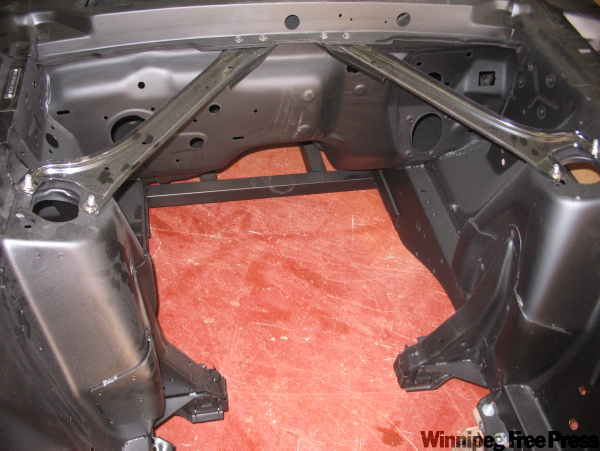
Licensed and approved by the Ford Motor Co., Dynacorn’s replacement body shell not only takes away all those countless hours of dent and rust repair, it provides a better platform for your project. The big-block engine bay on the Mustangs features reinforced shock towers and heavier front frame rails and torque boxes. Improvements continue in the rear with stronger frame rails and additional spot-welds. The body comes with the doors and trunk lid attached, and front fenders and hoods are available to complete the package.
Walker Auto Parts is one of the distributors for Gold Leaf Automotive in Winnipeg, and owner Reg Walker was proud to announce that he had acquired the first 1970 Mustang fastback body shell in North America. Sold to a customer in Neepawa, the body was briefly at Walker’s shop on King Edward Avenue, and I dropped in last week to have a look at serial number 1.
Still partially in its metal-framed shipping crate, dressed in a protective primer coat with no rust, dents or other damage, it was as if I was looking back in time. A completely new body, ready to be turned into whatever you want, with no restorative efforts required. This allows the enthusiast to go straight to the build stage, bypassing the usual teardown-and-refurbish period that has a tendency to drag on for some time.

Though the new bodies aren’t for everyone, it’s a game-changer in the restoration world. Buyers often pay several thousand dollars to acquire the popular car model that they want, only to be hampered by costly body repairs. Not anymore.
Cost of the reproduction bodies varies by year, make and model, and there are several additional cars in the queue for release in the near future. A reasonable alternative to hunting high and low to find a suitable car, Dynacorn’s classic muscle-car bodies may just be the ticket to the future of car-building.