A century of innovation: 1897-2004 Olds
Advertisement
Read this article for free:
or
Already have an account? Log in here »
To continue reading, please subscribe:

Digital Subscription
One year of digital access for only $205*
- Enjoy unlimited reading on winnipegfreepress.com
- Read the E-Edition, our digital replica newspaper
- Access News Break, our award-winning app
- Play interactive puzzles
*First annual payment billed as $205.00 + GST for one year. This annual subscription will automatically renew at $233.00 + GST every 52 weeks (10% off the regular annual price of $259.35). Offer available to new and qualified returning subscribers only. Cancel any time.
To continue reading, please subscribe:
Add Free Press access to your Brandon Sun subscription for only an additional
$1 for the first 4 weeks*
- Enjoy unlimited reading on winnipegfreepress.com
- Read the E-Edition, our digital replica newspaper
- Access News Break, our award-winning app
- Play interactive puzzles
*Your next Brandon Sun subscription payment will increase by $1.00 and you will be charged $17.95 plus GST for four weeks. After four weeks, your payment will increase to $24.95 plus GST every four weeks.
Read unlimited articles for free today:
or
Already have an account? Log in here »
Hey there, time traveller!
This article was published 06/11/2009 (6162 days ago), so information in it may no longer be current.
WHEN General Motors discontinued America’s oldest automobile maker, Oldsmobile, in 2004, it ended a grand tradition of technical achievement.
Oldsmobile was created by Ransom Eli Olds, born in 1864 in Geneva, Ohio. His father, Pliny F. Olds, moved the family to Lansing, Mich. in 1880 and established an engine-building and machinery repair company. Ransom joined the firm in 1883. He completed a crude steam car in 1887, followed by an improved version in 1891 that was featured in Scientific American. He built his first gasoline-powered vehicle in 1896 and founded the Olds Motor Works on Aug. 21, 1897.
After producing a few cars, Olds moved from Lansing to Detroit in 1900. A year later, a fire destroyed all of the company’s cars except a little one-cylinder Curved Dash model.
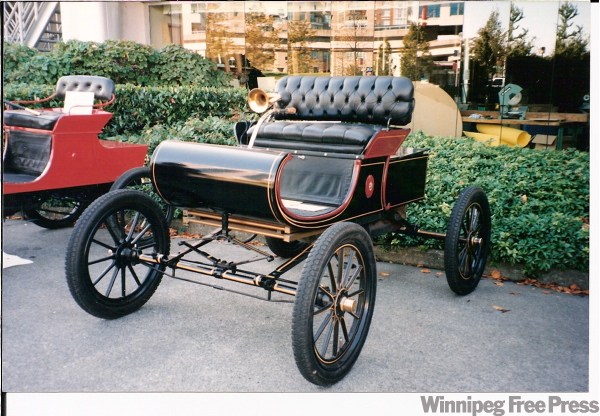
Olds resumed building Curved Dashes, adopting the Oldsmobile name in 1901.
The 318-kilogram, toboggan-nosed runabout was light, reliable and successful. Enticed back to Lansing by local interests in 1902, large-scale Curved Dash production made it America’s first quantity-produced car.
A modified Curved Dash Pirate reached 87.5 km/h on Ormond Beach, Fla., in 1903, a class record. In 1904, two Curved Dashes, "Old Steady" and "Old Scout," were driven 6,440 kilometres coast to coast in 44 days.
Ransom Olds left the company in 1904 over a difference with a board of directors that favoured larger cars. He then established a company called Reo derived from his initials.
Oldsmobile continued and introduced two-, four- and six-cylinder cars.
Financial difficulties loomed by 1908, and it was bought by Billy Durant for his new GM conglomerate.
Oldsmobile made steady progress producing medium-priced models. It offered a V8 engine from 1916 to 1923, but, in 1924, it went back to sixes.
Although losing money in the early 1930s, Oldsmobile survived the Depression with its solid, reliable cars. It introduced the Safety Automatic Transmission in 1938, a prelude to the 1940 Oldsmobile’s Hydra-Matic, the first fully automatic transmission.
Following the Second World War production hiatus, Oldsmobile developed a compact, short-stroke, overhead-valve, 135-h.p. Rocket V8 introduced in the new 1949 88 model. It made Oldsmobile one of the world’s best-performing cars, becoming dominant in NASCAR events. The 88 helped Oldsmobile lead mid-priced sales and become fourth in the industry (it reached third in 1972).
In 1961, Oldsmobile introduced its upscale compact F-85 with an aluminum 3.5-litre V8. It launched the Cutlass name, one of the industry’s most enduring, and introduced the world’s first production exhaust-driven, turbo-supercharger in the 1962 Jetfire sports coupe, beating Chevrolet’s turbocharged Corvair Spyder by a month.
Although the Jetfire was the first turbocharged production car, high-powered bigger engines were cheaper to build and turbocharging was discontinued after a couple of years. Rover bought the V8 for its cars and SUVs.
Oldsmobile stunned the industry in 1966 with its front-wheel-drive Toronado. Not used in America since the 1930s Cord, Oldsmobile revived the front-wheel drive and laid the groundwork for GM’s mass changeover to the setup in the 1980s.
As safety concerns rose, Oldsmobile’s 1974 Toronado was the first production car with an inflatable airbag, but it would soon disappear for more than a decade. Driven by the 1973-’74 energy crisis, Oldsmobile marketed the first American diesel car in 1978.

The 5.7-L gasoline V8, a mixed blessing, was discontinued in 1985 after fuel economy concerns subsided.
The drive for better economy in the 1970s and 1980s led GM to more four- and six-cylinder engines. When GM decided to revive twin-overhead-camshaft, four-valves-per-cylinder engines following the star-crossed 1975-’76 Chevrolet Cosworth Vega, Oldsmobile developed the Quad-4. This 150-h.p., 2.3-L four appeared in the 1988 Cutlass Calais. Following the GM trend, Oldsmobile gradually phased out rear-wheel drive, last seen on the 1990 Cutlass. Its Bravada SUV came in 1991, although not to Canada.
Oldsmobile’s demise in 2004 marked the end of not only the oldest name in American cars but one with an outstanding legacy of innovation.
— Canwest News Service