Critter myth-busters
Vets help de-bunk online pet-care claims
Advertisement
Read this article for free:
or
Already have an account? Log in here »
To continue reading, please subscribe:

Digital Subscription
One year of digital access for only $205*
- Enjoy unlimited reading on winnipegfreepress.com
- Read the E-Edition, our digital replica newspaper
- Access News Break, our award-winning app
- Play interactive puzzles
*First annual payment billed as $205.00 + GST for one year. This annual subscription will automatically renew at $233.00 + GST every 52 weeks (10% off the regular annual price of $259.35). Offer available to new and qualified returning subscribers only. Cancel any time.
To continue reading, please subscribe:
Add Free Press access to your Brandon Sun subscription for only an additional
$1 for the first 4 weeks*
- Enjoy unlimited reading on winnipegfreepress.com
- Read the E-Edition, our digital replica newspaper
- Access News Break, our award-winning app
- Play interactive puzzles
*Your next Brandon Sun subscription payment will increase by $1.00 and you will be charged $17.95 plus GST for four weeks. After four weeks, your payment will increase to $24.95 plus GST every four weeks.
Read unlimited articles for free today:
or
Already have an account? Log in here »
Hey there, time traveller!
This article was published 01/12/2009 (6116 days ago), so information in it may no longer be current.
The Internet is a blessing for many of us. It simplifies the research of varying topics with a mere touch of a few keys. Within minutes you can learn how to do Egyptian mummification and then discover the best alcohol to use in fruit cake. Naturally, there are some drawbacks (and I don’t mean eating the fruitcake). The biggest problem is that a lot of Internet information is plain wrong.
If your fruitcake recipe bombs it’s not the end of the world. When you’re researching how to keep your pet healthy, however, the Internet has to be cautiously navigated.
This situation reminds me of a topic revealed in one of my favourite movies, Man of the Year, starring Robin Williams. It discusses how television pits the learned professional against the average person with little distinction between them. The Internet does the same thing. Search the work ticks and you’ll get everything from a band that wrote, "She ticks me off because she kisses funny" to a peer-reviewed study of Lyme disease by top physicians in the world. If you’re hasty with your search, you might end up with faulty information.
This is something I take great care to avoid. Ensuring that any website I enter is supported by a respected institution allows me to prevent gathering misinformation. Contacting the professionals themselves is the best way to glean useful assistance.
Often, I’m asked for pet advice. In this regard, I try to serve as a conduit between you and the professional. I’d never wish to perpetuate a myth. With this in mind, I’d like to introduce something I’ve been working on with the Manitoba Veterinary Medical Association. It’s called Animal Myth Busters.
Veterinarians often listen to owners citing information that’s just false, and in some cases, dangerous. Together with MVMA, I’d like to give readers a place to double-check their theories before they share or implement them.
This first myth we jointly bust involves porcupines.
If you suspect you don’t have to worry about this lumbering rodent in winter, you’d be wrong. Porcupines don’t hibernate. Although they have a den (in a hollow tree or under rocks), they deftly climb trees. This makes sense since tree bark, fruit, flowers and evergreen needles are part of their diet.
It’s a fascinating herbivore. This nocturnal animal moves slowly and has poor eyesight (which leads me to believe Charles Darwin was wrong and that I must be related to them somehow).
In winter, cities that melt road ice with salt, pose a danger to them. As a salt-loving creature, it’s lured from the safety of the tree to lick salt off the roads. As a result, many are hit by cars. Their love of salt also means you should be attentive at your cabin. Drawn to the salty perspiration left by your hands, they’ve been known to nibble on many a canoe paddle.
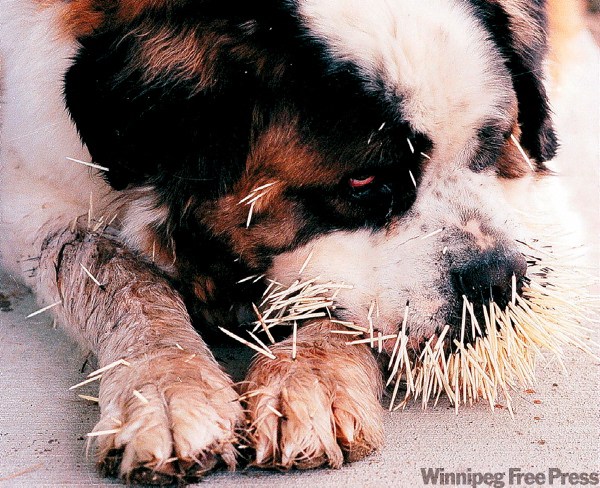
How does the porcupine affect your pet? With 30,000 quills to dispense, the porcupine should be avoided. For inquisitive hounds, however, this sometimes proves difficult. As you know, a porcupine will win that battle leaving lasting, painful reminders of the encounter.
Should this occur to your pet, keep the following myth, released by the MVMA, in mind.
MYTH: Cutting a porcupine quill lets the air out of them and allows easy removal.
Busted! This information is incorrect.
Cutting the quill will not help removal in the slightest. In fact, it makes removing quills more difficult because there is less to grab.
While mature quills have hollow, air filled shafts, it’s the black tip that is the prickly end of the problem. The point of a quill boasts tiny, sharp barbs that induce it to work inwards after sticking into any animal that gets too close. The mechanics are the same as a barbed fish hook. These barbs make the quills a serious defence mechanism. Quills have been known to migrate deeper into the body and in rare cases penetrate vital organs.
For this reason, prompt veterinary care is the best response to a porcupine encounter.

The only way to remove quills safely is at the veterinary clinic, often under a general anesthetic. This will minimize the chances of a rogue quill migrating into vital tissue. It also allows the veterinarian to fully and safely check your animal to ensure that all quills are removed.
It’s important to note that a porcupine uses its quills in defence. It doesn’t attack. Quills are not thrown. Instead, they detach when an animal touches the porcupine. A dog with quills indicates the dog initiated contact with the porcupine.
If you have a question, or have been sent an email that warns you about a pet-related item, contact the MVMA at: animalmyths@mvma.ca. Yours might be the next myth to get busted!
char.adam@mts.net twitter.com/charspetpage