

NDP trying to solve health-care problems from every angle — except the one likely to have the biggest impact

Advertisement
Read this article for free:
or
Already have an account? Log in here »
To continue reading, please subscribe:

Digital Subscription
One year of digital access for only $205*
- Enjoy unlimited reading on winnipegfreepress.com
- Read the E-Edition, our digital replica newspaper
- Access News Break, our award-winning app
- Play interactive puzzles
*First annual payment billed as $205.00 + GST for one year. This annual subscription will automatically renew at $233.00 + GST every 52 weeks (10% off the regular annual price of $259.35). Offer available to new and qualified returning subscribers only. Cancel any time.
To continue reading, please subscribe:
Add Free Press access to your Brandon Sun subscription for only an additional
$1 for the first 4 weeks*
- Enjoy unlimited reading on winnipegfreepress.com
- Read the E-Edition, our digital replica newspaper
- Access News Break, our award-winning app
- Play interactive puzzles
*Your next Brandon Sun subscription payment will increase by $1.00 and you will be charged $17.95 plus GST for four weeks. After four weeks, your payment will increase to $24.95 plus GST every four weeks.
Read unlimited articles for free today:
or
Already have an account? Log in here »
Winnipeg’s emergency-room wait times hit a record high in July, according to the latest data released Thursday by the Winnipeg Regional Health Authority.
The 90th-percentile wait for all emergency rooms and urgent-care sites hit a staggering 13.02 hours last month, the longest wait ever recorded since the WRHA began publishing monthly data.
Thirteen hours is not a wait, it’s an endurance test. And it’s getting worse.
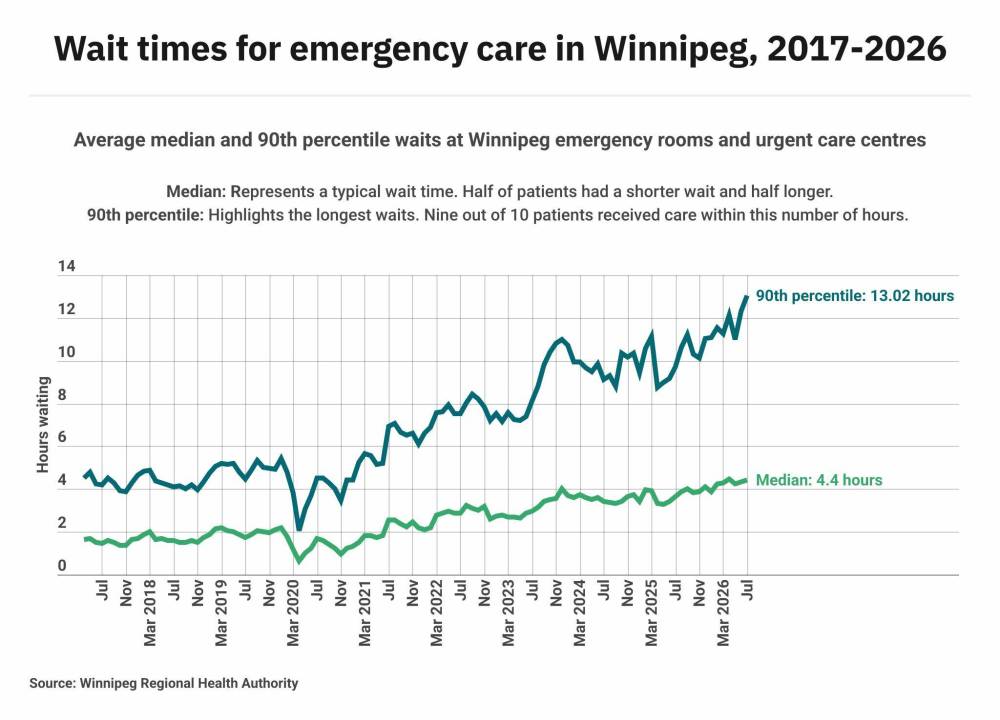
The 90th percentile is the point at which nine out of 10 patients experienced a shorter wait and one in 10 waited even longer.
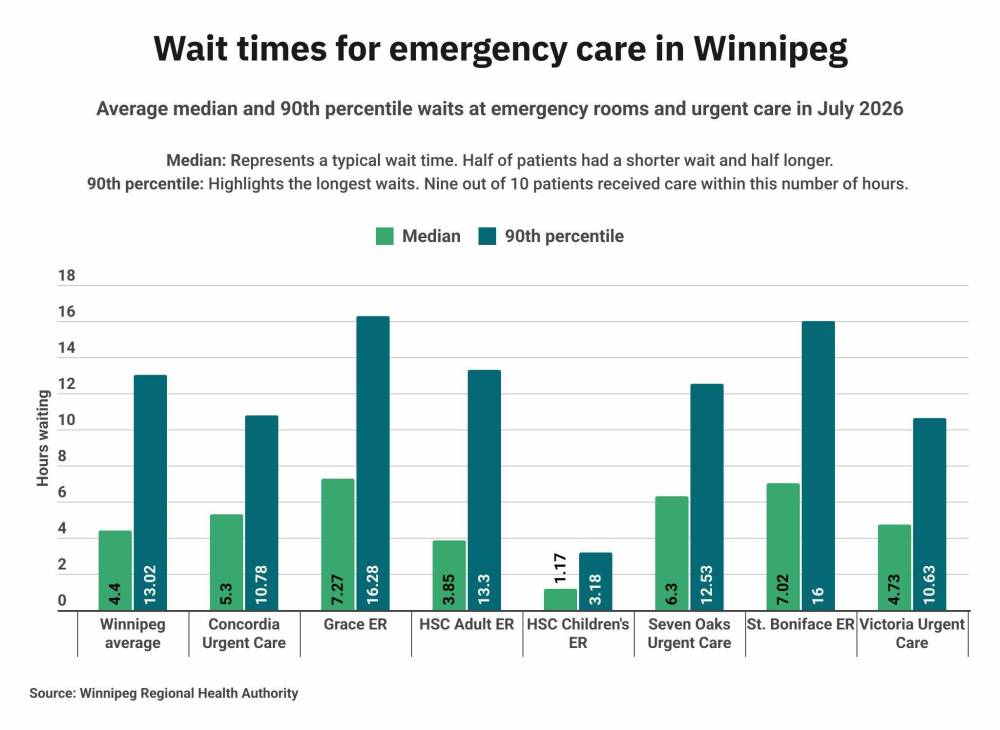
Grace Hospital had the longest wait time in July at 16.28 hours, up from 10.35 hours for the same month last year. St. Boniface Hospital had the second highest ER wait time at 16 hours.
The median wait time across all sites also increased in July, reaching 4.4 hours, up from 4.32 hours in June. That makes July the second-highest monthly median wait on record.
These wait times were unimaginable even a few years ago. And patient care is suffering, as a result.
The province says it’s attacking the problem from every possible angle. But if you talk to ER doctors and nurses, they’ll tell you they’re not seeing much evidence of that on the front lines.
The problem is that the system still lacks enough capacity to deal with the patients who need care — and, critically, enough capacity outside hospitals to move patients through the system, as I documented in a feature piece in the Free Press last weekend.
Anyone who spends time in a Winnipeg emergency department knows what happens.
Most emergency-room treatment areas are typically full. A significant proportion of the patients occupying those spaces are not actually waiting for emergency treatment. They have already been admitted to hospital.
They’re waiting for a bed on a medical ward. And they can wait there for days.
That creates a bottleneck that works its way backward through the entire system. When medical wards are full, admitted patients remain in emergency departments. When emergency departments are full, new patients arriving at the front door have nowhere to go.
The result is a waiting room packed with people who are sick, frustrated and increasingly desperate to get seen.
But the real problem often isn’t the emergency department, at all.
It’s the hospital bed upstairs. And sometimes it isn’t even the hospital bed upstairs. It’s the lack of somewhere else for patients on those wards to go.
Medical wards are routinely occupied by patients who no longer require acute-care treatment but can’t safely leave the hospital. They are waiting for what health-care administrators call an alternate level of care — a personal-care-home bed, assisted living, home care or some other community support.
If someone no longer needs a hospital bed but has nowhere else to go, the hospital bed is effectively lost to the system.
And when enough beds are lost this way, the emergency department becomes the waiting room for the entire health-care system.
You can’t squeeze more patients through the front door when there is nowhere for them to go once they’re inside.
The NDP government deserves some credit for trying to address some of the obvious problems. It has increased spending, hired more workers and pursued measures intended to improve patient flow.
But there is still no long-term strategy to dramatically increase the community-care capacity needed to unclog hospitals.
Where is the plan for substantially more personal-care-home beds? Where is the plan for expanding home care so more patients can safely return home? Where is the strategy for creating more assisted-living and supportive-housing options for people who don’t need a hospital but can’t live independently?
The government can’t simply keep adding pressure to the front end of the system and hope the congestion eventually clears. It needs to build far more capacity at the other end.
That means treating community care as health-care infrastructure, not as some optional social program that can be expanded when the budget allows.
A new hospital bed is of little use if the patient who occupies it can’t be discharged because there is nowhere appropriate for them to go.
And an emergency department can’t function properly if its treatment spaces are being used as overflow wards.
The July numbers should be more than another monthly embarrassment for government.
They should be a warning that the current approach isn’t working.

A 13-hour wait time should not be normalized. Neither should patients spending days in emergency departments waiting for hospital beds, or patients occupying hospital beds for weeks while waiting for community care.
There has been no shortage of political announcements promising that Manitoba’s health-care problems are being tackled from every direction.
But until government makes a serious, measurable commitment to expanding personal-care-home capacity, home care, assisted living and other community supports, the hospital bottleneck will remain.
And the emergency-room wait-time numbers will keep telling us what we already know: the system is full and there’s no sign of it getting better.
tom.brodbeck@freepress.mb.ca
Tom Brodbeck is an award-winning author and columnist with over 30 years experience in print media. He joined the Free Press in 2019. Born and raised in Montreal, Tom graduated from the University of Manitoba in 1993 with a Bachelor of Arts degree in economics and commerce. Read more about Tom.
Tom provides commentary and analysis on political and related issues at the municipal, provincial and federal level. His columns are built on research and coverage of local events. The Free Press’s editing team reviews Tom’s columns before they are posted online or published in print – part of the Free Press’s tradition, since 1872, of producing reliable independent journalism. Read more about Free Press’s history and mandate, and learn how our newsroom operates.
Our newsroom depends on a growing audience of readers to power our journalism. If you are not a paid reader, please consider becoming a subscriber.
Our newsroom depends on its audience of readers to power our journalism. Thank you for your support.
Tom Brodbeck is an award-winning author and columnist with over 30 years experience in print media. He joined the Free Press in 2019. Born and raised in Montreal, Tom graduated from the University of Manitoba in 1993 with a Bachelor of Arts degree in economics and commerce. Read more about Tom.
Tom provides commentary and analysis on political and related issues at the municipal, provincial and federal level. His columns are built on research and coverage of local events. The Free Press’s editing team reviews Tom’s columns before they are posted online or published in print – part of the Free Press’s tradition, since 1872, of producing reliable independent journalism. Read more about Free Press’s history and mandate, and learn how our newsroom operates.
Our newsroom depends on a growing audience of readers to power our journalism. If you are not a paid reader, please consider becoming a subscriber.
Our newsroom depends on its audience of readers to power our journalism. Thank you for your support.
Related Articles
At the city’s busiest fire and paramedic hall, first responders face a relentless workload




Advertisement Advertise With Us
Advertisement Advertise With Us