

So long to the roots of all evil
Commonwealth's shift to turf from grass for CFL's common good
Advertisement
Read this article for free:
or
Already have an account? Log in here »
To continue reading, please subscribe:

Digital Subscription
One year of digital access for only $205*
- Enjoy unlimited reading on winnipegfreepress.com
- Read the E-Edition, our digital replica newspaper
- Access News Break, our award-winning app
- Play interactive puzzles
*First annual payment billed as $205.00 + GST for one year. This annual subscription will automatically renew at $233.00 + GST every 52 weeks (10% off the regular annual price of $259.35). Offer available to new and qualified returning subscribers only. Cancel any time.
To continue reading, please subscribe:
Add Free Press access to your Brandon Sun subscription for only an additional
$1 for the first 4 weeks*
- Enjoy unlimited reading on winnipegfreepress.com
- Read the E-Edition, our digital replica newspaper
- Access News Break, our award-winning app
- Play interactive puzzles
*Your next Brandon Sun subscription payment will increase by $1.00 and you will be charged $17.95 plus GST for four weeks. After four weeks, your payment will increase to $24.95 plus GST every four weeks.
Read unlimited articles for free today:
or
Already have an account? Log in here »
Hey there, time traveller!
This article was published 16/03/2010 (5975 days ago), so information in it may no longer be current.
The football equivalent of the Berlin Wall has finally collapsed and come tumbling down.
There I was, web-surfing on slamsports.com — in the CFL category, of course — and I came across this poll question: "Do you think Commonwealth Stadium’s move to artificial turf is good for the Eskimos?"
I will always remember where I was when I learned that the evil empire of the CFL, the Edmonton Eskimos, had finally forfeited the biggest advantage in their home-field advantage — the grass.
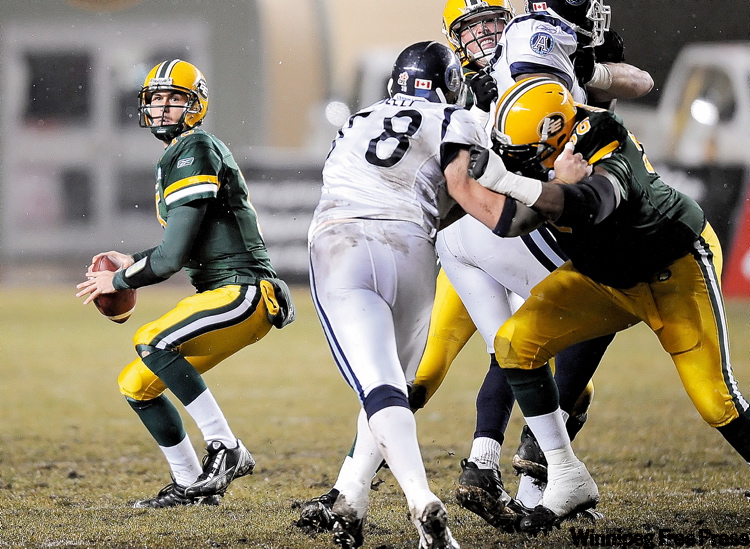
Back to the poll question: The majority of voters concluded that "No, grass is better," and I sat at my terminal wondering whether they meant "No, grass is a better playing surface," or "Oh no, grass is better for maintaining the Eskimos’ lopsided winning percentage at home." Hopefully, they inferred the latter, because the worst field in the history of pro football had to be good for at least a seven-point spread every game they played on it.
This may not seem like a big deal to you, hardly newsworthy, or worthy of the attention of an entire column. But it is, trust me.
Resurrection
It’s bigger than the Lions moving outdoors to a temporary resurrection of Empire Stadium this year. It’s way bigger than the first-ever regular-season game to be played in Atlantic Canada between the Argos and Eskimos.
And, in fact, I would put this revelation up there, consequence-wise, with the likes of, I dunno, removing the entire east-side stands behind the visitors’ bench at Canada Inns Stadium for the rest of this franchise’s history. Or the Alouettes playing with only their left arms for the duration of the season, or Henry Burris playing quarterback without those ridiculous red contact lenses in his eyes. You get my point.
It’s a huge loss to Edmonton.
Why, you may ask, is changing from a grass field to the kind of field turf every other team in the CFL uses a huge disadvantage for the Eskimos? Simple. Because almost every single player in the CFL, in my estimation, hated playing on the grass at Commonwealth Stadium, and thus hated travelling to Edmonton to play.
If it was nice outside, the field was as hard as concrete. If I had ever contemplated wearing volleyball knee pads under my own football knee pads and augmenting my arms with hockey elbow pads, it would have been for Commonwealth Stadium on a fine summer day when you would be better off wearing golf spikes than rubberized cleats.
If it was miserable outside, raining, sleeting, snowing, frozen, or otherwise, that field was virtually unplayable.
Well, unplayable in the sense that you had to cut your hard-charging athletic movements in half due to traction concerns, and your equipment manager had to put three different lengths, styles and widths of spikes on your shoes in an inverted V-shape, flock-of-geese pattern.
The field wasn’t something that could necessarily determine the outcome of the game, but when sports psychologists tell you that professional competition is 90 per cent mental and 10 per cent physical, and your brain tells you the field you are about to play on is complete horse $#%@, it’s fair to say there was a discernible, measurable outcome.
The urban myths about Commonwealth Stadium will forever live in the recesses of our minds where you keep things that annoy you no end, like people who don’t know how to merge and collective bargaining agreement negotiations.
Frigid temperatures
They say the City of Edmonton would purposely water the field the night before game day in frigid temperatures to ensure parts of it would be frozen the next day. In warmer conditions, the theory was that they let the grass grow so long that if it dried up, you could feed it to horses as hay.
That was to slow down your fastest players and play into the clutch, grab and smother style of their defence.

We were never allowed on the field the day before the game, as visiting teams are allowed in every other stadium. Often, the Commonwealth field crew would even padlock our access and lock us out entirely. Of course, the biggest urban legend was that this was fair play, because the Eskimo players did not practise on this field during the week and weren’t allowed on it until game day either.
But if we believed that story, how else could we justify so many of our losses at Commonwealth?
That they were simply better than us? I’m sticking with the secret deplorable-grass story. It helps me sleep at night in spite of so many memories of past defeats at the hands of the evil empire.
Doug Brown, always a hard-hitting defensive lineman and frequently a hard-hitting columnist, appears Tuesdays in the Free Press.
Related Articles
Mostly new faces on Bombers' coaching staff

Advertisement Advertise With Us
Advertisement Advertise With Us