Communication really is the key
Workshop aims to provide tools to strengthen relationships

Advertisement
Read this article for free:
or
Already have an account? Log in here »
To continue reading, please subscribe:

Digital Subscription
One year of digital access for only $205*
- Enjoy unlimited reading on winnipegfreepress.com
- Read the E-Edition, our digital replica newspaper
- Access News Break, our award-winning app
- Play interactive puzzles
*First annual payment billed as $205.00 + GST for one year. This annual subscription will automatically renew at $233.00 + GST every 52 weeks (10% off the regular annual price of $259.35). Offer available to new and qualified returning subscribers only. Cancel any time.
To continue reading, please subscribe:
Add Free Press access to your Brandon Sun subscription for only an additional
$1 for the first 4 weeks*
- Enjoy unlimited reading on winnipegfreepress.com
- Read the E-Edition, our digital replica newspaper
- Access News Break, our award-winning app
- Play interactive puzzles
*Your next Brandon Sun subscription payment will increase by $1.00 and you will be charged $17.95 plus GST for four weeks. After four weeks, your payment will increase to $24.95 plus GST every four weeks.
Read unlimited articles for free today:
or
Already have an account? Log in here »
Hey there, time traveller!
This article was published 17/01/2018 (3099 days ago), so information in it may no longer be current.
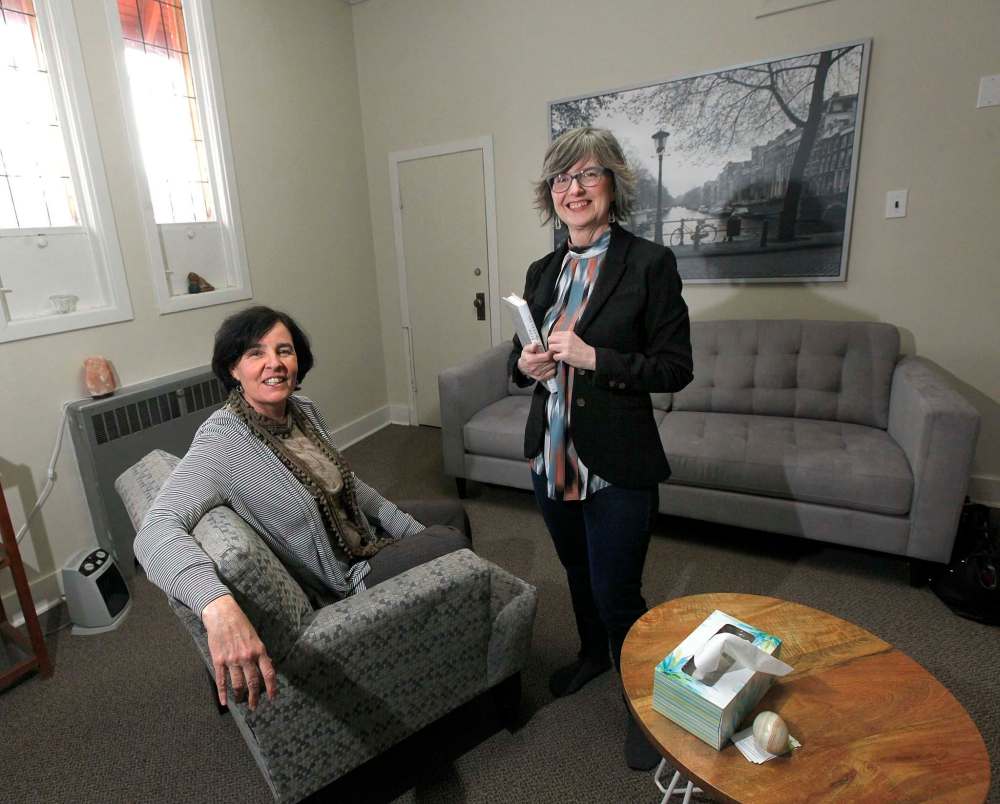
A few months ago, registered social workers Jennifer Sveinson and Lynn Crawford led a group session in which they posed a fill-in-the-blank question to the participants: “Relationships are… ?”
Some of the knee-jerk responses were illuminating, although not all that surprising to Crawford and Sveinson, who both have more than two decades experience.
“Confusing,” was one.
“Challenging” and “frustrating” were others.
“As we meet with people, we realized that the main thing they struggle with is in the everyday of relationships: at home, at work, with their siblings,” Crawford says. “And in their intimate world, their own struggle, their own thoughts.”
And so, Crawford decided she would hold a workshop to equip people with the tools to strengthen their bonds to each other and to themselves.
Co-facilitated by Sveinson, Transforming Relationships is a three-part series that will be delivered by Crawford over three consecutive Thursdays in February — Feb. 1, 8, and 15 — at Yoga at St. Marks (15 St. Mark’s Place).
Each two-hour session begins at 10 a.m., and those who would like to register can email ly.crawford@icloud.com. Cost for all three sessions is $155.
There’s been no shortage of articles bemoaning the fact that our relationships with smartphones have superseded our relationships with real live people.
We don’t talk to each other anymore, and when we do, it’s often text-based. We’ve become addicted to the dopamine high delivered by constant push notifications. We’re always distracted by shiny screens, even when we’re supposed to be enjoying the company of the friend in front of us — that is, if we haven’t already bailed on said friend via text.
But relationship woes don’t begin and end with the distractions afforded by technology. Insights into how we form and behave in relationships with one another can be found in our childhoods.
To that end, the first session of Transforming Relationships explores how our early attachments are formed, and how we might use that understanding to heal our relationships now.
“When we’re faced with difficulties in relationships, we have to look back at early childhood and see that, depending on what was going on — when there’s a lot of stress or conflict, or addictions in a home — important things related to relationships is impaired,” Crawford says. “For example, do you even perceive relationships as rewarding? It’s hard to invest in something if you don’t fundamentally believe it’s worthwhile.”
How we communicate in our relationships is also informed by our formative attachments.
“It does go back to early childhood,” Sveinson says. “In my work as a family therapist, the child or the adolescent was the patient — but as a family therapist I was seeing the whole family, and most of my work was with the parents. Because try as they might, they weren’t able to communicate and understand and support their young person because of their own history.
“We all experience the world through the lens of our childhood wounds. It wasn’t until they had that safe space to sit back and look at how they were wounded as a child that they could start to forgive themselves for not being a perfect parent.”
“If your state is one of blame and confusion, no matter what you want in your heart, you can’t communicate clearly if the pool is all muddy with your own sense of loss, wounding and longing for clarity,” Crawford adds.
“Clarity in communication comes when we ourselves see, ‘Oh, I didn’t ask or communicate clearly because I actually didn’t see it in my own upbringing.’”
The second session focuses on anxiety, how it affects relationships, and how to cope with it. The third session looks at self-esteem, as well as self-destructive behaviour.
Woven throughout all three sessions, Crawford says, is an emphasis on self-awareness and self-compassion. It’s difficult, after all, to forge healthy relationships with others if we don’t have healthy relationships with ourselves.
It can be tempting to retreat and escape into our own bubbles and not talk out our feelings or the feelings of those close to us — especially negative, messy, inconvenient feelings. Sveinson recalls a family she worked with that had 11 televisions in the house.
“It’s amazing how many families actually live in a fair amount of silence,” she says.
As well, constantly seeing everyone’s perfectly curated highlight reel on Instagram or Facebook might also convince us that we’re alone in our relationship problems — or serve as evidence that the “perfect” family or the “perfect” marriage exists somewhere. It doesn’t.
“That’s why we want to get people together to do this,” Sveinson says. “It’s not an individual issue. Being able to sit with other people and hear their struggles and start to let go of some of the shame you feel around your own challenges.”

So what makes for a good relationship? In Crawford’s view, it’s “when we offer time, attention, support, specificity — by that I mean we know very specific things about the other individual — and the last one is delight. That there’s a sense in the relationship that there’s something that’s just you that I can see.”
It sounds simple enough, but healthy relationships don’t just happen. They take consistent effort by people who are willing to show up, not just for each other, but for themselves.
“We called the sessions Transforming Relationships because we’re created in relationship, we’re maintained in relationship, and we’re healed in relationship,” Crawford says. “If you want good relationships, come back to the self. Do the work, because the payoff is going to be big.”
jen.zoratti@freepress.mb.caTwitter: @JenZoratti
Jen Zoratti is a columnist and feature writer working in the Arts & Life department, as well as the author of the weekly newsletter NEXT. A National Newspaper Award finalist for arts and entertainment writing, Jen is a graduate of the Creative Communications program at RRC Polytech and was a music writer before joining the Free Press in 2013. Read more about Jen.
Every piece of reporting Jen produces is reviewed by an editing team before it is posted online or published in print – part of the Free Press‘s tradition, since 1872, of producing reliable independent journalism. Read more about Free Press’s history and mandate, and learn how our newsroom operates.
Our newsroom depends on a growing audience of readers to power our journalism. If you are not a paid reader, please consider becoming a subscriber.
Our newsroom depends on its audience of readers to power our journalism. Thank you for your support.
Jen Zoratti is a columnist and feature writer working in the Arts & Life department, as well as the author of the weekly newsletter NEXT. A National Newspaper Award finalist for arts and entertainment writing, Jen is a graduate of the Creative Communications program at RRC Polytech and was a music writer before joining the Free Press in 2013. Read more about Jen.
Every piece of reporting Jen produces is reviewed by an editing team before it is posted online or published in print – part of the Free Press‘s tradition, since 1872, of producing reliable independent journalism. Read more about Free Press’s history and mandate, and learn how our newsroom operates.
Our newsroom depends on a growing audience of readers to power our journalism. If you are not a paid reader, please consider becoming a subscriber.
Our newsroom depends on its audience of readers to power our journalism. Thank you for your support.
Advertisement Advertise With Us
Advertisement Advertise With Us