

U of W falls back on tuition hikes amid budget crunch

Advertisement
Read this article for free:
or
Already have an account? Log in here »
To continue reading, please subscribe:

Digital Subscription
One year of digital access for only $205*
- Enjoy unlimited reading on winnipegfreepress.com
- Read the E-Edition, our digital replica newspaper
- Access News Break, our award-winning app
- Play interactive puzzles
*First annual payment billed as $205.00 + GST for one year. This annual subscription will automatically renew at $233.00 + GST every 52 weeks (10% off the regular annual price of $259.35). Offer available to new and qualified returning subscribers only. Cancel any time.
To continue reading, please subscribe:
Add Free Press access to your Brandon Sun subscription for only an additional
$1 for the first 4 weeks*
- Enjoy unlimited reading on winnipegfreepress.com
- Read the E-Edition, our digital replica newspaper
- Access News Break, our award-winning app
- Play interactive puzzles
*Your next Brandon Sun subscription payment will increase by $1.00 and you will be charged $17.95 plus GST for four weeks. After four weeks, your payment will increase to $24.95 plus GST every four weeks.
Read unlimited articles for free today:
or
Already have an account? Log in here »
The University of Winnipeg has joined other public post-secondary institutions across the province in hiking tuition rates by four per cent — as high as possible — for the fall.
Domestic fees are increasing by more annually in 2026-27 than they have in eight years in Manitoba.
International rates, which are unregulated and roughly four times those paid by their Canadian peers, are rising even higher.
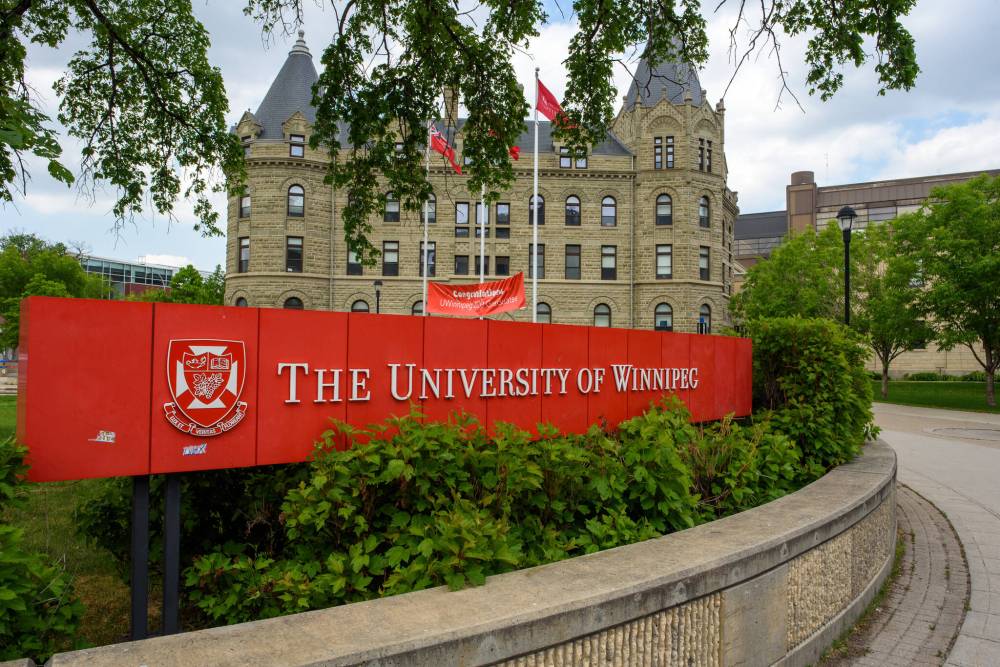
JESSE BOILY / FREE PRESS FILES
The University of Winnipeg’s board of regents approved a $180.7-million budget on June 22 that increases costs in undergraduate and graduate programs and hike tuition rates by four per cent for the fall.
U of W’s board of regents approved a $180.7-million budget on June 22 that increases costs in undergraduate and graduate programs and phases out “low rate” courses on the downtown campus.
“That was the only way we could balance the budget. If there was room, we would certainly try to find it,” interim president Jino Distasio said in an interview.
Distasio said faculties have scaled back discretionary spending and put in place vacancy management in preparation for another year of budget pressures.
Local university and college leaders have cited increasing wages, operating expenses and Ottawa’s annual restrictions on study permits, introduced in 2024-25, as key challenges heading into another school year.
Distasio noted that one- and two-year programs — many of which were run by the soon-to-be extinct Manitoba Institute of Trades and Technology — felt the impacts of the federal government’s caps “right away.”
“We’re trying to figure out what is the new normal for us. Is it 1,000 international students? Is it 800? Is it 15?” he said, noting U of W is known for its three- and four-year degree programs.
A total of 1,541 new and returning registrants made up its international student population this year. That’s 136 fewer students than one year earlier.
New undergraduate enrolment dropped nearly 40 per cent between the fall semesters in 2024 and 2025.
Criminal justice student Arpandeep Singh, who is originally from India, and other international students will pay 6.5 per cent more for tuition next year.
“Everything is increasing, day by day,” said Singh, the newly elected vice-president of student affairs at the University of Winnipeg Students’ Association.
U of W is launching a three-year plan, beginning this fall, to do away with low-cost courses for international students.
In order to find cost savings, a similar harmonization process began for domestic students last year. The tiered pricing system, which senior leadership indicated was outdated, confusing and often used arbitrarily, will cease to exist for them by the end of 2027.
Given many students already work multiple jobs to make ends meet and it is often challenging for international students to find work, the incoming changes could prove “significant” for some U of W students, Singh said.
He said his association has co-founded a new group, dubbed Manitoba Students, to brainstorm about campaigns to make post-secondary education more affordable.
(The Canadian Federation of Students’ local chapter and Manitoba Alliance of Post-Secondary Students have both scaled back their advocacy work in recent years.)
As far as the Manitoba Organization of Faculty Associations is concerned, the increasing reliance on tuition to balance budgets is cause for concern.
“It’s nothing more than privatization of higher education. I would go as far as saying that this type of tuition hike pushes us towards an American model. It’s the Americanization of post-secondary education,” association president Patrick Noël said.
Noël noted the percentage of government funding has been on the decline for decades. Student fees, donations and other “private” sources could surpass provincial and federal revenue on local campuses this year, he said.
The problem with that is post-secondary education is becoming increasingly inaccessible and students feel more entitled to higher grades when they pay higher prices, he added.
U of W’s interim president said his campus needs to look for new ways to support students as it adjusts to a new reality when it comes to international student revenue and tuition creeps up.
Manitoba’s 2026-27 domestic tuition cap is the highest since 2018-19. Last year, it was 3.5 per cent.
Advanced Education Minister Renée Cable was unavailable for an interview, but her office issued a statement touting Manitoba as home to “the lowest tuition rates in Western Canada.”
Cable said in a statement that tuition increases balance affordability and the current reality faced by post-secondary institutions is due to immigration policy changes. The Manitoba government’s 2026-27 budget topped up student loans by $11.6 million.
Newly released public salary compensation documents show the highest-paid post-secondary president in Manitoba ran the only local member of the U15, a group of Canada’s top research-intensive universities.
University of Manitoba president Michael Benarroch made $490,362 from Jan. 1 to Dec. 31, 2025.

Todd Mondor, who was abruptly removed from the helm of U of W at the end of November, earned $406,046.
Court documents indicate Mondor received both $52,038 in severance shortly after his termination, as well as nearly $800,000 in a lump sum payment in the new year.
He is suing his former employer over his termination, which Mondor alleges was done in a “misleading, callous, humiliating” way. University administration has appealed to the courts to have the case thrown out.
Distasio, who began teaching at the U of W about 30 years ago, was appointed interim president on Dec. 12. His 2025 salary was $220,532.
maggie.macintosh@freepress.mb.ca
Maggie Macintosh
Education reporter
Maggie Macintosh reports on education for the Free Press. Originally from Hamilton, Ont., she first reported for the Free Press in 2017. Read more about Maggie.
Funding for the Free Press education reporter comes from the Government of Canada through the Local Journalism Initiative.
Every piece of reporting Maggie produces is reviewed by an editing team before it is posted online or published in print — part of the Free Press‘s tradition, since 1872, of producing reliable independent journalism. Read more about Free Press’s history and mandate, and learn how our newsroom operates.
Our newsroom depends on a growing audience of readers to power our journalism. If you are not a paid reader, please consider becoming a subscriber.
Our newsroom depends on its audience of readers to power our journalism. Thank you for your support.
Maggie Macintosh
Education reporter
Maggie Macintosh reports on education for the Free Press. Originally from Hamilton, Ont., she first reported for the Free Press in 2017. Read more about Maggie.
Funding for the Free Press education reporter comes from the Government of Canada through the Local Journalism Initiative.
Every piece of reporting Maggie produces is reviewed by an editing team before it is posted online or published in print — part of the Free Press‘s tradition, since 1872, of producing reliable independent journalism. Read more about Free Press’s history and mandate, and learn how our newsroom operates.
Our newsroom depends on a growing audience of readers to power our journalism. If you are not a paid reader, please consider becoming a subscriber.
Our newsroom depends on its audience of readers to power our journalism. Thank you for your support.
Related Articles
Confusion part of syllabus as MITT winds down operations

Advertisement Advertise With Us
Advertisement Advertise With Us