Deficit of debate

Debt reduction not always the correct course of action

Advertisement

Advertise with us

Excerpt from Understanding the Manitoba Election 2019: Campaigns, Participation and Issues, edited by Royce Koop, Barry Ferguson, Karine Levasseur, Andrea Rounce and Kiera Ladner. The free ebook, produced by University of Manitoba Press, will be launched on Sept. 30 at McNally Robinson. It is available for download at: https://uofmpress.ca/election2019

Read this article for free:

or

Already have an account? Log in here »

To continue reading, please subscribe:

Subscribe and receive a limited-edition Free Press branded hat or tote.

Digital Subscription

One year of digital access for only $205*

  • Enjoy unlimited reading on winnipegfreepress.com
  • Read the E-Edition, our digital replica newspaper
  • Access News Break, our award-winning app
  • Play interactive puzzles

*First annual payment billed as $205.00 + GST for one year. This annual subscription will automatically renew at $233.00 + GST every 52 weeks (10% off the regular annual price of $259.35). Offer available to new and qualified returning subscribers only. Cancel any time.

To continue reading, please subscribe:

Add Free Press access to your Brandon Sun subscription for only an additional

$1 for the first 4 weeks*

  • Enjoy unlimited reading on winnipegfreepress.com
  • Read the E-Edition, our digital replica newspaper
  • Access News Break, our award-winning app
  • Play interactive puzzles
Start now

*Your next Brandon Sun subscription payment will increase by $1.00 and you will be charged $17.95 plus GST for four weeks. After four weeks, your payment will increase to $24.95 plus GST every four weeks.

Hey there, time traveller!
This article was published 28/09/2019 (2483 days ago), so information in it may no longer be current.

Excerpt from Understanding the Manitoba Election 2019: Campaigns, Participation and Issues, edited by Royce Koop, Barry Ferguson, Karine Levasseur, Andrea Rounce and Kiera Ladner. The free ebook, produced by University of Manitoba Press, will be launched on Sept. 30 at McNally Robinson. It is available for download at: https://uofmpress.ca/election2019

A spectre has been haunting Manitoba politics — the spectre of deficit reduction. This election cycle, both of Manitoba’s leading political parties campaigned on a promise to balance the provincial budget by 2024 or earlier. Though balancing the budget may seem like an uncontroversial, common-sense campaign promise, it necessarily reduces the space for ambitious campaign promises in the name of fiscal restraint. I posit that even though politicians frame a balanced budget as a politically neutral action, this policy is the foundation of a right-wing agenda which has been embraced by the Progressive Conservative Party and the New Democratic Party, despite the otherwise progressive rhetoric of the latter. To their credit, the federal Liberal Party ran a successful campaign in 2015 in part by committing to not balance the budget, but instead promising deficit spending to spur economic growth. I do not argue here that financial realities do not, nor should not, matter to Manitobans and their elected representatives. Rather, I hope to question the political rhetoric that is often posed as so obvious that it is beyond debate.

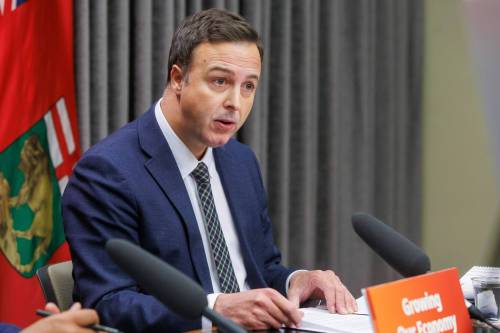
Progressive Conservative Leader Brian Pallister makes an announcement on lowering interest rates on small business tax claims. (Ruth Bonneville / Free Press files)

The logics of deficit reduction and fiscal responsibility have been entrenched in Manitoba politics through both concrete legislation and political rhetoric. Manitoba was one of the first provinces to introduce strong balanced-budget legislation in 1995 under Gary Filmon’s PC government. Though it was later relaxed by the NDP, and then suspended following the Great Recession in 2008, balanced-budget legislation was reintroduced by Pallister’s PC government as the Fiscal Responsibility and Taxpayer Protection Act in 2017. Coupled with legislation, the legitimization of deficit reduction can also be explained as a product of the centrist nature of Manitoba party politics, as identified by Jared Wesley. The neo-liberal tide sweeping Western governments captured political space in the electoral centre, and by the late 1980s and 1990s PC and NDP policies in Manitoba had converged on the values of government transparency, efficiency, tax reductions, and balanced budgets. The NDP’s acceptance of these values represents a rightward shift away from the progressive centre, despite their positioning as Manitoba’s centre-left party.

Prioritizing balanced budgets lends credence to the concern created by the PCs of a province with unsustainable debt, looming credit downgrades, and an economy in decay and decline. The Pallister government successfully ran on an austerity platform in 2016 by misrepresenting the health of Manitoba’s economy and trying to frighten Manitobans about the future of the province’s finances. Manitoba’s economy had, in fact, grown every year between 2000 and 2015, except in 2008 (due to the recession), although even then Manitoba’s GDP shrank the least out of all the provinces due to our generally diversified economy. Early into the Pallister government’s first mandate, researcher Lynne Fernandez observed that the rhetoric that Manitoba’s finances needed “fixing” and “repairing” was working as a cover to justify impending funding cuts to municipalities and the public sector. The PCs ran a similar campaign this election cycle, stressing that the province is getting its finances on track as long as the government continues to exercise fiscal restraint (coupled with the promise of tax cuts and the elimination of certain taxes).

Ideologically, it makes sense for a conservative party to pursue an election campaign based on deficit reduction and tax cuts. However, the NDP’s prioritization of a balanced budget above any more socially responsible campaign promises demonstrates that, despite their differences, there is a fundamental similarity between Manitoba’s two major political parties. When PC leader Brian Pallister promised to balance the budget by 2022 during a televised leader’s debate, modifying the PCs’ earlier promise of balancing the budget by 2024, the NDP response was tepid. NDP leader Wab Kinew raised concerns about what the PCs would cut to meet their new timeline, but he did not call the goal of deficit reduction into question, instead framing the NDP’s plan to balance the budget in four years as the more realistic option.

The lack of political push-back to the goal of balanced budgets is especially troubling at a time when Manitobans want, and would greatly benefit from, increased public spending. According to polling done by Probe Research, 62 per cent of Manitobans support increased government spending on services even if it means running a deficit for longer. Climate change strategies, especially upgrades to municipal infrastructure and the expansion of public transit, will require ambitious government spending. Reversing the unacceptably high rate of child poverty and Indigenous child poverty in Manitoba will require government spending. Protecting and expanding existing public services such as health care and education will require government spending. Improving income assistance so that those who require it can meet their needs and maintain a good quality of life will require government spending. As this election cycle demonstrated, the dogma of deficit reduction and fiscal restraint works to limit the political possibilities available to us all.

Born and raised in Winnipeg, Shreya Ghimire is currently completing her master of arts degree in political science at York University. Her areas of research are in Canadian political economy, Canadian aid policy, and gender and development.

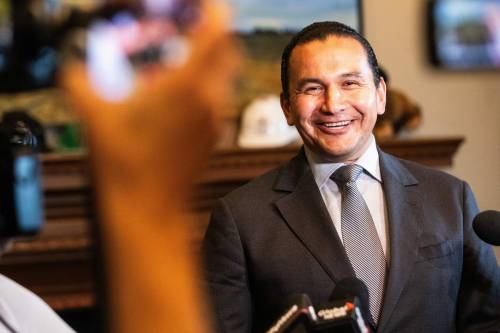
NDP Leader Wab Kinew hosts a roundtable discussion with a group of Winnipeg nurses to announce his platform commitment to the nursing industry at the Forth Cafe on Aug. 13. (Sasha Sefter / Free Press files)
Report Error Submit a Tip

More Stories

Police mum about final report on 10-day drug crackdown

Joyanne Pursaga 5 minute read Preview

Police mum about final report on 10-day drug crackdown

Joyanne Pursaga 5 minute read Yesterday at 6:19 PM CDT

Winnipeg police will not say whether results of the controversial 10-day crackdown on open drug use and drug trafficking that ended this month will be made public.

On Wednesday, Winnipeg Police Service said officials are still deciding whether or not to release the overall outcome of the operation, which took place from June 24 to July 3.

“We are reviewing both operational outcomes and community impacts, including valuable feedback provided by stakeholders. No final decisions have been made regarding reporting, future activities, or the release of results,” wrote Const. Dani McKinnon, in an email.

Mayor Scott Gillingham said the decision on whether to release the data is up to police, noting city council doesn’t have the power to direct law enforcement operations.

Read
Yesterday at 6:19 PM CDT

Snubbing wife’s desire for ‘sexercise’ not good sign

Maureen Scurfield 3 minute read Yesterday at 2:00 AM CDT

DEAR MISS LONELYHEARTS: With my encouragement, my chubby wife lost 45 pounds over the winter and spring. She also joined an all-female running group.

Last night she had the nerve to tell me she needs more sex as part of her physical rejuvenation. That turns me off somewhat — like I’m one of her exercise machines.

But if I don’t join her in her “more sex” campaign, would she be hurt and depressed and then gain back all the weight? She’s become really attractive-looking again, like she looked before she had our kids. She could actually probably get another guy if she tried.

If I knew she would become so sexual and demanding, I wouldn’t have bugged her to take the weight off. I was complaining about this to a friend I golf with, who is on his second wife and knows everything about cheating.

Report calls for schools to add more ‘sensory rooms’

Maggie Macintosh 5 minute read Preview

Report calls for schools to add more ‘sensory rooms’

Maggie Macintosh 5 minute read Updated: Yesterday at 9:34 AM CDT

Manitoba schools are being urged to set up more “sensory rooms” and use the spaces — which can feature mood lighting, flexible seating and fidget toys — to address growing concerns about student outbursts and related injuries.

A new report from the Manitoba Federation of Labour is renewing calls to better protect educational assistants, teachers and other public-sector employees.

One of its 10 recommendations, published on Monday, focuses on tackling overcrowding in community facilities and establishing “safe spaces in schools to respond to violence.”

“It’s become the norm: kids having meltdowns that require you have to evacuate the classroom,” said Jane Allison, an educational assistant in Winnipeg.

Read
Updated: Yesterday at 9:34 AM CDT

Manitoba Miracle forward signs five-year contract with club

Ken Wiebe 7 minute read Preview

Manitoba Miracle forward signs five-year contract with club

Ken Wiebe 7 minute read Yesterday at 5:45 PM CDT

Cole Perfetti is betting on himself. And the Winnipeg Jets are counting on him to take the next step in his development.

In what has been an interesting off-season to date, general manager Kevin Cheveldayoff knocked another important item off his to-do list as the Jets agreed to terms with Perfetti on a five-year contract that carries an average annual value of US$6 million.

Perhaps the most important part of this transaction was that it allowed the two sides to avoid going to arbitration next Monday, which would have been bad for business for both parties.

Although it’s easy to say that it’s just business, a one-year term in arbitration, no matter the amount, would have left neither side satisfied and it would have meant Perfetti was just one year away from the opportunity to explore unrestricted free agency.

Read
Yesterday at 5:45 PM CDT

Sheriff who died in train collision ‘loved everybody’

Tyler Searle 6 minute read Preview

Sheriff who died in train collision ‘loved everybody’

Tyler Searle 6 minute read Updated: Yesterday at 6:09 PM CDT

Brett Matheson-Maytwayashing was a loving father, hard-working sheriff and proud First Nations man who helped lead traditional ceremonies for a decade before he died in a collision with a train near Portage la Prairie.

Matheson-Maytwayashing, 27, died in the Tuesday morning crash, which occurred on a rural road west of Portage while he and another member of the sheriff’s service were on their way to attend court in Amaranth, his mother, Alissa Matheson-Maytwayashing, told the Free Press.

It was Matheson-Maytwayashing’s first day back at work after taking time off to participate in a sun dance ceremony in northern Saskatchewan last week, his mother said.

“Brett didn’t judge anybody, he would give people chances,” she said, her voice breaking. “He didn’t care what colour you were, he didn’t care your nationality — Brett just loved everybody.”

Read
Updated: Yesterday at 6:09 PM CDT

Deficit of debate

Shreya Ghimire 6 minute read Preview

Deficit of debate

Shreya Ghimire 6 minute read Saturday, Sep. 28, 2019

Excerpt from Understanding the Manitoba Election 2019: Campaigns, Participation and Issues, edited by Royce Koop, Barry Ferguson, Karine Levasseur, Andrea Rounce and Kiera Ladner. The free ebook, produced by University of Manitoba Press, will be launched on Sept. 30 at McNally Robinson. It is available for download at: https://uofmpress.ca/election2019

A spectre has been haunting Manitoba politics — the spectre of deficit reduction. This election cycle, both of Manitoba’s leading political parties campaigned on a promise to balance the provincial budget by 2024 or earlier. Though balancing the budget may seem like an uncontroversial, common-sense campaign promise, it necessarily reduces the space for ambitious campaign promises in the name of fiscal restraint. I posit that even though politicians frame a balanced budget as a politically neutral action, this policy is the foundation of a right-wing agenda which has been embraced by the Progressive Conservative Party and the New Democratic Party, despite the otherwise progressive rhetoric of the latter. To their credit, the federal Liberal Party ran a successful campaign in 2015 in part by committing to not balance the budget, but instead promising deficit spending to spur economic growth. I do not argue here that financial realities do not, nor should not, matter to Manitobans and their elected representatives. Rather, I hope to question the political rhetoric that is often posed as so obvious that it is beyond debate.

The logics of deficit reduction and fiscal responsibility have been entrenched in Manitoba politics through both concrete legislation and political rhetoric. Manitoba was one of the first provinces to introduce strong balanced-budget legislation in 1995 under Gary Filmon’s PC government. Though it was later relaxed by the NDP, and then suspended following the Great Recession in 2008, balanced-budget legislation was reintroduced by Pallister’s PC government as the Fiscal Responsibility and Taxpayer Protection Act in 2017. Coupled with legislation, the legitimization of deficit reduction can also be explained as a product of the centrist nature of Manitoba party politics, as identified by Jared Wesley. The neo-liberal tide sweeping Western governments captured political space in the electoral centre, and by the late 1980s and 1990s PC and NDP policies in Manitoba had converged on the values of government transparency, efficiency, tax reductions, and balanced budgets. The NDP’s acceptance of these values represents a rightward shift away from the progressive centre, despite their positioning as Manitoba’s centre-left party.

Read
Saturday, Sep. 28, 2019