

Endangered icons
Wooden grain elevators a disappearing sight on prairie horizon
Advertisement
Read this article for free:
or
Already have an account? Log in here »
To continue reading, please subscribe:
Monthly Digital Subscription
$1 per week for 24 weeks*
- Enjoy unlimited reading on winnipegfreepress.com
- Read the E-Edition, our digital replica newspaper
- Access News Break, our award-winning app
- Play interactive puzzles
*Billed as $4.00 plus GST every four weeks. After 24 weeks, price increases to the regular rate of $19.95 plus GST every four weeks. Offer available to new and qualified returning subscribers only. Cancel any time.
Monthly Digital Subscription
$4.99/week*
- Enjoy unlimited reading on winnipegfreepress.com
- Read the E-Edition, our digital replica newspaper
- Access News Break, our award-winning app
- Play interactive puzzles
*Billed as $19.95 plus GST every four weeks. Cancel any time.
To continue reading, please subscribe:
Add Free Press access to your Brandon Sun subscription for only an additional
$1 for the first 4 weeks*
*Your next subscription payment will increase by $1.00 and you will be charged $16.99 plus GST for four weeks. After four weeks, your payment will increase to $23.99 plus GST every four weeks.
Read unlimited articles for free today:
or
Already have an account? Log in here »
Hey there, time traveller!
This article was published 22/03/2021 (1869 days ago), so information in it may no longer be current.
The wooden grain elevator is known around the world as a symbol of Western Canada. For generations, any agricultural town of note had at least one elevator, and sometimes several.
Here in Manitoba, the number of elevators peaked at 745, in 1928. The number began to decline in the early 1960s, as railways started to abandon uneconomic branch lines. The pace of the decrease accelerated rapidly in the 1970s. Today, there are just 82 licensed commercial elevators in Manitoba. A few other elevators are used for local grain storage, but the total is less than 200, as deteriorating elevators are seen as a public safety hazard and are demolished. It is conceivable that, within our lifetimes, this once-ubiquitous Prairie icon will be gone.
Businessman William Hespeler built the first grain-storage structure in Manitoba. Constructed in 1879 using a distinctive circular design, Hespeler’s wooden structure looked remarkably like the steel granaries used on Manitoba farms today. The next generation used to store grain was the flat warehouse, an inefficient, horizontal building that saw its peak in the 1880s through early 1900s. The standard-plan wooden elevator — so called because it was built according to a standard set of specifications — appeared first at Gretna in 1881 and was predominant through the 20th century.
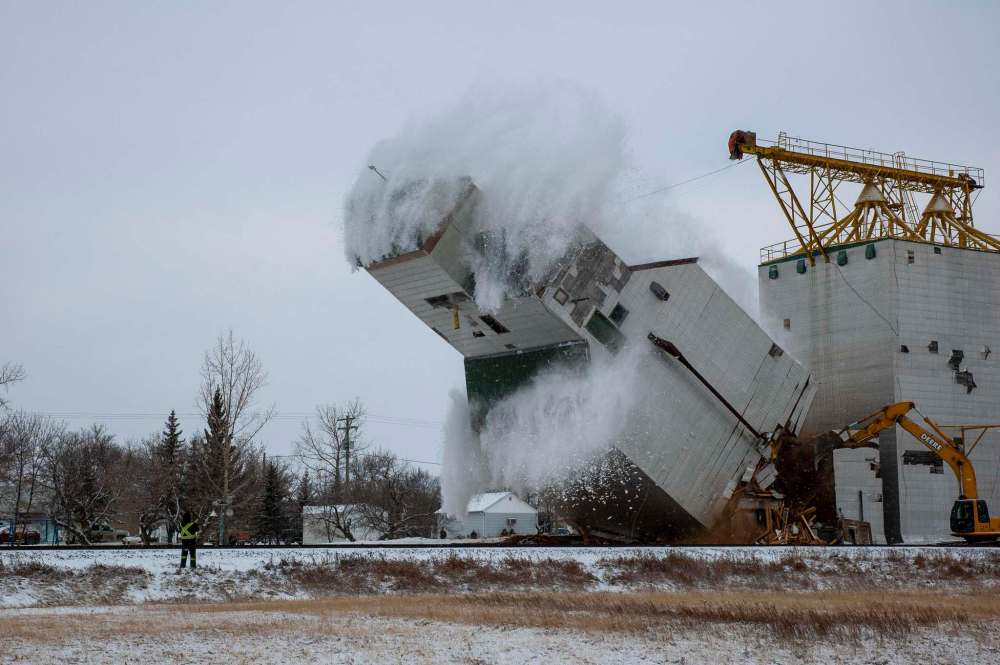
Today, the grain industry is dominated by a few huge elevators made of concrete or steel. Farmers must drive farther to deliver their grain to these sparsely distributed elevators. This means larger trucks, which in turn require better municipal and provincial roads. Improved roads and greater traffic lead to rural depopulation. Communities decline as rail lines are abandoned; small rural businesses close along with schools, churches and post offices.
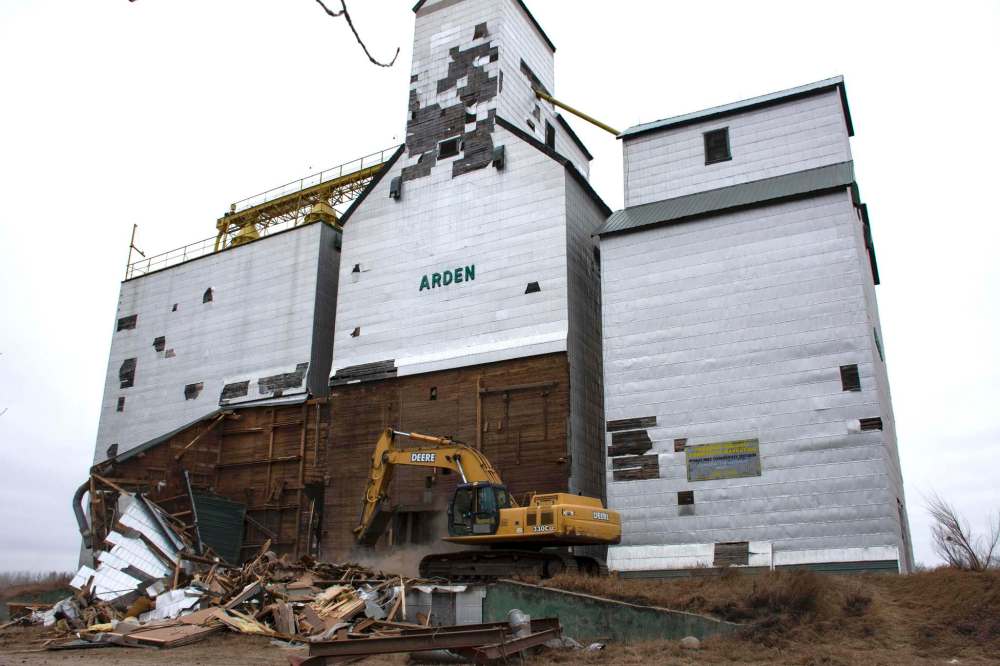
These days, when an elevator is closed by a grain company, it is demolished. Why is a perfectly good building, often only 20 or 30 years old, demolished rather than being offered for sale?
At one time, grain companies closing a rural elevator would be willing to sell to farmers for personal use. Today, many companies refuse to do so, because they do not want their former asset to become competition or because the railway on whose land the elevator stands will not allow the lease to be transferred. Railway companies are concerned about the risk of having deteriorating elevators adjacent to their lines if maintenance is neglected by small, private owners.
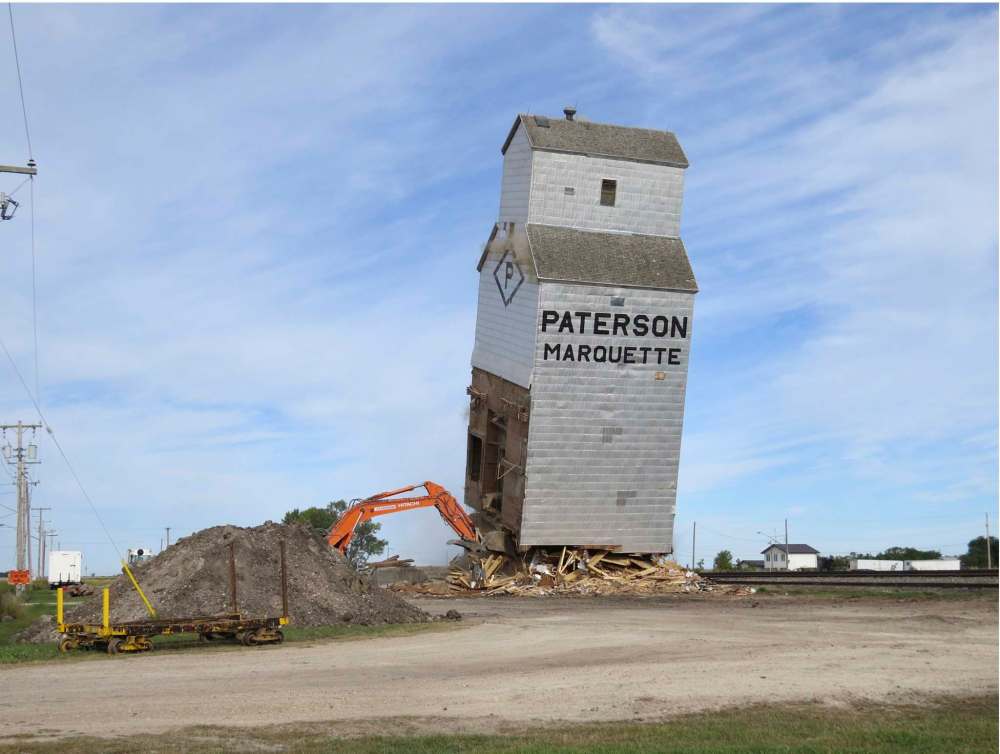
The result is that a few entrepreneurs are specializing in elevator demolition and have honed their technique so well that an elevator can be brought down in less than 30 minutes.
A few wooden elevators survive to remind us of the Golden Age from the 1920s to 1960s. The best preserved example is undoubtedly the row of five magnificent elevators at Inglis. Other elevators serve as local museums at Plum Coulee and the Manitoba Agricultural Museum near Austin.
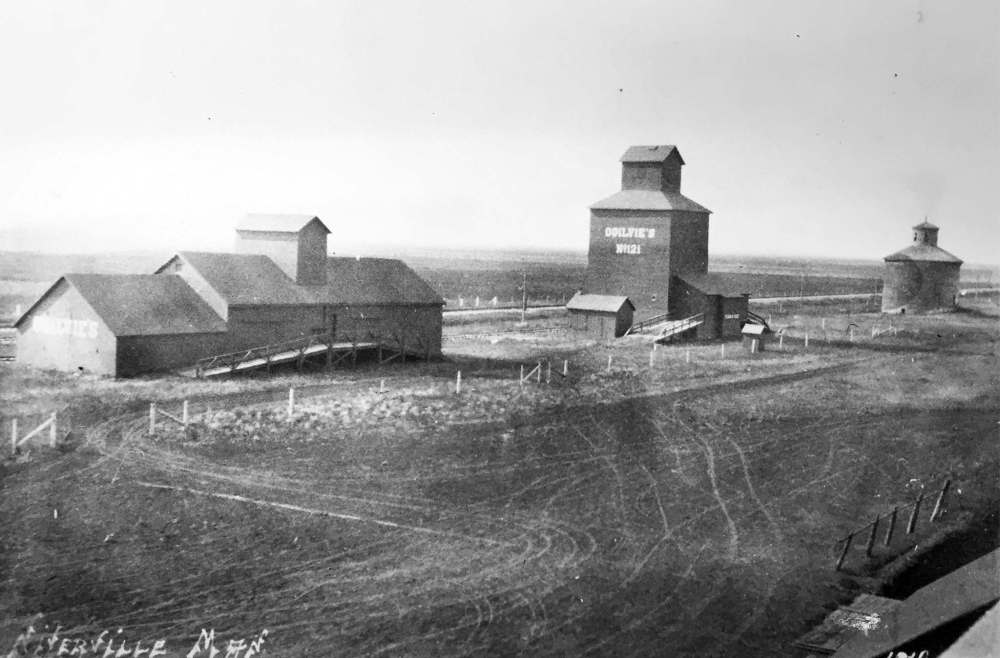

But there is something to be said for very old survivors. In 2010, a wooden grain elevator at Fleming, Sask., five kilometres west of the Manitoba border, was due to be designated as a national historic site. Built in 1895, it was Canada’s oldest standard-plan elevator still standing at its original site.
Unfortunately, in the wee hours of Feb. 9, 2010, the elevator was set on fire and destroyed. A Manitoba man was arrested, convicted of arson, and sentenced to two years in jail with a fine of $30,000. The second-oldest grain elevator in the nation then became the oldest. That elevator stands vacant in the Manitoba village of Elva, about seven miles southwest of Melita. Several lines of evidence suggest it was built in September 1897. Unfortunately, nobody seems interested in recognizing its historical significance. The oldest elevator in the nation is deteriorating rapidly and may fall victim to the vandal, the arsonist or the well-meaning safety advocate.
The Manitoba Historical Society maintains a “grain elevator countdown” on its website that shows an interactive map of Manitoba with all the remaining commercial wooden elevators. The total stands at 127 but it inches down month by month. Already, 2021 is shaping up to be a banner year for elevator demolition, with three torn down in the past month: two at Pierson and one at Winnipegosis.
Gordon Goldsborough is the president of the Manitoba Historical Society.
For more information or to become a member of the Manitoba Historical Society call 204-947-0559 or email: info@mhs.mb.ca. The MHS is on Facebook, Twitter and Instagram as manitoba-history. You can see more stories on our website at mhs.mb.ca.
Manitoba’s 10 oldest commercial standard-plan grain elevators
Location: Elva
Municipality: Two Borders
Builder: Lake of the Woods Milling
Year built: 1897
Location: Manitoba Agricultural Museum in Austin
Municipality: North Norfolk
Builder: Western Canada Flour Mills
Year built: 1901
Location: Cameron
Municipality: Two Borders
Builder: Lake of the Woods Milling
Year built: 1902
Location: Napinka
Municipality: Brenda-Waskada
Builder: Ogilvie Milling
Year built: 1902
Location: Kaleida
Municipality: Pembina
Builder: Ogilvie Milling
Year built: 1905
Location: Harmsworth
Municipality: Wallace-Woodworth
Builder: Lake of the Woods Milling
Year built: 1910
Location: Isabella
Municipality: Prairie View
Builder: Western Canada Flour Mills
Year built: 1910
Location: Purves
Municipality: Louise
Builder: Maple Leaf Milling
Estimated year built: 1910
Location: Woodland Hutterite Colony (original location — Grosse Isle)
Municipality: Woodlands (Rockwood)
Builder: Manitoba Elevator Commission
Year built: 1911
Location: McConnell
Municipality: Hamiota
Builder: Alfred S. Arnold
Year built: 1913
Related Articles
Grain elevators a nostalgic link to family farms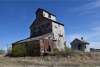
Advertisement Advertise With Us
Advertisement Advertise With Us
History
Updated on Monday, March 22, 2021 6:49 AM CDT: Styles factbox
Updated on Monday, March 22, 2021 6:57 AM CDT: Adds links