

Grain elevators a nostalgic link to family farms

Advertisement
Read this article for free:
or
Already have an account? Log in here »
To continue reading, please subscribe:
Monthly Digital Subscription
$1 per week for 24 weeks*
- Enjoy unlimited reading on winnipegfreepress.com
- Read the E-Edition, our digital replica newspaper
- Access News Break, our award-winning app
- Play interactive puzzles
*Billed as $4.00 plus GST every four weeks. After 24 weeks, price increases to the regular rate of $19.95 plus GST every four weeks. Offer available to new and qualified returning subscribers only. Cancel any time.
Monthly Digital Subscription
$4.99/week*
- Enjoy unlimited reading on winnipegfreepress.com
- Read the E-Edition, our digital replica newspaper
- Access News Break, our award-winning app
- Play interactive puzzles
*Billed as $19.95 plus GST every four weeks. Cancel any time.
To continue reading, please subscribe:
Add Free Press access to your Brandon Sun subscription for only an additional
$1 for the first 4 weeks*
- Enjoy unlimited reading on winnipegfreepress.com
- Read the E-Edition, our digital replica newspaper
- Access News Break, our award-winning app
- Play interactive puzzles
*Your next Brandon Sun subscription payment will increase by $1.00 and you will be charged $17.95 plus GST for four weeks. After four weeks, your payment will increase to $24.95 plus GST every four weeks.
Read unlimited articles for free today:
or
Already have an account? Log in here »
Hey there, time traveller!
This article was published 22/03/2021 (1877 days ago), so information in it may no longer be current.
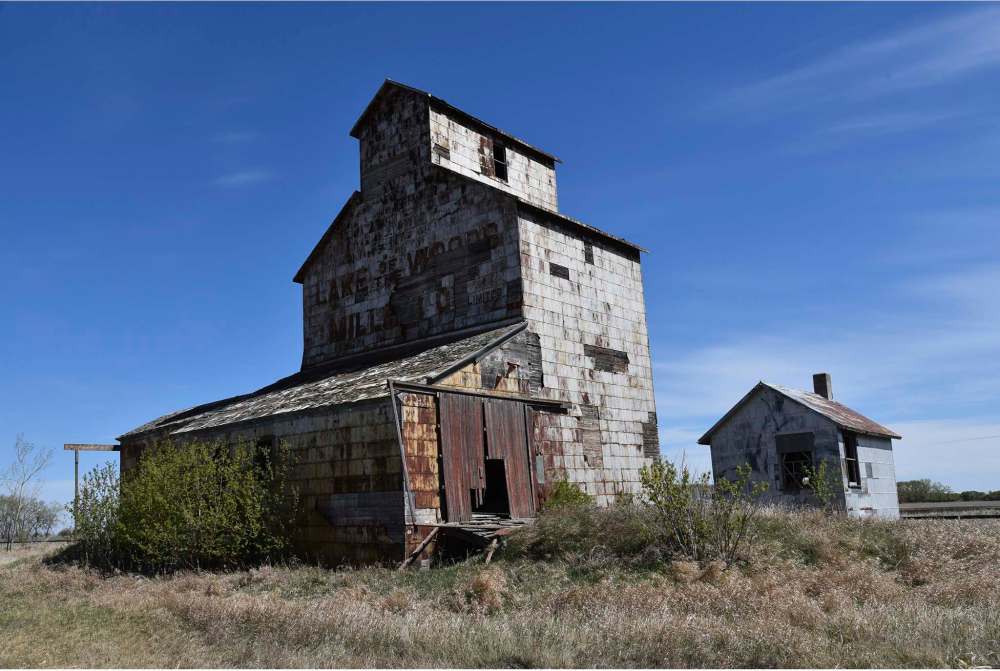
It’s easy to romanticize the Prairie grain elevator. These giant signposts of the West are evidence a community exists near the highway when people drive by.
A visit to one of the grain elevators in Radway, Alta., population 170, was a peek into a different world for a six-year-old farm kid. Radway had two pale green Alberta Wheat Pool elevators, faded by decades in the sun, and three United Grain Growers elevators, which were white with light blue lettering — farmer co-operatives from a bygone era.
There were train cars to see because Prairie grain elevators were built alongside railway lines, and big trucks were unloading grain.
It was 1973, and the elevator manager’s office was filled with charts, ledgers, books, carbon paper and small weigh scales. Sieves were used to filter chaff and weeds from grain samples to determine “dockage” from a farmer’s delivery. Playing cards and a cribbage board were set aside for slow times.
The manager would change storage bins by turning a big iron wheel, but there was also a hand-operated, one-man elevator that was not much more than a wooden plank and ropes; he would climb on and pull himself to the top of the structure to check if there was room.
There was grain dust everywhere.
There were also large “No Smoking” signs everywhere because these dusty, bone-dry, wooden buildings would go up in a flash if a stray spark or match fell to the floor.
The elevators were the tallest structures around until you got to the next town, Waskatenau, 12 kilometres further east on the rail line, or even smaller Egremont, about 15 km the other way.
Grain elevators were the GPS of the 1970s during family car trips. You could pass by a small town and find out where you were and how far there was to go by checking a roadmap. Millet, Alta., Marshall, Sask., Binscarth, Man.: the town’s name was always painted on the side of the elevator.
That old-fashioned GPS doesn’t work so well these days, as most small-town grain elevators are gone, either burned down or demolished.
The Canadian National Railway closed the line past Radway years ago, dooming the grain-delivery business in the village and its main enterprise.
One of the elevators remains as a museum, repainted with the logo of Krause Milling Co., which built the elevator in 1929.
Knocking down an elevator, or watching one burn to the ground, was and is sad news for rural communities. Much like the Bay’s shuttered downtown store in Winnipeg, they are landmarks and part of a town’s history, but there is a bigger economic issue. Each elevator gone means a bit more business has gone with it.
As much as grain elevators are a symbol of Western Canada, as the Manitoba Historical Society correctly says, they have also become a symbol of rural decline and the consolidation of family farms. There were 15,877 farms in Manitoba, according to the 2011 census, Statistics Canada’s latest figures, a 16.7 per cent drop from 2006. The average farm size shot up to 1,135 acres during the same time period, a 13.4 per cent increase.

Instead of driving three-ton trucks full of grain the few kilometres to the local elevator, farms — which have become small businesses owned by families rather than family farms — have upgraded to semi-trailer trucks or hire one out to ship 40 tonnes of grain at a time to Prairie elevators miles away to inland terminals, such as Winnipeg’s CentrePort.
That six-year-old farm kid eventually grew up and drove trucks to Radway’s elevator, but went to university in the big city, like so many other farm kids.
He went into newspapers, another business that clings to a romantic past that isn’t romantic, battles technological change and consolidation, yet continues to play an important part in people’s lives.
alan.small@freepress.mb.ca
Twitter:@AlanDSmall
Alan Small
Reporter
Alan Small was a journalist at the Free Press for more than 22 years in a variety of roles, the last being a reporter in the Arts and Life section.
Our newsroom depends on a growing audience of readers to power our journalism. If you are not a paid reader, please consider becoming a subscriber.
Our newsroom depends on its audience of readers to power our journalism. Thank you for your support.
Alan Small
Reporter
Alan Small was a journalist at the Free Press for more than 22 years in a variety of roles, the last being a reporter in the Arts and Life section.
Our newsroom depends on a growing audience of readers to power our journalism. If you are not a paid reader, please consider becoming a subscriber.
Our newsroom depends on its audience of readers to power our journalism. Thank you for your support.
Related Articles
Wooden grain elevators a disappearing sight on prairie horizon
Advertisement Advertise With Us
Advertisement Advertise With Us