Men: if your boys can’t swim, talk about it
Author hopes his journey with infertility will help others open up, seek help

Advertisement
Read this article for free:
or
Already have an account? Log in here »
To continue reading, please subscribe:
Digital Subscription
One year of digital access for only $1.44 a week*
- Enjoy unlimited reading on winnipegfreepress.com
- Read the E-Edition, our digital replica newspaper
- Access News Break, our award-winning app
- Play interactive puzzles
*Billed as $5.77 plus GST every four weeks. After 52 weeks, price increases to the regular rate of $19.95 plus GST every four weeks. Offer available to new and qualified returning subscribers only. Cancel any time.
To continue reading, please subscribe:
Add Free Press access to your Brandon Sun subscription for only an additional
$1 for the first 4 weeks*
- Enjoy unlimited reading on winnipegfreepress.com
- Read the E-Edition, our digital replica newspaper
- Access News Break, our award-winning app
- Play interactive puzzles
*Your next Brandon Sun subscription payment will increase by $1.00 and you will be charged $17.95 plus GST for four weeks. After four weeks, your payment will increase to $24.95 plus GST every four weeks.
Read unlimited articles for free today:
or
Already have an account? Log in here »
Hey there, time traveller!
This article was published 20/04/2021 (2015 days ago), so information in it may no longer be current.
In 2009, Winnipeg author Jon Waldman and his wife Elana set out on what would become a six-year journey through infertility.
The couple started trying for a baby about a year and a half after getting married in 2007. After nearly a year, Elana got pregnant — but the happy news was soon replaced by heartache: Elana suffered a miscarriage at eight weeks.
Medical histories were teased apart. Tests were done to determine female-factor infertility, male-factor or both. Ultimately, the answer was unsatisfying: mixed factor but unexplained infertility (a frustratingly common diagnosis). “We started to look at corrective pieces for myself, there was a low motility in my sperm, which thankfully because it wasn’t in a red zone or absolutely nil, I was able to correct it with change of diet, change in exercise etc.,” Waldman says.
Ultimately, the couple went to a fertility clinic in Victoria, B.C. and Elana got pregnant after a successful round of in-vitro fertilization. But the anxieties don’t end with getting pregnant; they turn to staying pregnant. “But sure enough, in July 2015, we had our baby girl.”
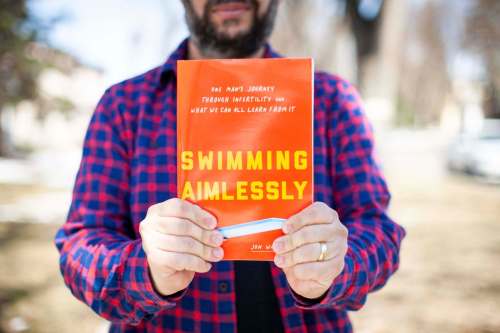
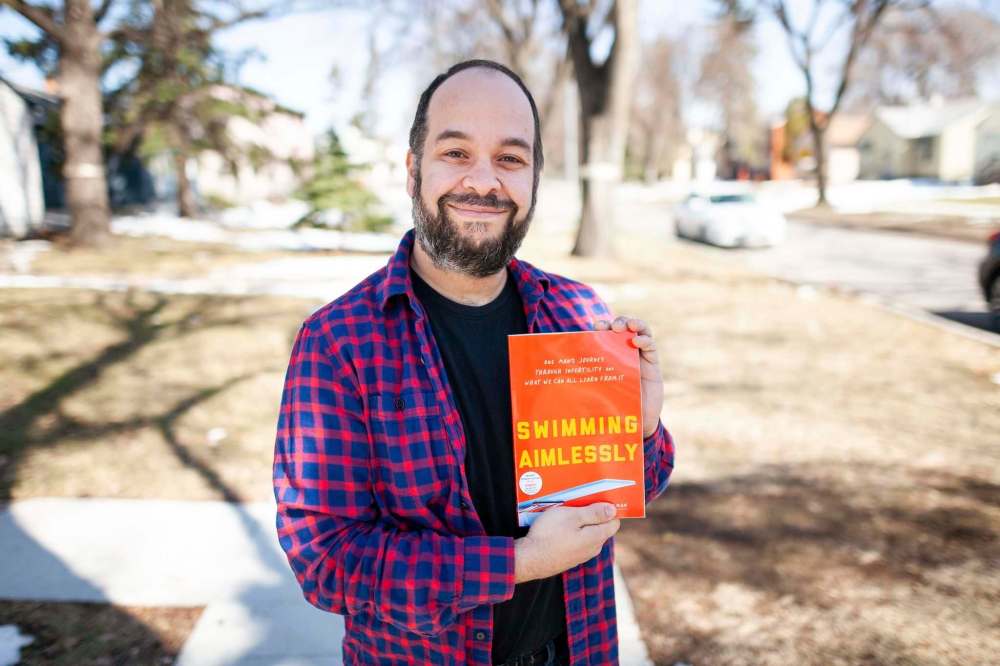
Waldman’s story is the launch pad for his latest book, Swimming Aimlessly: One Man’s Journey Through Infertility and What We Can All Learn From It, which was released last month via Tiller Press, an imprint of Simon & Schuster. Waldman, 41, will officially launch the book at a McNally Robinson-hosted virtual event on Wednesday, April 21 at 7 p.m. — smack-dab in the middle of Canadian Infertility Awareness Week.
Pink toys crowd the frame of Waldman’s Zoom chat window, and while his own journey resulted in fatherhood, he recognizes not everyone’s does. That’s why he didn’t just want to tell his story in Swimming Aimlessly.
“If I’m doing a book on male infertility, it has to be done as fully as I can,” he says. “I can’t depend on my story. It has to be as many different points of view and as many different points of articulation as possible.”
That realization led to Waldman speaking to other men, other couples, doctors, and fertility experts to write a guidebook for a journey with few such texts. Swimming Aimlessly delves into everything from feelings of shame, isolation and inadequacy to the financial, physical and emotional toll of infertility.
Before Waldman wrote a book on the subject, he was something of a reluctant spokesman for male infertility. “I found that there just weren’t a lot of guys who were talking,” he says. There weren’t a lot of Facebook groups; at the support groups he attended with his wife, there was a distinct “I’m just here for my partner” vibe among the men. So, Waldman decided to start talking — he did his first interviews anonymously — and keep talking about it. In 2017, he got up on stage and delivered a TEDx Winnipeg talk called Swimming Aimlessly: Getting Men To Talk About Infertility.
Humour, perhaps not surprisingly, is both an entry point into a difficult subject and a coping mechanism for Waldman. The title, Swimming Aimlessly, is a riff on George Costanza’s famous Seinfeld outburst — “my boys can swim!” — and the book’s use of humour makes its subject matter approachable.
“The one thing that you’ll find with anybody who’s in infertility is any sort of censor goes out the window,” he says. “When the central part of your life involves human sexuality, you go very quickly from from TGIF on ABC, to Comedy Central roast.”
One of the things Waldman wants people to realize is that, even if the process ends in a baby, the infertility journey is ongoing. Many couples do not become parents; others grapple with what’s known as secondary infertility, or the inability to get pregnant or carry a pregnancy to term a second time. Waldman still feels a pang when people announce a pregnancy, that twinge of “Why couldn’t it have been that easy for us?”
He’d like to see more research into male-pattern infertility, as well as more support for parents navigating the system in general. But crucially, he wants men to start opening up to one another about their struggles with infertility.
“I think in general, men just don’t talk about anything,” he says. “The stereotype is ‘men don’t talk.’ And in a way, it’s true in that men primarily talk, especially amongst other men, about very high-level things, very superficial things like sports and entertainment, home renovations, your family — if you have one. You don’t get into a lot of conversations between men about the deeper things. You have to be extremely close to a guy, and the receiver has to be open to those conversations about be it fertility, be it other health concerns, be it deep financial troubles.”
Waldman suspects this has to do with generations of men being told to buck up, get back in the game, don’t cry, and, perhaps most damaging of all, “man up.” Swimming Aimlessly, then, can serve as an antidote to that silencing messaging.

“This is an element of toxic masculinity, traditional masculinity, that people talk about, but it’s not one that’s talked about enough: how men treat other men, and how men perpetuate this idea that you have to be closed off, that you have to be this pillar of robotic strength,” he says.
“You don’t have to be. It’s OK to talk. It’s OK to to let your emotions out.”
To register for Wednesday night’s book launch, visit http://wfp.to/G11
jen.zoratti@freepress.mb.ca
Twitter: @JenZoratti
Jen Zoratti is a columnist and feature writer working in the Arts & Life department, as well as the author of the weekly newsletter NEXT. A National Newspaper Award finalist for arts and entertainment writing, Jen is a graduate of the Creative Communications program at RRC Polytech and was a music writer before joining the Free Press in 2013. Read more about Jen.
Every piece of reporting Jen produces is reviewed by an editing team before it is posted online or published in print – part of the Free Press‘s tradition, since 1872, of producing reliable independent journalism. Read more about Free Press’s history and mandate, and learn how our newsroom operates.
Our newsroom depends on a growing audience of readers to power our journalism. If you are not a paid reader, please consider becoming a subscriber.
Our newsroom depends on its audience of readers to power our journalism. Thank you for your support.
Advertisement Advertise With Us
Advertisement Advertise With Us