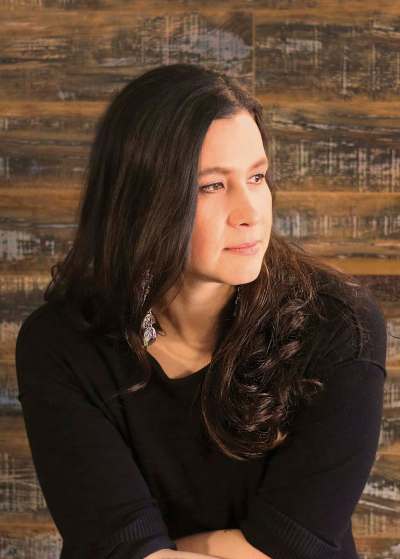
Family matters
Community of women fight for survival in Winnipegger's stunning new novel
Advertisement
Read this article for free:
or
Already have an account? Log in here »
To continue reading, please subscribe:

Digital Subscription
One year of digital access for only $205*
- Enjoy unlimited reading on winnipegfreepress.com
- Read the E-Edition, our digital replica newspaper
- Access News Break, our award-winning app
- Play interactive puzzles
*First annual payment billed as $205.00 + GST for one year. This annual subscription will automatically renew at $233.00 + GST every 52 weeks (10% off the regular annual price of $259.35). Offer available to new and qualified returning subscribers only. Cancel any time.
To continue reading, please subscribe:
Add Free Press access to your Brandon Sun subscription for only an additional
$1 for the first 4 weeks*
- Enjoy unlimited reading on winnipegfreepress.com
- Read the E-Edition, our digital replica newspaper
- Access News Break, our award-winning app
- Play interactive puzzles
*Your next Brandon Sun subscription payment will increase by $1.00 and you will be charged $17.95 plus GST for four weeks. After four weeks, your payment will increase to $24.95 plus GST every four weeks.
Read unlimited articles for free today:
or
Already have an account? Log in here »
Hey there, time traveller!
This article was published 08/10/2021 (1830 days ago), so information in it may no longer be current.
Although it’s impossible to read The Strangers without hearing everywhere the haunting echoes of The Break, Winnipeg writer Katherena Vermette’s award-winning debut, the many-voiced narration of this second novel will instantly command readers’ attention, whether they have read The Break or taken in other Vermette work — poems, graphic novels, documentary film, children’s books — or not.
That’s because from its opening pages, The Strangers, which made the 2021 Giller Prize long list, as well as the five-book short list for the Atwood Gibson Writers’ Trust Award, speaks, starkly and eloquently, as if directly to the community of readers it creates. “Speaks,” whether in the first or third person, whether the character is a girl, an old woman, an auntie or a mother or a daughter, because Vermette has an uncanny ear for the rhythm and the cadences of all her characters’ voices — internal, on the street, in jail, in a dark bar, or at the dinner table.
Always compelling, these voices are angry, sad, pained, loving, yearning, despairing and, occasionally, hopeful. The narrative develops through brief episodes, none longer than 20 pages, principally through the lives of four characters: Phoenix, her sister Cedar, their mother Elsie, and Elsie’s mother, Margaret — four generations of women of the Stranger family, a Métis clan whose experience stretches back to life in the bush and forward to their embattled life in the city.

All of them are imprisoned within the institutionalized racism of jails, hospitals, schoolyards, adoptive families and/or the (mostly) white men and women who control their lives. Against this array of prohibitive constrictions, the Stranger women cleave to or long for the love and hope and comfort of extended family — even as drugs, crime, estrangement and violence tear at their bonds.
That violent, jarring force of separation begins on the first page as Phoenix, incarcerated for crimes never fully revealed in The Strangers, goes into painful labour in a dire institutional setting. She will have to give up her baby as soon as it is born. The language that Vermette has Phoenix speak in — tellingly, the most explosively profane in the novel’s chorus — is strikingly guttural but genuine. Phoenix names her baby Sparrow, after her sister, who died shockingly young; both Sparrows haunt the narrative with yet another layer of loss.
Vermette’s inspired ventriloquism probes every facet of her characters’ fight for survival: mothers like Elsie struggle to kick their addictions; daughters like Phoenix to re-establish connections with her sister; and grandmothers like Margaret, daughter herself of Annie, the matriarch, to reach across several generations through mere force of will, for which she pays a steep price.
All of the characters cleave to or rebel from their roots in the extended family that descends from and precedes Annie, the matriarch; through Annie, Vermette recreates, with clear-eyed love, a nuanced portrait that gives us Annie’s every contradictory facet. And through Annie and her descendants, Vermette gives us, unvarnished, the conflicted tones of their Métis language and heritage. They are not Aboriginal. They are not white. They are not French, or English. They speak from and occupy a distinctive embattled space, and they know it. Vermette’s keen apprehension of this space — beginning with its language — underwrites every scene.
The narration culminates in the voice and experience of Cedar, Phoenix’s sister, living with a mixed family — her biological father, from whom she has long been estranged, and his narcissistic and neurotic, if well-meaning, wife. Like Margaret before her, Cedar fights to climb out of her circumstances; unlike Margaret, who ultimately fails, Cedar closes out the novel with a gesture of hope set amidst the masks and distancing of the pandemic lockdown.


This ending feels a bit rushed — the only minor flaw in a searing and stunning performance. Vermette is still in the early years of her vocation; thankfully, her formidable narrative powers continue to grow.
Neil Besner taught Canadian writing for 30 years at the University of Winnipeg.