Art inextricably linked with challenges of everyday life

Advertisement
Read this article for free:
or
Already have an account? Log in here »
To continue reading, please subscribe:

Digital Subscription
One year of digital access for only $205*
- Enjoy unlimited reading on winnipegfreepress.com
- Read the E-Edition, our digital replica newspaper
- Access News Break, our award-winning app
- Play interactive puzzles
*First annual payment billed as $205.00 + GST for one year. This annual subscription will automatically renew at $233.00 + GST every 52 weeks (10% off the regular annual price of $259.35). Offer available to new and qualified returning subscribers only. Cancel any time.
To continue reading, please subscribe:
Add Free Press access to your Brandon Sun subscription for only an additional
$1 for the first 4 weeks*
- Enjoy unlimited reading on winnipegfreepress.com
- Read the E-Edition, our digital replica newspaper
- Access News Break, our award-winning app
- Play interactive puzzles
*Your next Brandon Sun subscription payment will increase by $1.00 and you will be charged $17.95 plus GST for four weeks. After four weeks, your payment will increase to $24.95 plus GST every four weeks.
Read unlimited articles for free today:
or
Already have an account? Log in here »
Hey there, time traveller!
This article was published 22/04/2023 (1267 days ago), so information in it may no longer be current.
“You have to listen to what isn’t being said,” advises a character in this whisper-quiet comedy-drama from Kelly Reichardt.
That’s basically the key to watching the American art-house writer-director’s films (First Cow, Certain Women, Old Joy), which are slow and patient and so unemphatic that it’s often only in hindsight — after some brief moment of beauty and connection — that you realize how much you’ve already been given.
Showing Up is set in Portland, Ore., at a small art school and in the neighbourhood around it, a place of pleasantly rundown houses and overgrown yards.
Lizzy (the miraculous Michelle Williams), an artist who also works at the school office, is trying to prepare for a gallery show that’s opening in a few days. She makes small, wildly coloured ceramic figures caught in moments of free, expressive movement. She calls them “her girls,” and they seem to be all the things the self-contained, slightly depressed Lizzy is not.
Trying to get down to a last push of work, Lizzy keeps getting sidetracked by little domestic issues — by a demanding cat, a wounded bird, by family problems. At one point, her office mate asks her if she has any dental floss, which seems like a throwaway line but concisely demonstrates how Lizzy is the person other people go to when they need something.
On top of this, Lizzy’s townhouse has no hot water, which is making a bad week worse. Her landlord, Jo (Hong Chau), is a fellow artist preparing for two shows of her own, and — unlike Lizzy — Jo refuses to be interrupted. It’s through this gently tragicomic tussle over a hot-water tank that Reichardt represents the complicated interconnections of everyday life and art.
Williams, who has worked with Reichardt in Wendy and Lucy, Meek’s Cutoff and Certain Women, pulls off a performance that is both minimalist and loaded with meaning and unexpressed emotion.
Reichardt, co-scripting with Jonathan Raymond, presents Lizzy’s difficulty in concentrating on her own artistic practice with patient, low-key observation but without obvious direct comment. Is it an admirable selflessness, a tendency to self-martyrdom, a perverse form of procrastination, or some combo of all three?
Allyson Riggs / A24 Michelle Williams stars in Showing Up.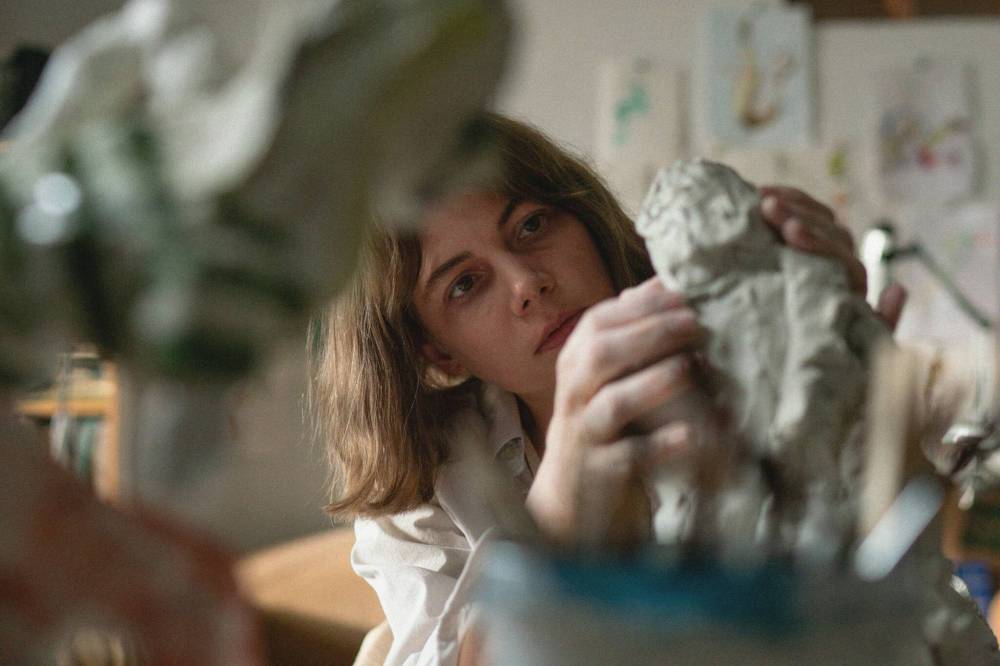
Reichardt hints — again, just barely — at the dynamics of Lizzy’s family. Her mother (Maryann Plunkett), a school administrator, and her father (Judd Hirsch), a retired ceramicist, are acrimoniously divorced.
Her brother (John Magaro) is struggling with mental illness, something her parents respond to with various forms of avoidance and denial. In a compressed concluding scene, we understand how Lizzy stands at the centre of all this, how she might have come to take on the worries of the world.
Mostly, though, we get the granular textures and subtle rhythms of workaday life. Reichardt’s films can feel naturalistic, even a little scruffy and shaggy, but when you look closely, you can see she is handling time and space with conscious, crafted care.
Take the film’s art school setting, which offers a constantly shifting background buzz of creativity, skill and labour. As Lizzy walks to lunch, we see the ceramics kids waiting anxiously to see what comes out of the kiln, the textile students weaving and dying, the painters and video artists doing their things.
Films set in art schools often tend to snarky satire, and though Reichardt does convey some minor rivalries and resentments, this is mostly a generous, affectionate evocation of art school and all the work that goes into art-making.
And while Reichardt is not making some Big Statement about art and artists — she’s not that kind of filmmaker — Showing Up could be read as a sideways rebuke, an understated comic tweak, of the way artistic creation has conventionally been seen on screen. Often artist biopics fetishize art making as the solitary, single-minded expression of a (generally male) genius, with the artist so wrapped up in his encounter with paint and canvas that his family, his friends, the entire world could go up in flames and he’d just keep on painting. Of course, there’s often a much-put-upon spouse behind him, seeing to the banal business of ordinary life.
Lizzy has only herself, but as the film suggests in a final scene that’s suffused with melancholy and just a gleam of muted hope, that could be enough.
alison.gillmor@freepress.mb.ca
Studying at the University of Winnipeg and later Toronto’s York University, Alison Gillmor planned to become an art historian. She ended up catching the journalism bug when she started as visual arts reviewer at the Winnipeg Free Press in 1992.
Our newsroom depends on a growing audience of readers to power our journalism. If you are not a paid reader, please consider becoming a subscriber.
Our newsroom depends on its audience of readers to power our journalism. Thank you for your support.
MOVIE REVIEW
Showing Up
Starring Michelle Williams
● Dave Barber Cinematheque
● 108 minutes, 14A
★★★★ stars out of five
Studying at the University of Winnipeg and later Toronto’s York University, Alison Gillmor planned to become an art historian. She ended up catching the journalism bug when she started as visual arts reviewer at the Winnipeg Free Press in 1992.
Our newsroom depends on a growing audience of readers to power our journalism. If you are not a paid reader, please consider becoming a subscriber.
Our newsroom depends on its audience of readers to power our journalism. Thank you for your support.
Advertisement Advertise With Us
Advertisement Advertise With Us