Nature and plenty of nurture Year-round cultivation, co-ordination and creativity behind Assiniboine Park's summer splendour
Read this article for free:
or
Already have an account? Log in here »
To continue reading, please subscribe:

Digital Subscription
One year of digital access for only $205*
- Enjoy unlimited reading on winnipegfreepress.com
- Read the E-Edition, our digital replica newspaper
- Access News Break, our award-winning app
- Play interactive puzzles
*First annual payment billed as $205.00 + GST for one year. This annual subscription will automatically renew at $233.00 + GST every 52 weeks (10% off the regular annual price of $259.35). Offer available to new and qualified returning subscribers only. Cancel any time.
To continue reading, please subscribe:
Add Free Press access to your Brandon Sun subscription for only an additional
$1 for the first 4 weeks*
- Enjoy unlimited reading on winnipegfreepress.com
- Read the E-Edition, our digital replica newspaper
- Access News Break, our award-winning app
- Play interactive puzzles
*Your next Brandon Sun subscription payment will increase by $1.00 and you will be charged $17.95 plus GST for four weeks. After four weeks, your payment will increase to $24.95 plus GST every four weeks.
Read unlimited articles for free today:
or
Already have an account? Log in here »
Hey there, time traveller!
This article was published 02/06/2023 (1215 days ago), so information in it may no longer be current.
The grass in the park glistens an electric almost-impossible-to-believe-your-eyes green.
A cloud of blush petals sway against the luminous blue sky; in the English Garden the Rosybloom crabapple tree is in full splendour.
Flowerbeds are ablaze with colour: pink-kissed petals of dianthus; sunrise lantanas; white pentas, and lavender salvia flash brightly against the rich loam.
RUTH BONNEVILLE / WINNIPEG FREE PRESS
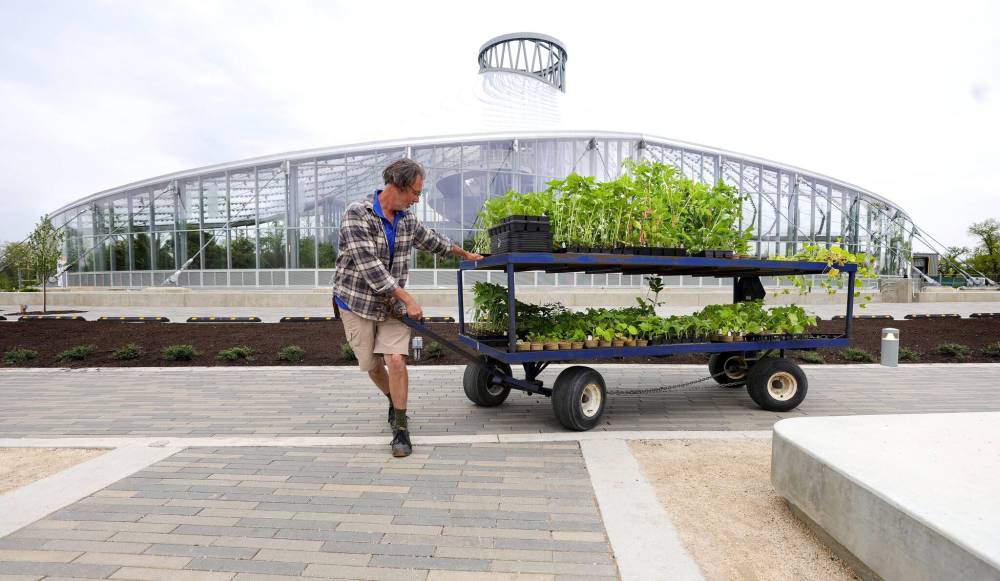
Outdoor garden supervisor Craig Gillespie tows a wagon full of vegetables to be planted in the Kitchen Garden.
Weeks of warmer weather coupled with soft, spring rain have done their job: life is once again blossoming in the Assiniboine Park Conservancy.
It’s May 23, the day after the long weekend, and Assiniboine Park is a hive of activity. The ground has finally warmed up and clusters of seasonal gardeners are busy weeding, tilling and raking the soil in preparation for outdoor planting.
Trowels, shovels, rakes and spades are all in employ as teams toil to transfer more than 70,000 new plants from the greenhouse to the garden beds.
The 400-acre park, which includes the 80-acre zoo, is composed of five signature gardens: the Leo Mol Sculpture Garden; the English Garden; the Streuber Family Children’s Garden (located in the Nature Playground); the Pollinator Garden; and Gardens at The Leaf. The latter, which was completed two years ago, boasts six themed areas: the Indigenous Peoples Garden, Kitchen Garden, Sensory Garden, Performance Garden, Seasonal Garden and the arboretum, the Grove.
Dotted around the rest of the space are approximately 230 individual plant beds and 337 planters, which include hanging baskets.
Nurturing everything is a collaborative effort.
Outdoor garden supervisor Craig Gillespie and greenhouse lead gardener Kerry Witherspoon and their teams have been working hard to get things ready for summer.
But long before the gardeners can get their hands in the soil, park manager of operations Kurtis Johnson and his grounds department have to clean things up.
They get going as soon as the snow begins to melt, clearing pathways for water to travel through and removing winter messes such as sand and debris.
RUTH BONNEVILLE / WINNIPEG FREE PRESS
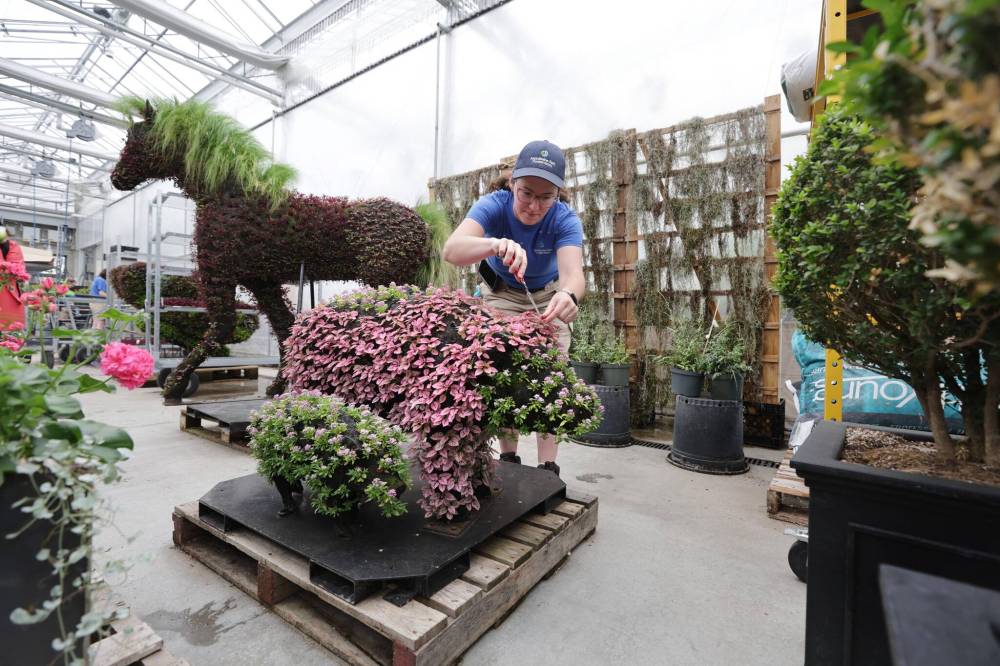
Greenhouse lead gardener Kerry Witherspoon clips blooms from one of their mosaic cultured sculptures in the form of a pig inside the greenhouse.
As temperatures rise the turf grass starts showing signs of life.
Spring showers have sprouted more than just summer flowers and the lush green is growing fast.
The grounds department maintains approximately 150 acres of turf areas and this year the team has developed precise mowing plans based on priorities and public usage.
“We are right now mowing every day, different parts of the park, to keep up,” Johnson says.
Plans for this summer’s blooming began as far back as last autumn when Gillespie prepared the layout of the season’s plantings with Wade Meisner, the conservancy’s curator of horticulture.
“We look at a number of things: what is the perennial of the year, what is the annual of the year, what is the herb of the year. And then there is also colour of the year. We take all these things into consideration. I talk to each of the area crew leads and get input from them about what worked and what didn’t, and we try to incorporate all these things into our plans,” Gillespie explains.
Not all the plants are grown on site — some are shipped in from nurseries — so the team has to make sure orders are placed in time.
Before any new plants or seeds can ordered, the duo examines the park’s database of permanent trees, shrubs, and perennials. From there they decide if more should be added. After that, “high impact spots,” such as the park’s signature gardens, are tackled by plotting out planting plans of annuals and perennials for each individual garden bed. It’s a big job.
MIKAELA MACKENZIE / WINNIPEG FREE PRESS
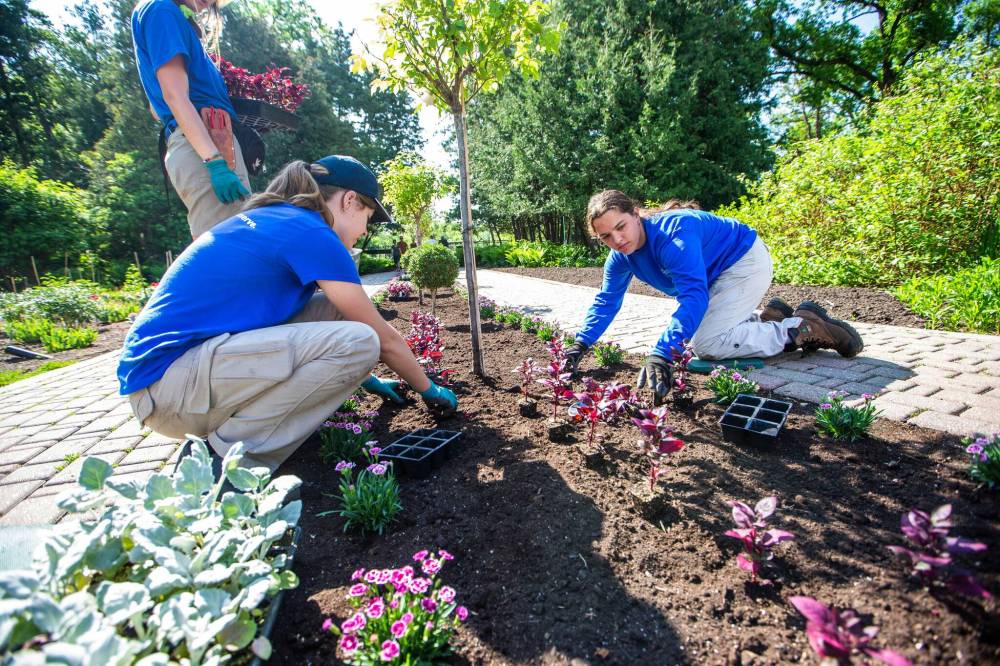
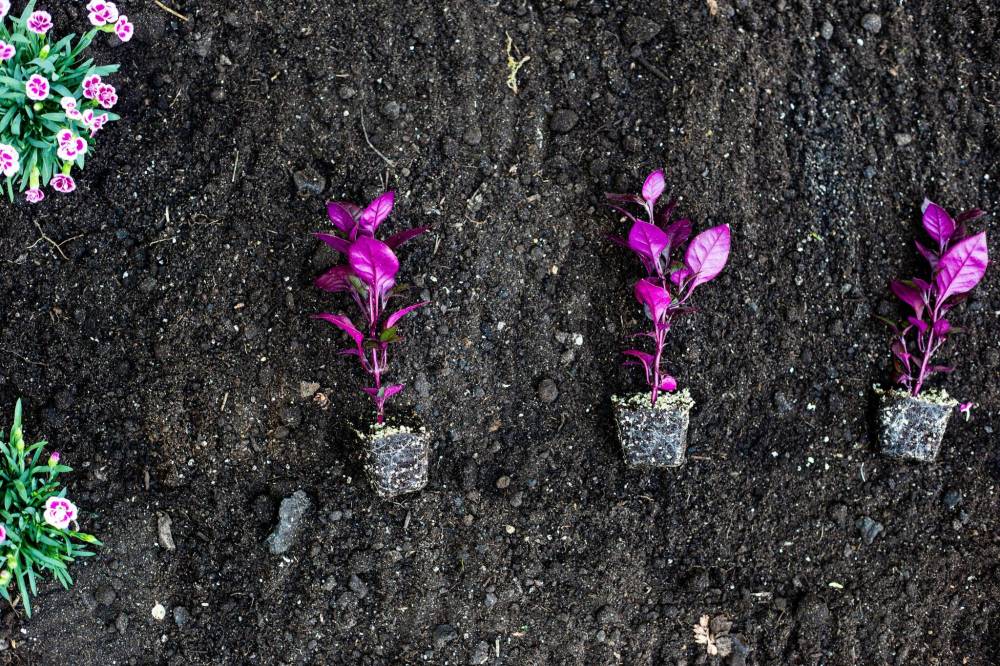
Olivia Fast (left) and Morgan Wabick place Purple Prince Alternanthera in the English Gardens.
“Once we finalize the plants, I give Wade a list of where everything is scheduled to go and we get our drawings created, which he does on AutoCAD (computer-aided design software),” Gillespie says.
In January, the orders start coming through to Witherspoon in the greenhouse.
She begins by seeding plants and tending to speciality cuttings such as verbenas, petunias and coleus brought in from commercial conservatories.
Her task is to ensure the plants survive Manitoba’s subzero cold. She takes care of them in the temperature and humidity controlled greenhouse, making sure the plants that need heat remain warm while others, such as roses and boxwood topiary that need to lie dormant in the cold season, don’t freeze to death.
In summer, the opposite is true. Peak summer temperatures can slow plant growth, so keeping them cool is priority. The greenhouse’s roof is designed to be opened up, allowing fresh air to circulate through the space. Watering is also key.
“Plants have a very set range of temperatures they are comfortable in. They don’t do well in the extremes,” she says. “Best watering times are in the morning, and if it’s really hot we water in the afternoon to make they can survive the rest of the day.”
Activity ramps up towards the end of March and into April when annual bedding plants, trees and shrubs from suppliers start arriving.
The greenhouse is bursting at the seams.
Outside in the horticulture yard, Witherspoon, clipboard in hand, checks off shipments as they roll in and out of the space. It’s her job to make sure the plants get to where they need to go.
MIKAELA MACKENZIE / WINNIPEG FREE PRESS
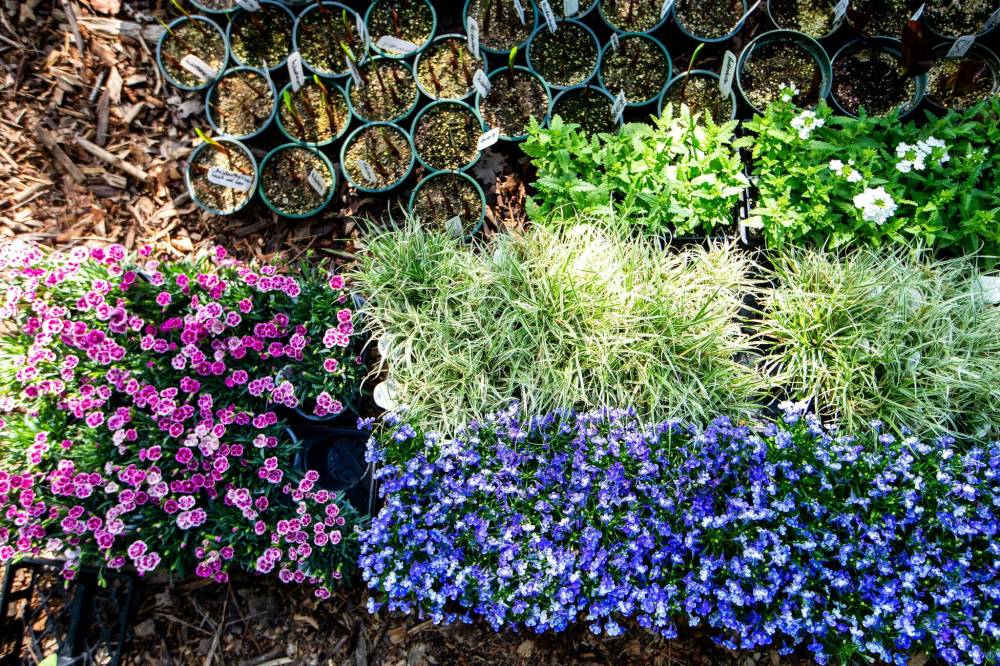
Seedling plugs are ready for planting.
Behind her, sets of large planters, grouped into themes and colours and filled with flowers and shrubs, wait to be moved to their respective locations across the park.
Small pots of herbs, radish and tomato plants on the back of a truck trundle off in the direction of the Kitchen Garden.
“Craig will give me lists of things to pull for an order and I put them on carts for his team to take. They do the plants bed-by-bed and as they go through their planting, they send through their requests,” Witherspoon says.
With all the moving — and growing — parts, organization is key.
“You have to be into record-keeping in this job”, Witherspoon laughs. “I don’t think the general public thinks a lot about behind the scenes logistics, so most of what we do doesn’t occur to people. There’s a lot of planning and work that no one ever sees, but they can appreciate the final product by enjoying the gardens.”
Witherspoon and her team are also in charge of creating the park’s mosaiculture sculptures.
Made from metal frames, the form is packed with soil bags that are attached in pieces.
Witherspoon then plants more than 1,0000 individual plants of five or six different varieties using a special tool that is able to pierce the tough fabric. Plants are chosen based on whether they can spread out across the frames.
MIKAELA MACKENZIE / WINNIPEG FREE PRESS
Purple Prince Alternanthera wait to be planted.
“We want plants that can be trimmed. You want them to continue to grow bigger instead of taller so it’s really important the type you pick,” she explains as she works on Conney B, a horse-shaped frame being planted with living grass and flowers. Nearby, Sweet Pea, a pig, and Petunia, a piglet, wait to be transported to Aunt Sally’s farm exhibit at the zoo.
Outdoor planting generally takes place the day after the May long weekend. The ground has warmed up enough for the annuals and seasonal gardeners are out in force. But Manitoba’s mercurial climate is still very much a worry.
“I have waited on things — I think it’s safe to say that we are past the frost, although June 9 is the historic last frost day,” Gillespie says.
If the temperature changes drastically and frost makes an appearance then he’ll be here first thing, before dawn, rinsing it off with a hose.
“I’d come in around 3.30 a.m. to do this. And then I’d cover them up with fleece sheets,” he says.
Luckily it doesn’t look like he’ll have to do that this year, which is fortunate as there are other things on his plate.
There’s new staff to train, a recent shipment of plant material to look over, more beds to fill, more perennials to tamp down, and so much more weeding, tilling and raking to be done.
“At this time of year you’re seeing the bones of the garden. It takes a little bit of heat and some nice rain for everything to bloom,” he says.
He works long days, often starting shortly after 5 a.m. and remains on site until 3 p.m., and often much later. His mind is never far from the garden.
MIKAELA MACKENZIE / WINNIPEG FREE PRESS
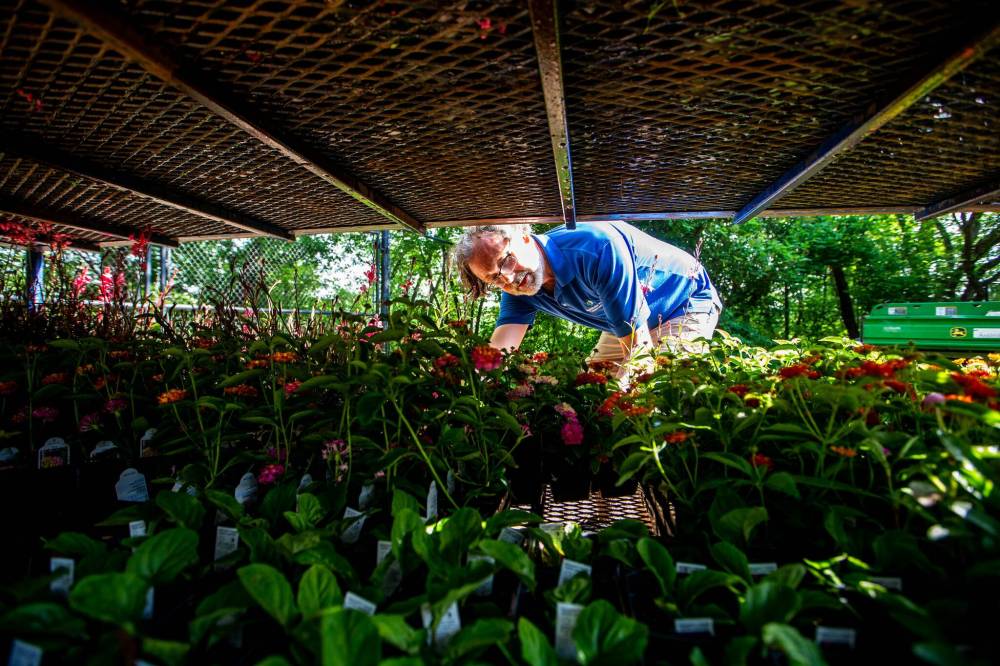
Craig Gillespie, supervisor of outdoor gardens at Assiniboine Park, picks up seedling plugs to plant in the English Gardens.
“I would get here even earlier if I could,” he says, entirely seriously. “I’m always thinking about the plants.”
This is his 14th season at Assiniboine Park, and he knows every inch of it like the back of his hand. When not whizzing about on a golf cart, mini truck or Gator utility vehicle, he’s walking close to a marathon a day — more than 40 kilometres five days a week, keen eyes ever on alert.
He can tell, just by looking at a plant, how well it’s doing, or not doing.
“First, we inspect the conditions the plant is growing in. It may be as simple as adjusting the amount of water the plant is getting. Then a visual inspection for pests.
“I’ve worked in the park going on 14 years, and have yet to resort to a pesticide. For example, with scarlet lily beetles, we visually inspect our lilies, and hand pick and squish any beetles. It is a case-by-case decision — if we determine a plant is diseased and may infect other plants, it is removed,” he says.
This year, for the first time, Gillespie has sowed four different types of wheat in the Kitchen Garden: two are ornamental and will be used to weave baskets, while two others are for consumption.
When the wheat is ready to be harvested, it will be threshed and then milled into flour, which he hopes to use to make pizza dough, with tomatoes, peppers and basil from the garden as toppings. He plans to fire his pies in the garden’s outdoor oven as a treat for his team.
He’s also thinking of growing Pattypan squash again.
RUTH BONNEVILLE / WINNIPEG FREE PRESS
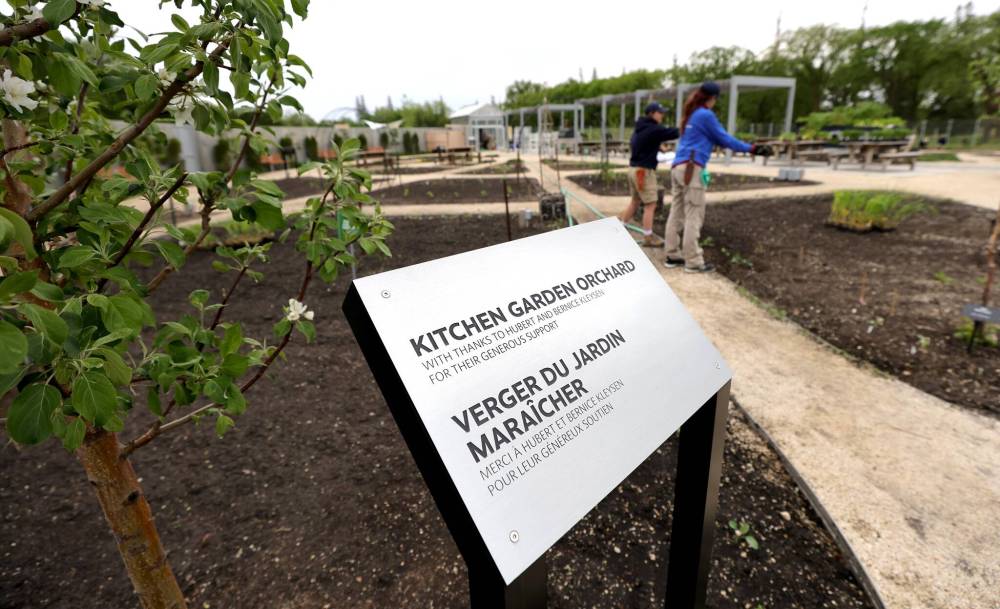
The Kitchen Garden is one of six themed areas outside the Gardens at The Leaf. The outdoor themed areas opened in 2021.
“There are certain crops that are good for the animals in the zoo. The squash was such a hit last year, so we are doing them again this year. The tortoise loved them; you could almost see a smile on his face he was enjoying it so much,” Gillespie says.
Eighty per cent of the Kitchen Garden is replanted annually and almost all of its plants are edible. Fruit trees, grown on the espalier wall, are already showing signs of blossom.
“We are on Year 3 on these trees, eventually there will be big gnarly woody limbs growing flat,” Gillespie says.
The trees bloom sooner than they would if they were planted out in the open. The hardy varieties seem to be doing well and Gillespie has to train them to adapt to specific spacing on limbs.
“The don’t want to always agree,” he laughs, whipping out his secateurs to prune misbehaving leaves.
Even as work on this season’s plantings go on all around, Gillespie is already thinking of next summer. His goal is to have the 2024 plan completed in September when the wholesale suppliers produce a list of what new is going to be on offer next year.
“We have to have things in place, otherwise you miss out,” he says. “Our final order doesn’t go in until January, but we are planning as we can see what is succeeding and what isn’t in the gardens. It’s tough to rely on photos and memories when everything is covered in snow.”
That’s still a long way off.
On this May day, crews are on their hands and knees pulling weeds out by their roots and transferring new plants from the carts to the beds.
RUTH BONNEVILLE / WINNIPEG FREE PRESS
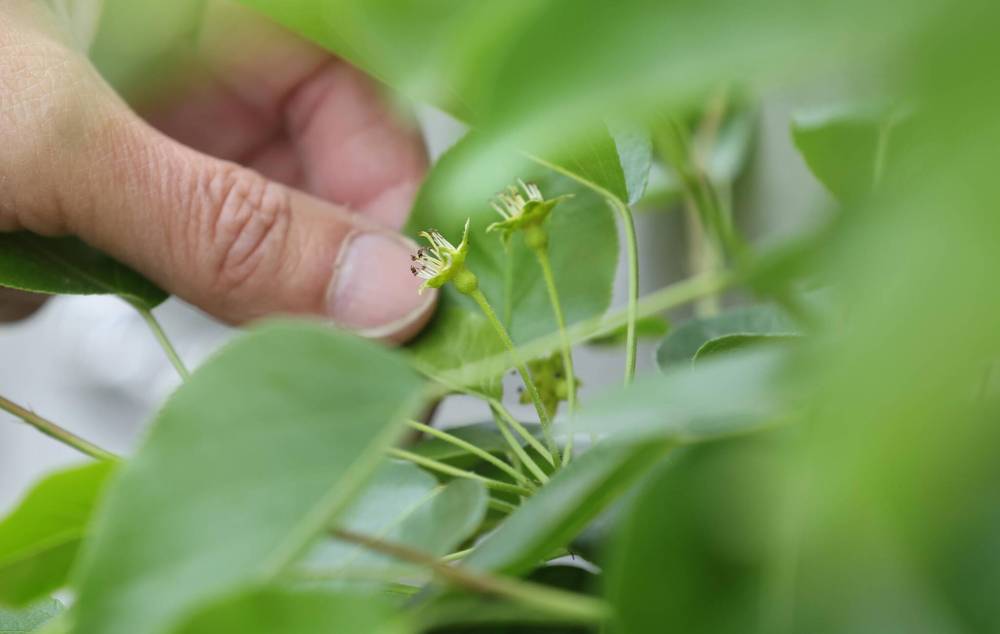
Craig Gillespie prunes a pear tree in the Kitchen Garden Orchard.

A new variety of roses — the 49th parallel collection — is due and next week water lilies will arrive, ready to be transplanted to the large pool in the Leo Mol Sculpture Garden. Sunflowers, at least 100 of them, are planned for both the Kitchen Garden and the Pollinator Garden in the zoo.
Fingers are crossed that rain will come, but not too much, that the sun will shine and that temperatures will remain warm, but not get too hot.
And, of course, the frost steers well clear.
It’s the Goldilocks of gardening and they’re hoping everything will turn out just right.
av.kitching@freepress.mb.ca

AV Kitching is an arts and life writer at the Free Press. She has been a journalist for more than two decades and has worked across three continents writing about people, travel, food, and fashion. Read more about AV.
Every piece of reporting AV produces is reviewed by an editing team before it is posted online or published in print — part of the Free Press‘s tradition, since 1872, of producing reliable independent journalism. Read more about Free Press’s history and mandate, and learn how our newsroom operates.
Our newsroom depends on a growing audience of readers to power our journalism. If you are not a paid reader, please consider becoming a subscriber.
Our newsroom depends on its audience of readers to power our journalism. Thank you for your support.