Behind every great bard…
Did Shakespeare write with an Italian woman?

Advertisement
Read this article for free:
or
Already have an account? Log in here »
To continue reading, please subscribe:

Digital Subscription
One year of digital access for only $205*
- Enjoy unlimited reading on winnipegfreepress.com
- Read the E-Edition, our digital replica newspaper
- Access News Break, our award-winning app
- Play interactive puzzles
*First annual payment billed as $205.00 + GST for one year. This annual subscription will automatically renew at $233.00 + GST every 52 weeks (10% off the regular annual price of $259.35). Offer available to new and qualified returning subscribers only. Cancel any time.
To continue reading, please subscribe:
Add Free Press access to your Brandon Sun subscription for only an additional
$1 for the first 4 weeks*
- Enjoy unlimited reading on winnipegfreepress.com
- Read the E-Edition, our digital replica newspaper
- Access News Break, our award-winning app
- Play interactive puzzles
*Your next Brandon Sun subscription payment will increase by $1.00 and you will be charged $17.95 plus GST for four weeks. After four weeks, your payment will increase to $24.95 plus GST every four weeks.
Read unlimited articles for free today:
or
Already have an account? Log in here »
Hey there, time traveller!
This article was published 15/06/2023 (1156 days ago), so information in it may no longer be current.
There’s no reason to doubt who wrote Jessica B. Hill’s newest play, The Dark Lady, which opens today at Shakespeare in the Ruins. But when it comes to the collected works of William Shakespeare, question marks abound.
How one person could write so much and so well about places he’d never visited and societies he never knew is a conundrum that has fed centuries of healthy skepticism about authorship, memory and legacy.
“If you look at the latest Oxford University Press edition of the collected works, you will see them attributed to about 12 authors,” says William Leahy, the chairperson of the Shakespeare Authorship Trust, an organization founded in 1922 to “seek, and if possible establish, the truth concerning the authorship of Shakespeare’s plays and poems.”
Mike Thiessen / Winnipeg Free Press
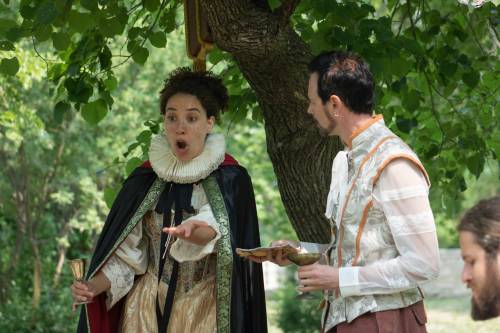
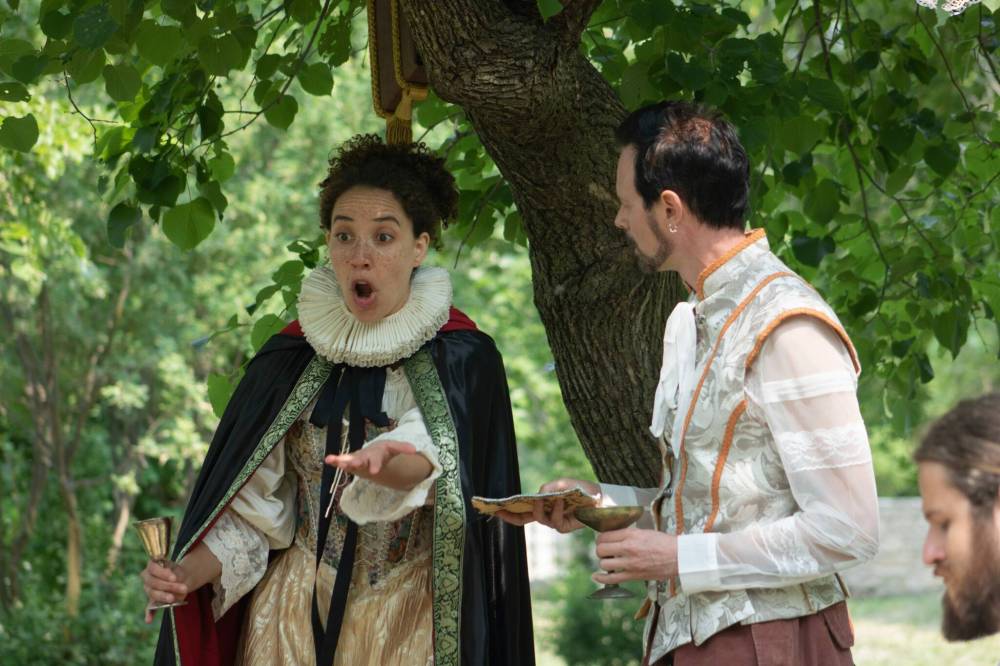
Jessica B. Hill (left) and Eric Blais star in The Dark Lady, a show Hill wrote about Emilia Bassano, a real person and writer who is believed to be the “dark lady” Shakespeare wrote about in his sonnets.
“It is now agreed that Shakespeare did not produce all the works alone,” he adds.
Along with Edward de Vere, long theorized to have authored some works attributed to the Bard, the trust lists six other “candidates” for authorship: Sir Francis Bacon, John Florio, Christopher Marlowe, Henry Neville, William Stanley and Mary Sidney.
One name not included is Emilia Bassano, a 17th-century Italian writer who was the subject of a viral 2019 article in The Atlantic headlined “Was Shakespeare a Woman?” That piece suggested Bassano as a potential inspiration, if not a direct source, for a number of Shakespearean works, including Titus Andronicus, The Comedy of Errors and The Merchant of Venice.
“Whether she had any role in the production of the plays is something we are open to hearing about but would need to see some evidence to support the claim,” Leahy says. “That said, part of the claim rests on the assertion that she, like many women in our literary history, was written out of that (his)story. We are very sympathetic to that truth.”
Authorship aside, the Atlantic article also brought to the surface yet another Shakespearean mystery: was the dark-skinned Emilia Bassano the “dark lady” written about in sonnets 127-154?
The Montreal-born Hill was fascinated by that question, and promptly dove deep into all things Bassano, who in 1611 became the first woman to publish a collection of poetry in the English language, according to various sources.
“When you do a little bit of digging on this woman, the research is pretty outstanding,” says Hill, who was intrigued by cascading coincidences too irresistible to deny as impossibilities.
“Her father died when she was seven or eight, and she was brought up by this rich countess, who made sure Emilia had access to education, learning about literature, Latin and Greek history,” says Hill. “That’s the premise to All’s Well That Ends Well.
“But here’s where it gets interesting,” she adds. There is documented evidence, she says, that Bassano was a longtime mistress of Lord Chamberlain, a high-ranking official in Queen Elizabeth’s court who also happened to fund Shakespeare’s theatre company, Lord Chamberlain’s Men, in the late 1590s.
That adds some support to the notion, in Hill’s eyes, that Bassano and Shakespeare’s paths may have crossed. Bassano’s literary prowess didn’t hurt her case, either.
“When I read her poetry, that’s when the bottom dropped,” says Hill, who wrote and starred in Pandora, a one-woman show at Prairie Theatre Exchange in February. “I saw there was a story here. She had such a vibrant, passionate, ambitious, fervent desire to create a world where men and women were equal.”
Bassano’s story was explored in 2018 in Emilia, an all-female show that debuted at London’s Globe Theatre.
Mike Thiessen / Winnipeg Free Press
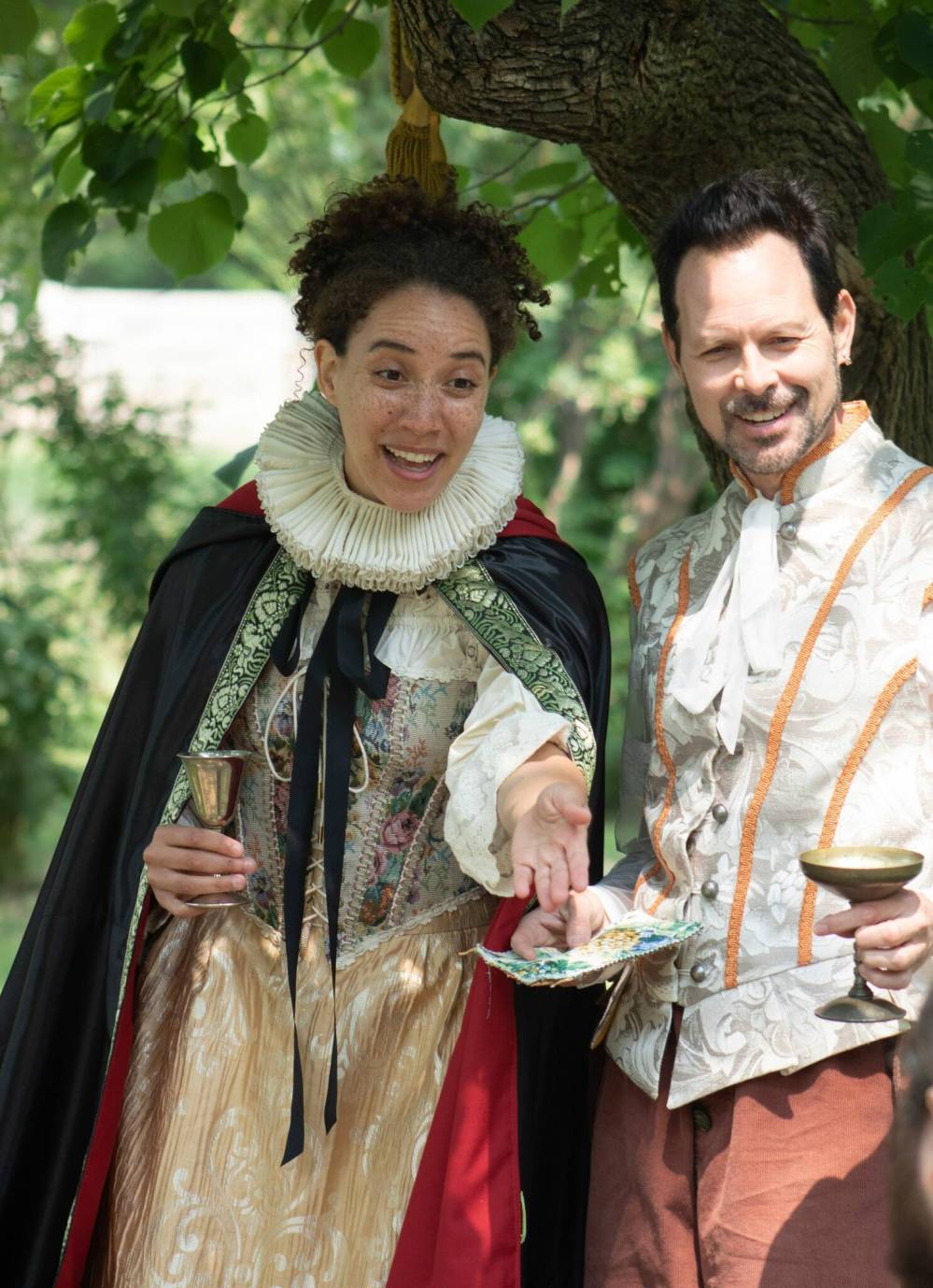
Jessica B. Hill (left) and Eric Blais star in The Dark Lady, a show Hill wrote about Emilia Bassano, a writer believed to be the ‘dark lady’ Shakespeare wrote about in his sonnets.
Hill took a different tack, casting Bassano and Shakespeare himself as the only characters in the story, imagining their interactions and collaborative relationship through a modern lens and in contemporary language.
“It’s so juicy to imagine a world where they would meet, be fascinated with each other, and embark on a collaborative friendship-turned-love that may last their entire lives, influencing each other’s work and growing as artists throughout their relationship,” says Hill, who will play Bassano opposite Eric Blais’s Shakespeare.
Shakespeare in the Ruins’ artistic director Rodrigo Beilfuss, who also directed Hill’s Pandora, says it’s the first time in the company’s 30-year history that Shakespeare is being depicted in the flesh.

The interplay between Bassano and the Bard is whip-smart, and hints at a different type of SiR production than audiences might be used to, depicting Shakespeare as a deeply flawed character, with Bassano as his mirror, interrogator and quite possibly his superior.
The answer to certain questions — Shakespearean authorship, Bassano’s relationship to the Bard — may never have precise answers.
But in that ambiguity, Hill found potential for storytelling and truth-seeking.
“I kind of like the mystery,” she says.
ben.waldman@winnipegfreepress.com
Ben Waldman is a National Newspaper Award-nominated reporter on the Arts & Life desk at the Free Press. Born and raised in Winnipeg, Ben completed three internships with the Free Press while earning his degree at Ryerson University’s (now Toronto Metropolitan University’s) School of Journalism before joining the newsroom full-time in 2019. Read more about Ben.
Every piece of reporting Ben produces is reviewed by an editing team before it is posted online or published in print — part of the Free Press‘s tradition, since 1872, of producing reliable independent journalism. Read more about Free Press’s history and mandate, and learn how our newsroom operates.
Our newsroom depends on a growing audience of readers to power our journalism. If you are not a paid reader, please consider becoming a subscriber.
Our newsroom depends on its audience of readers to power our journalism. Thank you for your support.
Theatre preview
The Dark Lady
by Jessica B. Hill
Co-production of Shakespeare in the Ruins and Shakespeare on the Saskatchewan
● Opens tonight (June 15), run to July 2
● Tickets: $15-$30 at shakespeareintheruins.com
Ben Waldman is a National Newspaper Award-nominated reporter on the Arts & Life desk at the Free Press. Born and raised in Winnipeg, Ben completed three internships with the Free Press while earning his degree at Ryerson University’s (now Toronto Metropolitan University’s) School of Journalism before joining the newsroom full-time in 2019. Read more about Ben.
Every piece of reporting Ben produces is reviewed by an editing team before it is posted online or published in print — part of the Free Press‘s tradition, since 1872, of producing reliable independent journalism. Read more about Free Press’s history and mandate, and learn how our newsroom operates.
Our newsroom depends on a growing audience of readers to power our journalism. If you are not a paid reader, please consider becoming a subscriber.
Our newsroom depends on its audience of readers to power our journalism. Thank you for your support.
Related Articles
Bard’s Dark Lady more than mistress, more than muse
Advertisement Advertise With Us
Advertisement Advertise With Us