Quirky encounters
Eccentric auteur’s vintage vistas set stage for tragicomic exploration of vulnerability

Advertisement
Read this article for free:
or
Already have an account? Log in here »
To continue reading, please subscribe:

Digital Subscription
One year of digital access for only $205*
- Enjoy unlimited reading on winnipegfreepress.com
- Read the E-Edition, our digital replica newspaper
- Access News Break, our award-winning app
- Play interactive puzzles
*First annual payment billed as $205.00 + GST for one year. This annual subscription will automatically renew at $233.00 + GST every 52 weeks (10% off the regular annual price of $259.35). Offer available to new and qualified returning subscribers only. Cancel any time.
To continue reading, please subscribe:
Add Free Press access to your Brandon Sun subscription for only an additional
$1 for the first 4 weeks*
- Enjoy unlimited reading on winnipegfreepress.com
- Read the E-Edition, our digital replica newspaper
- Access News Break, our award-winning app
- Play interactive puzzles
*Your next Brandon Sun subscription payment will increase by $1.00 and you will be charged $17.95 plus GST for four weeks. After four weeks, your payment will increase to $24.95 plus GST every four weeks.
Read unlimited articles for free today:
or
Already have an account? Log in here »
Hey there, time traveller!
This article was published 24/06/2023 (1183 days ago), so information in it may no longer be current.
Operating at Peak Wes Anderson, this exquisite comedy-drama-diorama rapidly fills up the American auteur’s cinematic bingo card. There are distant fathers, solemn children, symmetrical framing, harpsichord music, excellent luggage.
Movie-goers will find Anderson’s highly mannered, immaculately stylized little world either wondrous and delightful or colossally irritating and twee.
This review won’t even attempt to win over that second group. Speaking to the first group, though, fans can be assured that Asteroid City is all the things Andersonites already love, along with an added, possibly unexpected degree of poignance.
Asteroid City has a mid-life vibe. Jason Schwartzman, after all, a one-time high-schooler in 1998’s Rushmore, is now playing a widower, and Anderson seems to be self-consciously contemplating the arrow of time, bringing infinity and mortality, art and life, into tragicomic collision.
In the sense that it’s “about” anything, Asteroid City involves a group of precocious “Junior Stargazers and Space Cadets” and their baffled parents converging on a 10-cabin motor court, roadside diner and gas station in the middle of the American West in the middle of the 1950s.
Scientists and representatives of the military are also there, slightly oppressive but mostly comic, relaying orders directly from President Truman. There is a pretty schoolmarm, along with her freckle-faced charges, and a stranded group of cowboys. (Singing cowboys, of course.) There’s an eager motel manager.
Gathered one night in the crater of an ancient asteroid, this oddball group experiences a cosmic encounter. Using retro special effects and some charming stop-motion animation, Anderson materializes a “bewildering and bedazzling celestial event.”
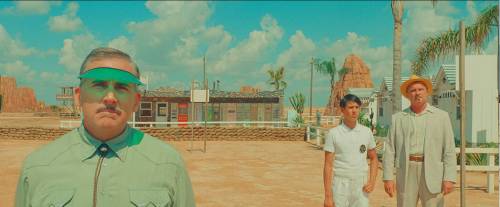
Packed with knowing allusions to spaghetti westerns and Saturday morning cartoons, Dr. Strangelove and Ace in the Hole, the visuals are beguiling. Asteroid City’s desert oasis is all robin’s-egg blue and ochre, suggesting the faded intensity of old Kodak vacation photos, or picture layouts from McCall’s magazine, circa 1953, or the stereoscopic images of a vintage View-master.
The endless horizon is broken only by iconic bits of Americana — sandstone buttes, tumbling tumbleweeds, passing freight trains, a stray roadrunner, the odd mushroom cloud from nearby atomic testing.
Pop. 87 Productions / Focus Features Scarlett Johansson stars as a Marilyn Monroe-type amid Wes Anderson’s endless horizon in Asteroid City, now playing.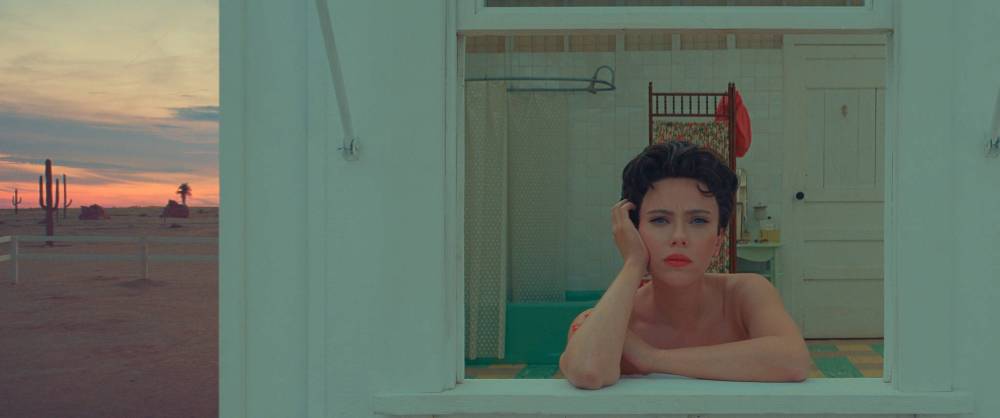
The cast includes practically everybody. There are Anderson familiars — Tilda Swinton, Jeffrey Wright, Stephen Park, Bob Balaban, Adrien Brody, Edward Norton. The cast list, conveyed onscreen in yellow, customized, very Andersonian typeface, just goes on and on. Anderson is also trying out something new with Tom Hanks.
Scarlett Johansson plays Midge Campbell, a Marilyn Monroe-type star, beautiful and doomed. (Midge often gets cast as “tragic, abused alcoholics,” though, as people keep pointing out, “she’s actually a gifted comedienne.”) Schwartzman is war photographer Augie Steenbeck, who is there with his children, the awkward, brilliant Woodrow (Jake Ryan) and three utterly mysterious little girls. The children’s mother, Augie’s wife, died three weeks ago, and he still hasn’t managed to tell them.
Through the windows of their cabins, Midge and Augie begin what could be a distanced courtship. It’s hard to say. Augie keeps his camera between himself and the world; Midge uses sunglasses. They are, Midge suggests, “two catastrophically wounded people who don’t express the depths of their pain because they don’t want to.”
The pain is nonetheless there. That’s not to say that anyone in this film directly expresses it. One of the funniest moments in Asteroid City features Hanks’s face and hands and voice just frizzling with repressed feeling.
But Anderson seems to be using his 11th feature to explore what lies beneath his characteristic look, beneath the elaborate setups, the deadpan delivery, the precise gestures, the seemingly frozen avoidance of emotion. Asteroid City functions as a manifesto of sorts, demonstrating why Anderson needs art to make sense of life, to give order and beauty to the ephemeral and the uncontrollable.
Pop. 87 Productions/Focus Features From left, Jake Ryan, Jason Schwartzman and Tom Hanks in “Asteroid City.”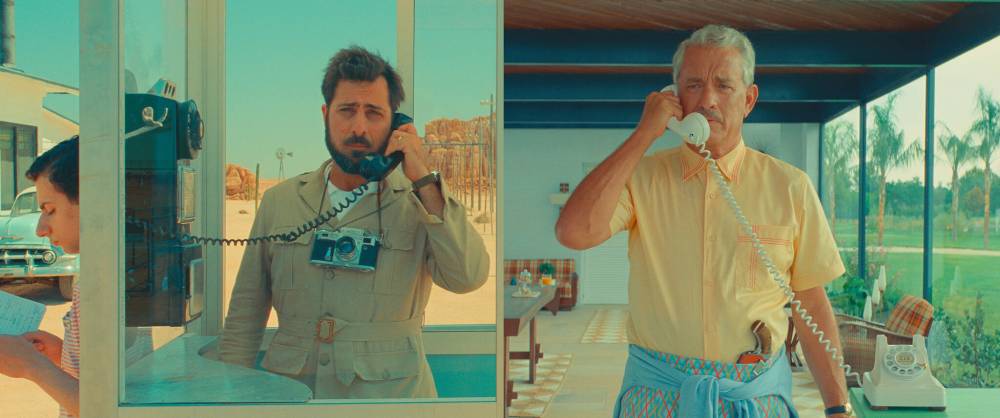
We are told from the get-go that everything is fictitious. A black-and-white framing device, featuring Bryan Cranston as the narrator, informs us that Asteroid City does not exist. It is an imaginary drama created expressly for the purposes of this broadcast. The characters are fictional, the text hypothetical, the events an apocryphal fabrication.”
We are watching a live teleplay about the creation of a theatrical play, which then transforms into a film.
This may sound like even more hermetically sealed artifice than usual, but Anderson uses it to access a new dimension of vulnerability.
There’s a final scene in which Schwartzman moves through layers of representation, from movie, to TV, to play, to the play about the play, to “the outside world,” which is really just another set. He is looking for his grief, and — in an indelible scene with Margot Robbie — he finds it.
So does Anderson, and so will Anderson’s fans. I know I did: I expected the quirks in Asteroid City. I didn’t expect the tears.
alison.gillmor@winnipegfreepress.com
Studying at the University of Winnipeg and later Toronto’s York University, Alison Gillmor planned to become an art historian. She ended up catching the journalism bug when she started as visual arts reviewer at the Winnipeg Free Press in 1992.
Our newsroom depends on a growing audience of readers to power our journalism. If you are not a paid reader, please consider becoming a subscriber.
Our newsroom depends on its audience of readers to power our journalism. Thank you for your support.
Movie review
Asteroid City
Starring Jason Schwartzman and Scarlett Johansson
Grant Park, McGillivray, Polo Park
105 minutes, PG
HHHH out of five
OTHER VOICES
Funny, but often quietly devastating.
— Linda Marric, The Jewish Chronicle
While the concept sometimes seems unnecessarily complicated, I’m growing fonder of Asteroid City the more I think of it.
— Moira MacDonald, Seattle Times
Maybe the whole endeavour is some kind of self-portrait of an artist who doesn’t know what he wants to say anymore.
— Michael O’Sullivan, Washington Post
Think of it as the Wes Anderson equivalent of the Marvel multiverse, except entertaining and inventive.
— Barry Hertz, Globe and Mail
Studying at the University of Winnipeg and later Toronto’s York University, Alison Gillmor planned to become an art historian. She ended up catching the journalism bug when she started as visual arts reviewer at the Winnipeg Free Press in 1992.
Our newsroom depends on a growing audience of readers to power our journalism. If you are not a paid reader, please consider becoming a subscriber.
Our newsroom depends on its audience of readers to power our journalism. Thank you for your support.
Advertisement Advertise With Us
Advertisement Advertise With Us