Found in translation Théâtre Cercle Molière’s English subtitles help put its plays in the hands of anglo audience members
Read this article for free:
or
Already have an account? Log in here »
To continue reading, please subscribe:

Digital Subscription
One year of digital access for only $205*
- Enjoy unlimited reading on winnipegfreepress.com
- Read the E-Edition, our digital replica newspaper
- Access News Break, our award-winning app
- Play interactive puzzles
*First annual payment billed as $205.00 + GST for one year. This annual subscription will automatically renew at $233.00 + GST every 52 weeks (10% off the regular annual price of $259.35). Offer available to new and qualified returning subscribers only. Cancel any time.
To continue reading, please subscribe:
Add Free Press access to your Brandon Sun subscription for only an additional
$1 for the first 4 weeks*
- Enjoy unlimited reading on winnipegfreepress.com
- Read the E-Edition, our digital replica newspaper
- Access News Break, our award-winning app
- Play interactive puzzles
*Your next Brandon Sun subscription payment will increase by $1.00 and you will be charged $17.95 plus GST for four weeks. After four weeks, your payment will increase to $24.95 plus GST every four weeks.
Read unlimited articles for free today:
or
Already have an account? Log in here »
Hey there, time traveller!
This article was published 02/11/2023 (1017 days ago), so information in it may no longer be current.
Jack Maier wasn’t on stage during Théâtre Cercle Molière’s run of Gustave Akakpo’s On Marronne, but the 25-year-old actor played a crucial role in the sprawling production.
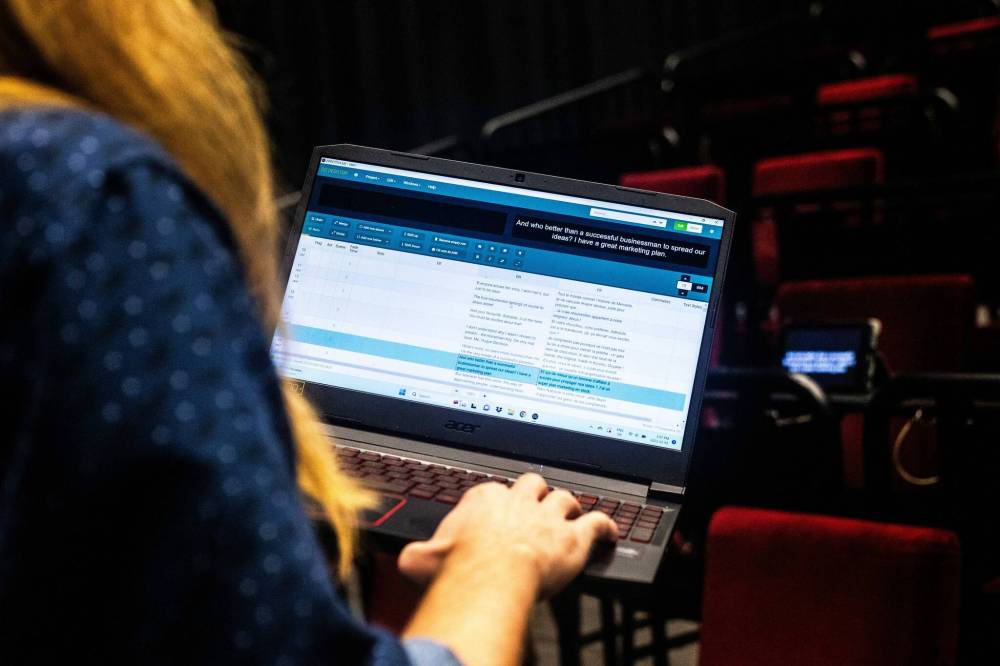
For the last two seasons, Maier has been contracted by the country’s oldest continuously operating theatre company to translate French scripts into English, a painstaking process of text consolidation that requires grammatical prowess and theatrical comprehension in both languages.
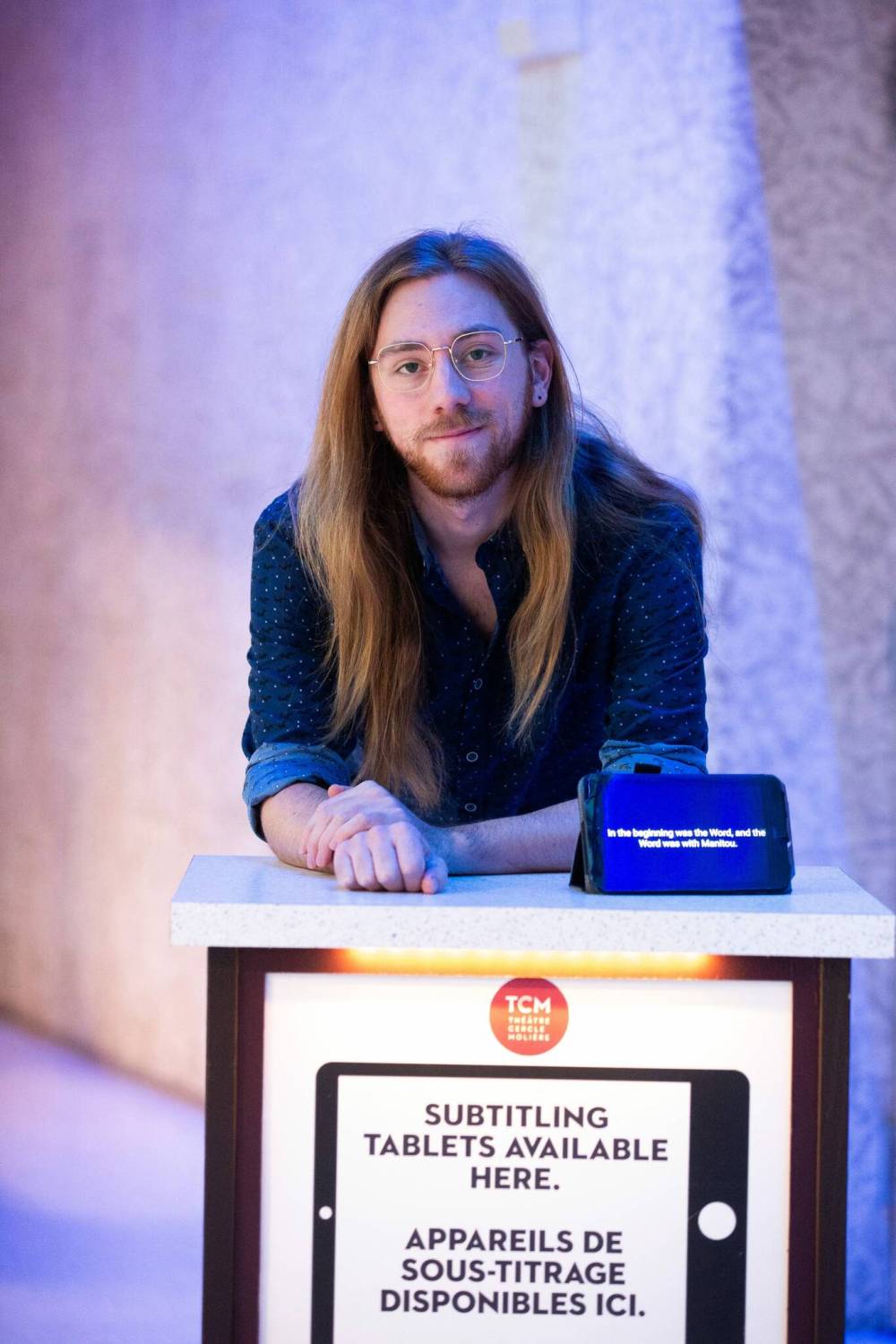
Once the English text is complete, audience members attending performances can read along on individual tablets provided by TCM, with Maier operating the subtitling system.
MIKAELA MACKENZIE / WINNIPEG FREE PRESS
Jack Maier translates French scripts into English for live performances so audience members can read along with the dialogue.
“It really feels like trying to crack a code,” says Maier, who minored in interdisciplinary linguistics at the University of Winnipeg. “I love doing a deep dive into every line of dialogue, seeing which metaphors, words or phrases are repeated, trying to maintain rhyme, alliteration and meaning.”
Maier’s process begins with a rough translation at a quick pace.
But translating isn’t precisely algebraic, and often requires Maier to excise words to prevent the formation of an impenetrable on-screen wall of textual bricks.
“If your subtitles are too long, the actor is going to be three lines ahead by the time (the audience) stops reading,” says Maier, who has translated three shows for TCM.
Live translation isn’t new to the company, says artistic director Geneviève Pelletier, who first hired a translator in 2014 for production of Yasmina Reza’s God of Carnage.
“Access has always been an intrinsic value at le TCM and the idea of sharing our francophone cultural world with everyone was and still is exciting.”–Geneviève Pelletier
“Access has always been an intrinsic value at le TCM and the idea of sharing our francophone cultural world with everyone was and still is exciting,” she says.
When Pelletier first suggested implementing a subtitling system, there was a bit of skepticism, but it was clear the service would expand TCM’s reach beyond the francophone community it has served since 1925.
Amongst the skeptics was Lorraine Forbes, a bilingual theatre pro with a diploma in translation from the Université de St. Boniface and a degree in literature and theatre from Queen’s University.
“I hated (the idea) of those big letters skimming across the proscenium arch,” she recalls.
MIKAELA MACKENZIE / WINNIPEG FREE PRESS
Jack Maier says English translation tablets have been offered at every performance except one over the past two years.
That wasn’t Pelletier’s idea, though. Instead, during the early heyday of the iPad, she leaned toward a tablet-based system. In need of volunteers, Forbes raised her hand. “I said, ‘I’m your man,’” says Forbes, who spent seven years as the production manager of the Conservatoire d’art dramatique de Québec.
“First and foremost, translation is an adaptation process,” says Forbes, who went on to translate 22 shows for TCM before retiring last year. “You’re always trying to create a link between the audience member and the action onstage.”
It’s different than creating subtitles for film or television, she says.
“Theatre productions don’t have an automatic sequence. The actors slow down, or they speed up. Here and there, someone fudges a line,” she says. “You really have to have a close vision of what’s going on in every moment.”
In general, the translated version contains about 60 per cent of the original text, she says. Repeated lines are sometimes dropped — if a character screams “Pourquoi?” three times, she would write “Why?” once.
“There’s only so much you can have on the screen at once,” she says; two or maybe three lines are all a reader can handle without the connection to the action being broken.
Readers might be wondering whether AI could replace the work Forbes and Maier do.
Maier points to the title of On Marronne as an example of AI’s current shortcomings. An AI translating system suggested translating the title to “We’re Turning Brown,” which completely disregarded the nuance of Akakpo’s script, centred on a group of expats returning to their cultural traditions.
The computer couldn’t have done what Maier did next.
Marronnage, the title’s source word, refers to a group of slaves who escape, he says. “But instead of the western connotation of escaping into a ‘civilized’ society, they were returning to nature to recapture their traditional way of life,” he says.
MIKAELA MACKENZIE / WINNIPEG FREE PRESS
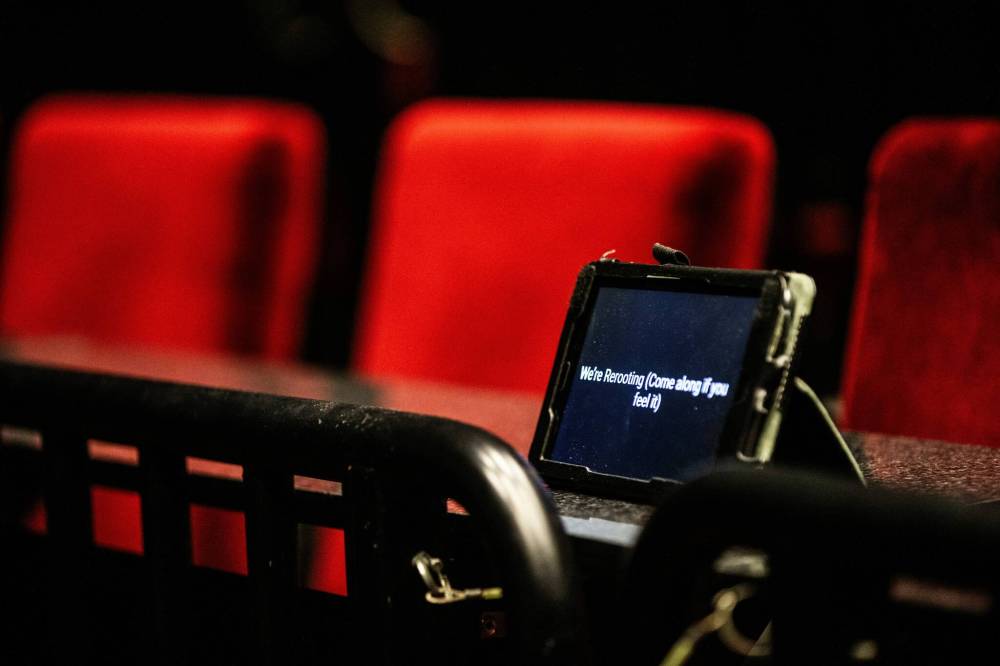
Théâtre Cercle Molière’s English-language translations are delivered to individual tablets.
The word also refers to the use of dead wood as a building material, Maier says, creating something new from material that was otherwise disregarded.
He ended up suggesting “We’re Re-Rooting” as the English translation for the title. “It has the double meaning of choosing a new path, like rerouting, but also in a broad metaphorical sense, while it also has the connotation of a return to roots, or ways of traditional knowledge,” he says. “It took a lot of brainstorming.”

“You can smell machine translation a mile away,” says Forbes. “We are trying to get at emotional subtlety, character-building and poetry.”
All that hard work is paying off. At every performance but one over the last two years, Maier says audience members have taken tablets to follow along. Even native French speakers have taken them out of curiosity, he says.
The feedback has been overwhelmingly positive, both say.
“One person said to me, ‘You must be good. My sister-in-law laughed from start to finish,’” Forbes remembers. “That’s what makes it worth it.”
ben.waldman@winnipegfreepress.com

Ben Waldman is a National Newspaper Award-nominated reporter on the Arts & Life desk at the Free Press. Born and raised in Winnipeg, Ben completed three internships with the Free Press while earning his degree at Ryerson University’s (now Toronto Metropolitan University’s) School of Journalism before joining the newsroom full-time in 2019. Read more about Ben.
Every piece of reporting Ben produces is reviewed by an editing team before it is posted online or published in print — part of the Free Press‘s tradition, since 1872, of producing reliable independent journalism. Read more about Free Press’s history and mandate, and learn how our newsroom operates.
Our newsroom depends on a growing audience of readers to power our journalism. If you are not a paid reader, please consider becoming a subscriber.
Our newsroom depends on its audience of readers to power our journalism. Thank you for your support.