Thrills are alive
What movie? Full-throated production makes case for seeing beloved film’s stage incarnation

Advertisement
Read this article for free:
or
Already have an account? Log in here »
To continue reading, please subscribe:
Digital Subscription
One year of digital access for only $1.44 a week*
- Enjoy unlimited reading on winnipegfreepress.com
- Read the E-Edition, our digital replica newspaper
- Access News Break, our award-winning app
- Play interactive puzzles
*Billed as $5.77 plus GST every four weeks. After 52 weeks, price increases to the regular rate of $19.95 plus GST every four weeks. Offer available to new and qualified returning subscribers only. Cancel any time.
To continue reading, please subscribe:
Add Free Press access to your Brandon Sun subscription for only an additional
$1 for the first 4 weeks*
- Enjoy unlimited reading on winnipegfreepress.com
- Read the E-Edition, our digital replica newspaper
- Access News Break, our award-winning app
- Play interactive puzzles
*Your next Brandon Sun subscription payment will increase by $1.00 and you will be charged $17.95 plus GST for four weeks. After four weeks, your payment will increase to $24.95 plus GST every four weeks.
Read unlimited articles for free today:
or
Already have an account? Log in here »
Hey there, time traveller!
This article was published 02/12/2023 (1057 days ago), so information in it may no longer be current.
In 1959, six years before Maria and the von Trapps were preserved in celluloid, The Sound of Music began its storybook existence on a Broadway stage.
The show — about a rebellious governess and a grieving Austrian family’s musical perseverance under the black, leathered thumb of the Nazi party at the time of the Anschluss — was a Tony-winning smash, running for 1,443 performances and setting the theatre world ablaze.
But few fans of the Rodgers and Hammerstein musical could tell you it was Mary Martin and Theodore Bikel, not Julie Andrews and Christopher Plummer, who first danced the Laendler as the jubilant Maria and the stiff Captain Georg von Trapp.
photos by Dylan Hewlett
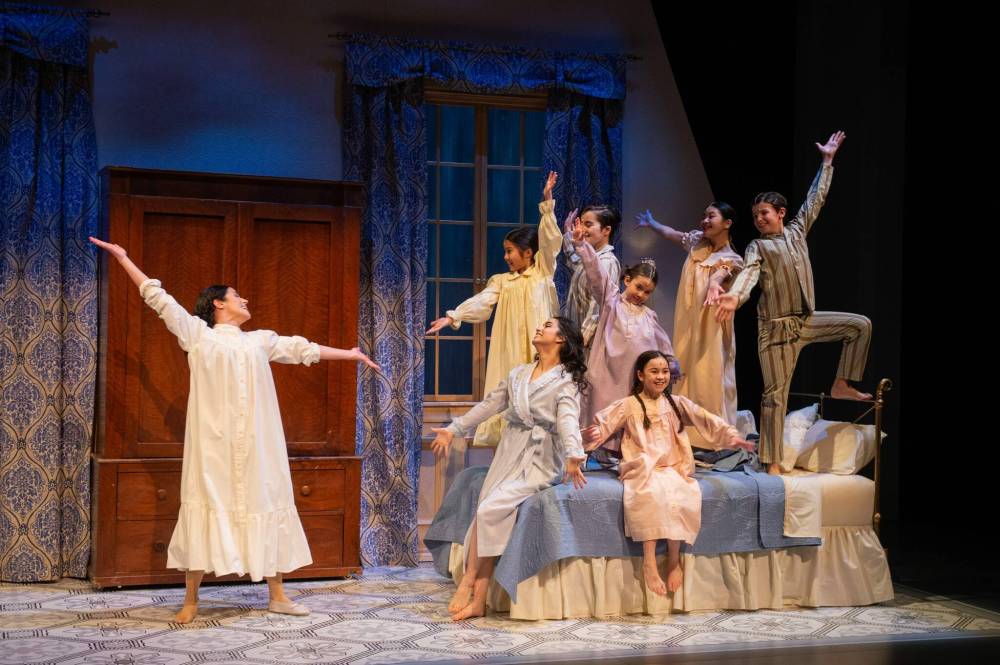
Maria (Priya Narine, left) brings song back into the lives of the Von Trapp family in RMTC’s enjoyable staging of Rodgers and Hammerstein’s classic musical.
So it can be tempting to compare the Royal Manitoba Theatre Centre’s current run of The Sound of Music to the beloved filmed version.
But it would also be a disservice to director Rachel Peake’s well-cast and perfectly enjoyable staging, a full-throated ode to the necessity of harmony and dissonance in a time of societal and familial disarray, brought to light on the John Hirsch Mainstage under the musical direction of Andrew St. Hilaire.
The production begins at Nonnberg Abbey, a secluded sanctuary in the Austrian alps, where a group of nuns are incanting an august prayer. With the Mother Abbess (an angelic Lara Ciekiewicz) leading the way, the opening scene makes the case that the human voice is a gift from God to be revered, not squandered.
But the novice Maria (a lovely Priya Narine in her RMTC debut) feels otherwise. She has a habit of belting out tunes simply for personal enjoyment, which rankles the establishment. “I’ve even heard her singing in the abbey!” Sister Sophia (Katie German) hypocritically sings during a gentle dis track that shoos Maria toward an auspicious job transfer as a governess for a wealthy family in a nearby town.
Waltzing in through the doors of the grand von Trapp manor, Narine’s Maria carries herself as a kite on air, stopped in her tracks by the wooden Captain (a solid, aptly surnamed Charlie Gallant), a decorated navy admiral who can sense the changing winds.
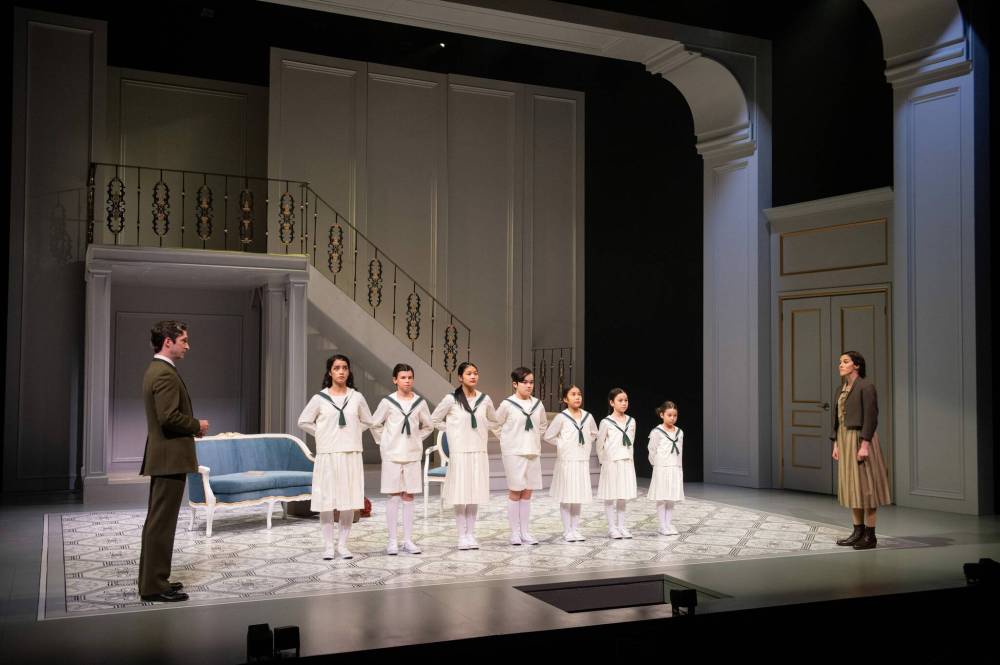
While Maria arrives toting an acoustic guitar, Georg von Trapp has his own baggage. A widower in denial, the Captain treats his seven children as hired crew instead of family. After the death of his wife, the once musical patriarch banned song from the home, relying on a series of whistles to get his adorable ducks in a row.

Dylan Hewlett
Scared by the spark with the Captain, Maria (Priya Narine) returns to the abbey without saying auf Wiedersehen or goodbye, but is encouraged to persevere by the Mother Abbess (Lara Ciekiewicz).
As they should, the von Trapp children — Micah Buenafe, Isaac Di Cresce, Davison Gee, Ida May Meacham, Anastasia Rautert, Madelyn Torres and Christina Nguyen (save for Nguyen, the cast of children alternates nightly) — arrive on command to inject a helpful dose of youthful innocence, rebellion and naivete into the storyline.
On opening night, Narine’s voice sometimes lacks enough power to carry the show’s soaring tunes alone, but when she builds connections with the children, the rest of the production falls into place.
Slowly but surely, Maria brings music back into the childrens’ lives, notably during the abbreviated musical theory class of Do-Re-Mi and the funny, funicular Lonely Goatherd, which summons the spirits of mountains the audience never sees, but can certainly sense in the exaggerated heights of the set.
There are subtle notes to Lorenzo Savoini’s vertical design that hint at the resistance to come. Atop the central cathedral window is a floral design reminiscent of the edelweiss, a symbolic plant representing the Captain’s stubborn defence of his home. Meanwhile, the railing of the manor’s grand staircase is supported by iron balusters wrought in the rough shapes of violins: music never left, it was just on mute.
The Captain still knows the steps of the Laendler, sharing a folk dance with Maria after cutting in for Kurt.
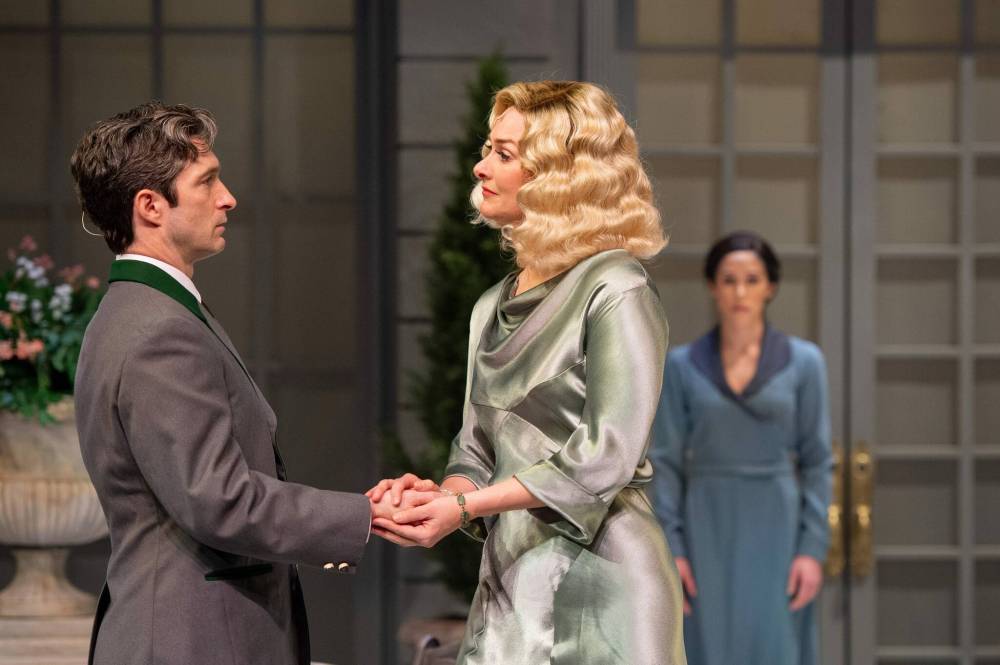
It’s this flirtatious pas de deux — choreographed by Ainsley Hillyard and Sam Hutchings — that leads the Captain to see his lowly governess in a fresh light, and soon, his high-brow, high-rent lover Frau Schraeder (Kristi Hansen) in a fading one.
Dylan Hewlett
This is a full-throated ode to the necessity of harmony and dissonance in a time of societal and familial disarray, brought to light on the John Hirsch Mainstage under the musical direction of Andrew St. Hilaire.
Scared by the spark, Maria returns to the abbey without saying auf Wiedersehen or goodbye, but is encouraged to persevere by the Mother Abbess. With her advice to Climb Ev’ry Mountain, Ciekiewicz, a trained opera singer, makes as thrilling and compelling an argument as possible in her first RMTC engagement.
Soon, wedding bells are ringing, but something more than love is in the air.
Aside from von Trapp manor, swastikas fly in front of every house in the region. Even Liesl’s (Nguyen) seemingly harmless crush Rolph (Jesse Drwiega) is wearing a red armband and delivering telegrams in the Fuhrer’s name. This shift is swift and severe: the arrival of Admiral von Schreiber (Arne MacPherson) signals the start of a new and painful era.

But remember the music?
Urged by a friend (Kevin Klassen) with shifting loyalties who sees dollar signs in the von Trapp children’s charms, the family is put through its paces in a regional singing competition, donning lederhosen and trotted out as a novelty act, backed by the red, white and black of Nazi banners.
This penultimate scene, which highlights the Nazis’ propaganda machine as it revs its engines, is the production’s best. With the audience transplanted to an Austrian concert hall, the insidious threats of censorship and fascistic control are made startlingly clear. How quickly, and how easily, culture can be misused as distraction.
Dylan Hewlett
It might be tempting to compare RMTC production’s of The Sound of Music with the filmed version, but don’t.
When the Captain sings the elegiac Edelweiss with his eyes squeezed shut, the banners are momentarily cast in shadows, and the audience feels the SS guards waiting in the wings. That’s the power of the sound of music, and that’s the benefit of seeing it on the stage, not just on the screen.
ben.waldman@winnipegfreepress.com
Ben Waldman is a National Newspaper Award-nominated reporter on the Arts & Life desk at the Free Press. Born and raised in Winnipeg, Ben completed three internships with the Free Press while earning his degree at Ryerson University’s (now Toronto Metropolitan University’s) School of Journalism before joining the newsroom full-time in 2019. Read more about Ben.
Every piece of reporting Ben produces is reviewed by an editing team before it is posted online or published in print — part of the Free Press‘s tradition, since 1872, of producing reliable independent journalism. Read more about Free Press’s history and mandate, and learn how our newsroom operates.
Our newsroom depends on a growing audience of readers to power our journalism. If you are not a paid reader, please consider becoming a subscriber.
Our newsroom depends on its audience of readers to power our journalism. Thank you for your support.
Theatre review
The Sound of Music
Co-production with Citadel Theatre
● Royal Manitoba Theatre Centre mainstage
● To Dec. 23
● Tickets at royalmtc.ca
★★★★ out of five
Ben Waldman is a National Newspaper Award-nominated reporter on the Arts & Life desk at the Free Press. Born and raised in Winnipeg, Ben completed three internships with the Free Press while earning his degree at Ryerson University’s (now Toronto Metropolitan University’s) School of Journalism before joining the newsroom full-time in 2019. Read more about Ben.
Every piece of reporting Ben produces is reviewed by an editing team before it is posted online or published in print — part of the Free Press‘s tradition, since 1872, of producing reliable independent journalism. Read more about Free Press’s history and mandate, and learn how our newsroom operates.
Our newsroom depends on a growing audience of readers to power our journalism. If you are not a paid reader, please consider becoming a subscriber.
Our newsroom depends on its audience of readers to power our journalism. Thank you for your support.
Related Articles
Child cast of The Sound of Music become family on set
Advertisement Advertise With Us
Advertisement Advertise With Us