Leaking theatre roof could be showstopper for Tara Players

Advertisement
Read this article for free:
or
Already have an account? Log in here »
To continue reading, please subscribe:

Digital Subscription
One year of digital access for only $205*
- Enjoy unlimited reading on winnipegfreepress.com
- Read the E-Edition, our digital replica newspaper
- Access News Break, our award-winning app
- Play interactive puzzles
*First annual payment billed as $205.00 + GST for one year. This annual subscription will automatically renew at $233.00 + GST every 52 weeks (10% off the regular annual price of $259.35). Offer available to new and qualified returning subscribers only. Cancel any time.
To continue reading, please subscribe:
Add Free Press access to your Brandon Sun subscription for only an additional
$1 for the first 4 weeks*
- Enjoy unlimited reading on winnipegfreepress.com
- Read the E-Edition, our digital replica newspaper
- Access News Break, our award-winning app
- Play interactive puzzles
*Your next Brandon Sun subscription payment will increase by $1.00 and you will be charged $17.95 plus GST for four weeks. After four weeks, your payment will increase to $24.95 plus GST every four weeks.
Read unlimited articles for free today:
or
Already have an account? Log in here »
Hey there, time traveller!
This article was published 10/04/2024 (886 days ago), so information in it may no longer be current.
As the snow melts, a leaky roof above a clubhouse on Erin Street is putting a half-century tradition of Irish theatre in Winnipeg at risk of being washed away.
Since the company’s founding in 1973, the Irish Association of Manitoba’s Tara Players have produced more than 200 shows about the Emerald Isle, bringing the likes of Beckett and Behan, Shanley and Shaw to the stage.
“That’s a hell of a lot of plays,” says company co-founder Brendan Carruthers, a 77-year-old who speaks with the gentle melody of his native Dublin.
MIKE DEAL / FREE PRESS
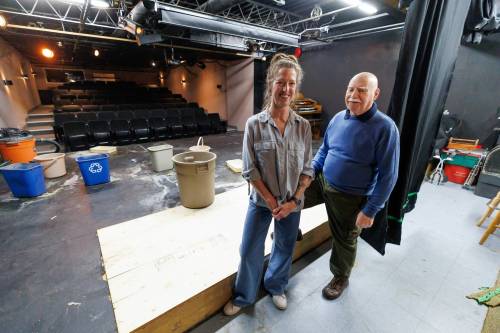
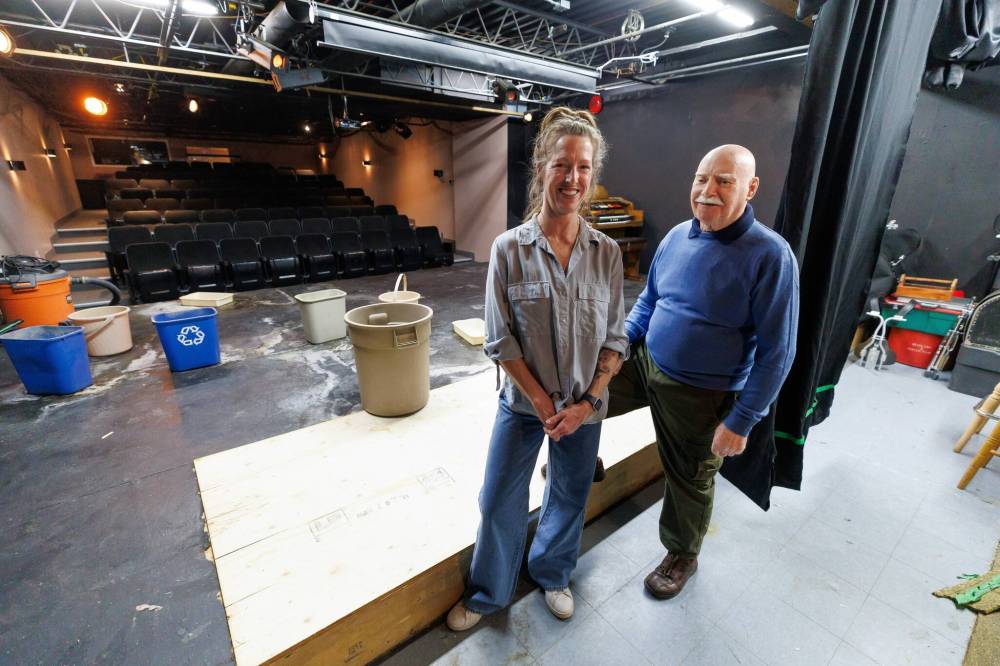
Siobhan Keely (left) and Brendan Carruthers stand onstage at the Irish Association, where buckets are collecting rainwater coming in through the roof.
“It’s our hope to do hundreds more.”
However, the climate is not co-operating. For nearly three years, the culprits were cursed droplets of a different sort. Then in 2022, the flat, 50-year-old roof above the clubhouse was bombarded by precipitation. Siobhan Keely heard the score of raindrops tinkling through the shingles and into the Players’ 83-seat theatre.
“We’ve gotten to the point where the patches no longer do the trick,” says Keely, a member of the Irish Association’s nine-member board who made her Tara debut in a 1990 production of Sean O’Casey’s The Moon Shines on Kylenamoe.
The damage is to the tune of $60,000. That bill is made no easier to stomach by the looming deadline for repayment of a pandemic-era governmental loan of $40,000.
With the theatre space mostly out of commission, the Irish Association has been missing a key source of income generation for more than two years. The clubhouse hosts frequent events, including popular movie screenings and St. Patrick’s Day celebrations for the public and its 160 paid members.
But this past March 17, the creamy pints of Kilkenny poured at the club’s bartop were accompanied by a bitter acknowledgment that the association’s beating heart was in desperate need of defibrillation.
“We can’t let our beloved theatre die,” Keely says.
The Irish Association was founded in 1972; it took less than a year for its inaugural board to recognize the necessity of an amateur theatre company to its mission: to facilitate, aid and promote the integration of Irish culture.
The Tara Players’ inception coincided with the formalization of several performance groups, including the Winnipeg Mennonite Theatre, as well as the nascent stage of an annual celebration of cultural and ethnic groups now known as Folklorama.
Those developments were spurred not only by community interest, but by public support for the arts provided by multiple levels of government, including the federal Liberals under Pierre Trudeau.
The timing was fortuitous: in October 1971, Trudeau introduced an official government policy of multiculturalism, appointing a minister of multiculturalism one year later. By 1975, the Trudeau policy of cultural pluralism had birthed the National Multicultural Theatre Association, which until the late 1980s provided a framework of support for companies like the Tara Players.
During that period, Manitoban playwrights such as Ukrainian-Manitoban Ted Galay (After Baba’s Funeral, Sweet and Sour Pickles) enjoyed success with ethnic-forward productions, while newer companies such as Prairie Theatre Exchange (then the Manitoba Theatre Workshop) explored language and nationality with shows such as Dennis Foon’s comedy New Canadian Kid, a Chalmers Award winner wherein newcomers spoke English and “domestic Canadians” conversed in gibberish.
Carruthers witnessed the boom with the eyes of an outsider, having arrived in Winnipeg in 1968 to work as a printer before falling in with what turned out to be the right crowd.
“I had never been in a theatre production, but you cannot grow up in Ireland without an interest in the theatre. It’s so much a part of the makeup of the country,” he says.
Soon after the Irish Association started in 1972, led by founding president Aidan O’Brien, Carruthers got involved, becoming a cast member in the Players’ first show, a production of J.M. Synge’s In the Shadow of the Glen mounted during Folklorama 1973 in a hall at St. Ignatius church.
“I can still quote my lines,” he says. “ ‘Come along with me now, lady of the house…’”
Once the Tara Players began performing at their current home, the company gained a reputation for solid, professional-grade productions with now-acclaimed actors such as Omar Alex Khan and Lorraine James often featured on its stage, according to theatre historian Kevin Longfield, a longtime member of the Irish Association. Meanwhile, the company helped spearhead the Acting Irish International Theatre Festival, which shut down with the onset of COVID.
MIKE DEAL / FREE PRESS
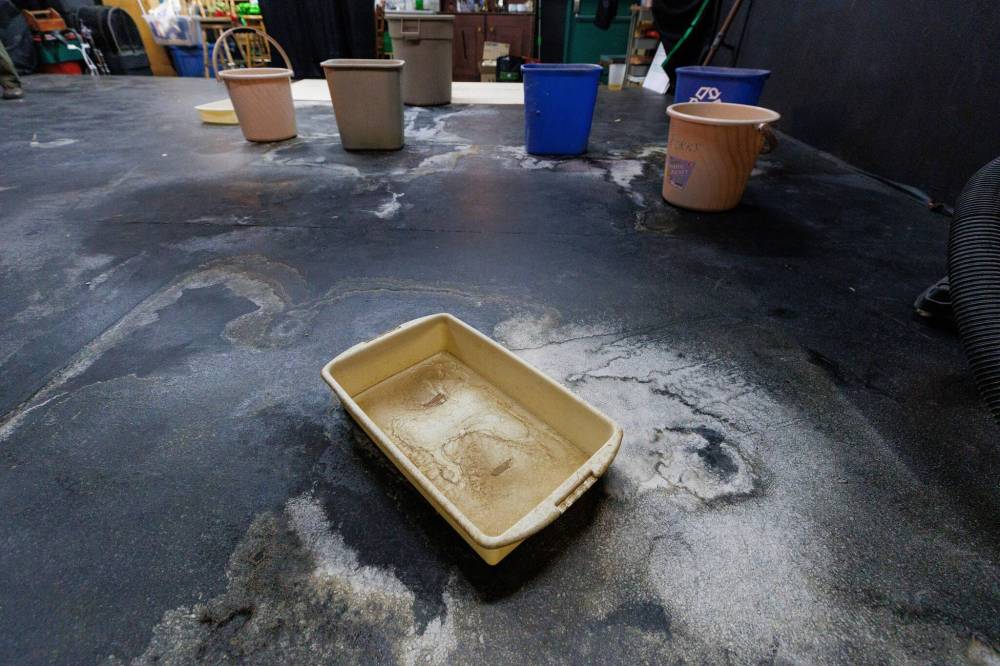
Damage to the roof is estimated to cost $60,00 to repair.
“The word ‘amateur’ means you do it for the love, and that’s the first misunderstanding. Amateur does not mean second-rate,” says Carruthers.
In the 1990s, both the Taras and Prairie Theatre Exchange staged Frank McGuinness’s Someone Who’ll Watch Over Me, a show whose Tony-winning run on Broadway starred Stephen Rea and Michael York.
Longfield saw both Manitoban productions.
He enjoyed far better the version realized by the troupe headquartered on Erin Street.
Over the past several months, Keely and the Irish Association have been passing the hat, raising about 12 per cent of the fundraising goal online through a GoFundMe campaign. If reached, the $90,000 will go toward not just repairing the roof, but ameliorating damage to the carpets, lighting systems and the stage itself, she says.
They’ve also been contacting government representatives; while waiting for replies, the group has applied for a series of grants to ensure the theatre’s long-term viability.
“It is my goal to have this theatre up and running by September,” says Keely, whose parents joined the Irish Association in the 1970s and who debuted her first play in the theatre under the leaking roof. “It’s feeling a little daunting right now.”
Carruthers hopes Keely’s ideal timeline holds, because after serving as director, producer and actor, he is set to break new creative ground.

“Once a Dream is the first play I’ve written for the Tara Players,” he says.
It was supposed to debut this month.
On Sunday, Carruthers, director Ray Cloutier and the show’s cast met for a rehearsal, gathering in the club’s dining hall instead of inside the theatre, where buckets collected raindrops.
“One way or another, that play will happen, and obviously, we’d like for it to happen in that theatre to open the next Tara season,” says Carruthers.
ben.waldman@winnipegfreepress.com
Ben Waldman is a National Newspaper Award-nominated reporter on the Arts & Life desk at the Free Press. Born and raised in Winnipeg, Ben completed three internships with the Free Press while earning his degree at Ryerson University’s (now Toronto Metropolitan University’s) School of Journalism before joining the newsroom full-time in 2019. Read more about Ben.
Every piece of reporting Ben produces is reviewed by an editing team before it is posted online or published in print — part of the Free Press‘s tradition, since 1872, of producing reliable independent journalism. Read more about Free Press’s history and mandate, and learn how our newsroom operates.
Our newsroom depends on a growing audience of readers to power our journalism. If you are not a paid reader, please consider becoming a subscriber.
Our newsroom depends on its audience of readers to power our journalism. Thank you for your support.
Ben Waldman is a National Newspaper Award-nominated reporter on the Arts & Life desk at the Free Press. Born and raised in Winnipeg, Ben completed three internships with the Free Press while earning his degree at Ryerson University’s (now Toronto Metropolitan University’s) School of Journalism before joining the newsroom full-time in 2019. Read more about Ben.
Every piece of reporting Ben produces is reviewed by an editing team before it is posted online or published in print — part of the Free Press‘s tradition, since 1872, of producing reliable independent journalism. Read more about Free Press’s history and mandate, and learn how our newsroom operates.
Our newsroom depends on a growing audience of readers to power our journalism. If you are not a paid reader, please consider becoming a subscriber.
Our newsroom depends on its audience of readers to power our journalism. Thank you for your support.
Advertisement Advertise With Us
Advertisement Advertise With Us