Love and resistance
Sinclair’s writing on Winnipeg highlights Indigenous struggles in Canada — and offers hope for the future
Advertisement
Read this article for free:
or
Already have an account? Log in here »
To continue reading, please subscribe:

Digital Subscription
One year of digital access for only $205*
- Enjoy unlimited reading on winnipegfreepress.com
- Read the E-Edition, our digital replica newspaper
- Access News Break, our award-winning app
- Play interactive puzzles
*First annual payment billed as $205.00 + GST for one year. This annual subscription will automatically renew at $233.00 + GST every 52 weeks (10% off the regular annual price of $259.35). Offer available to new and qualified returning subscribers only. Cancel any time.
To continue reading, please subscribe:
Add Free Press access to your Brandon Sun subscription for only an additional
$1 for the first 4 weeks*
- Enjoy unlimited reading on winnipegfreepress.com
- Read the E-Edition, our digital replica newspaper
- Access News Break, our award-winning app
- Play interactive puzzles
*Your next Brandon Sun subscription payment will increase by $1.00 and you will be charged $17.95 plus GST for four weeks. After four weeks, your payment will increase to $24.95 plus GST every four weeks.
Read unlimited articles for free today:
or
Already have an account? Log in here »
Hey there, time traveller!
This article was published 01/06/2024 (854 days ago), so information in it may no longer be current.
To say that Winnipeg is complex is an understatement. The city’s weather, history and ecology — and its legacy of racism, classism and colonialism — are the roots of this place.
Once labelled the pariah city of racism, Winnipeg is also the centre of Indigenous resistance and reclamation, the landing spot for newcomers from all over the globe and a place where allyship is nurtured and cultivated.
Scholar, journalist, activist and community leader Niigaan Sinclair has always purposely blurred the lines between research, direct action and s–t disturbing for the purpose of naming our colonial past and present while paving a pathway forward.

Mike Deal / Free Press files
In this 2022 photo, hundreds of people take part in a march from the The Forks to the RBC Convention Centre as part of the National Day of Truth and Reconciliation.
In his scholarly writing, his walks with Mama Bear Clan, his consulting with organizations and his Free Press columns, Sinclair’s work is centred around his love for this city and his commitment to truth and reconciliation.
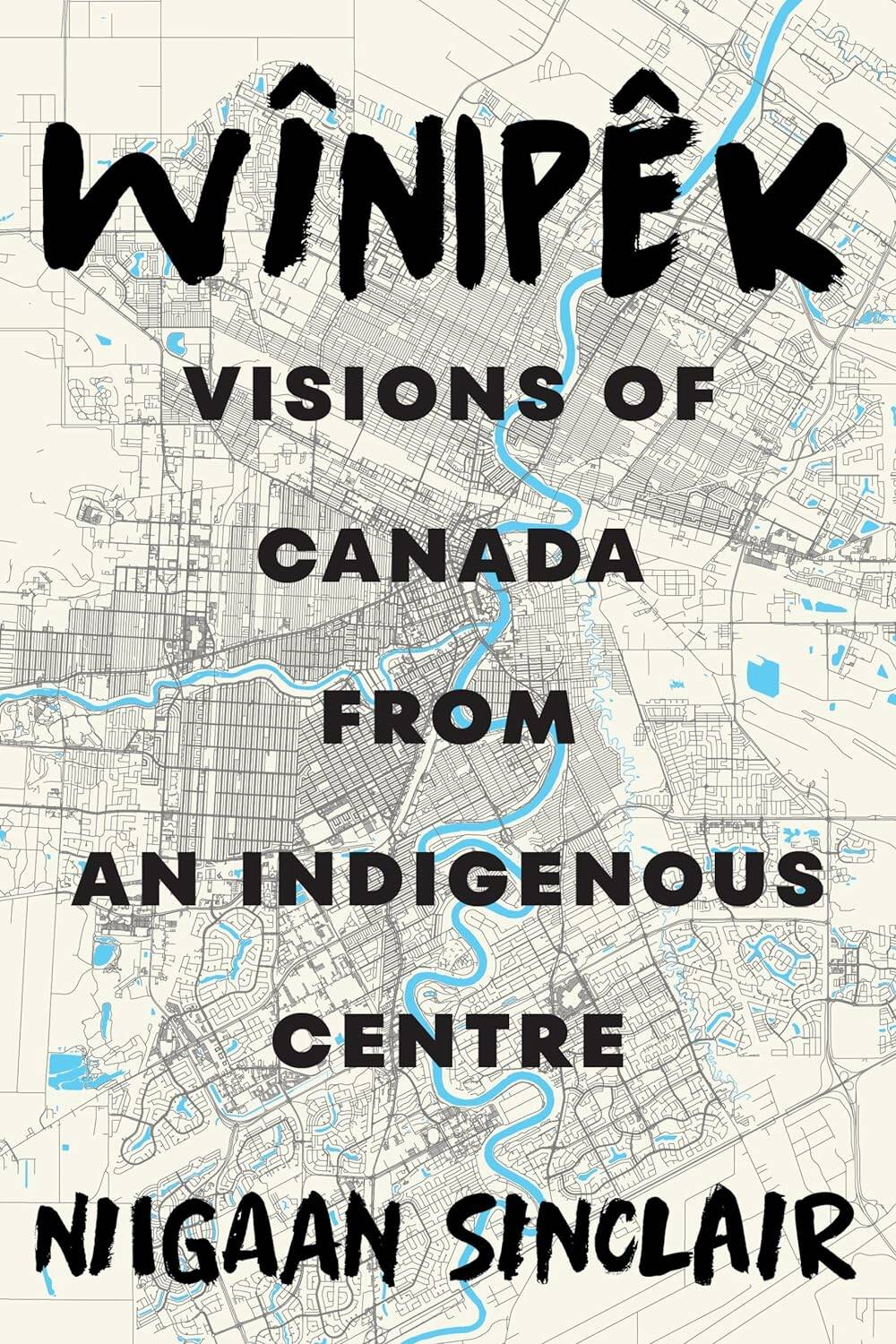
A compilation of the Anishinaabe writer’s columns and other clippings, Wînipêk: Visions of Canada from an Indigenous Centre sees Sinclair takes the reader on a journey through the land, water and seasons, the underbelly and magnificence that is Winnipeg.
Organizing his writings into four parts — Niibin (Summer), Dgwaagin (Fall), Biboon (Winter) and Ziigwan (Spring) — Wînipêk presents the reader with the historical context and cognitive tools to begin to make sense of the challenges and hard truths Winnipeg faces while highlighting the immense work taking place by folks all across this city who want a more just, sustainable and egalitarian future.
With unfailingly precise language, Sinclair uses the word “Wînipêk” to link the past to the future, summer to winter. “Wînipêk is an ethic, a term that gestures to the creation of delicate and intricate collaborations between all things; a process where forces — good and bad — come together to form relationships that flow into the world,” he writes.
For Sinclair, his purpose is to shed light on this complexity. “The life that exists in whatever we call this place — Wînipêk, Winnipeg, Treaty 1, Manitoba — is rich, dynamic, and the centre of many things; most namely, life.”
But the undercurrent of Wînipêk is racism — the devastating racism experienced by First Nations, Métis and Inuit peoples in the city and beyond. There is no denying that the relationship that was thrust upon Indigenous peoples in this country and this city is one founded on eurocentric greed and contempt. “[T]he city is a microcosm of the ways Indigenous peoples have experience the country as a whole,” Sinclair writes, but also a place where “creative solutions emerge with regularity.”

Mikaela MacKenzie / Free Press files
Niigaan Sinclair
Writing about the history of the Peguis-Selkirk Treaty of 1817, the Missing and Murdered Indigenous Women and Girls (MMIWG) campaign, poverty, Rooster Town, police violence and the catastrophe that is Lake Winnipeg, Sinclair identifies the overt racism as well as the legislative, calculated mindsets that have intentionally set out to destroy Indigenous peoples and culture — much of which is exemplified and sustained in the Indian Act.
And yet Indigenous peoples are here, and thriving — this despite the fact that, as Sinclair argues, “Canada has a sickness” when it comes to the treatment of Indigenous peoples. (“It costs all of us when a society decides some lives are more than others,” he notes.) Sinclair illuminates this sense of thriving and resistance through stories, as he does regularly in his columns. “Stories are the currency of life for people, giving purpose, meaning, and inspiration all the same time,” he writes.
Wînipêk highlights the amazing work of resistance by artists, educators, politicians, scholars and community workers who won’t let Maclean’s magazine’s lazy trope of Winnipeg being “Canada’s most racist city” become truth. Sinclair’s treatises, vignettes and existential jabs tell a story of resistance, allyship and love — despite the wounds that fester, heal and perhaps recede into scars.
At times, those festering wounds can seem like too much. But Sinclair is not one to dwell solely on the problems: by nature, he is hopeful. As he eloquently writes, “This place is ground zero in Canada’s future. In Winnipeg and Manitoba, we find some of the country’s most crucial front lines of reconciliation — and the numbers prove it.”

Much of this work of reconciliation has been performed in schools. Think back to your education compared to the education of our children. Think about how our children speak of their part in both truth and reconciliation.
Thanks to brave teachers, Sinclair writes, “Children are receiving some of the best and most inclusive and complete education in history … if one wants to witness the level of change happening in Winnipeg … drive by an elementary school playground on the National Day of Truth and Reconciliation.”
Wînipêk
Sinclair provides clear teachings of truth, hope and love in Wînipêk. Change, like our cycling prairie seasons, is slow and grinding. But change is necessary to fulfil the promise of the first treaties as envisioned by Indigenous peoples.
Wînipêk is a portal into our violent past, our precarious present and the promise of tomorrow. It should be mandatory reading for all Canadians.
Matt Henderson is superintendent of Winnipeg School Division.
Book Review
Wînipêk: Visions of Canada from an Indigenous Centre
By Niigaan Sinclair
McClelland & Stewart, 384 pages, $36
Related Articles
History society honours Free Press columnist Brodbeck
Advertisement Advertise With Us
Advertisement Advertise With Us