The pull of wool Textile artist inspired by spinning wide range of natural fibres

It wouldn’t be an exaggeration to say Maureen Winnicki Lyons is obsessed with wool.

Read this article for free:


or

Already have an account? Log in here »

To continue reading, please subscribe:

Subscribe and receive a limited-edition Free Press branded hat or tote.

Digital Subscription

One year of digital access for only $205*

  • Enjoy unlimited reading on winnipegfreepress.com
  • Read the E-Edition, our digital replica newspaper
  • Access News Break, our award-winning app
  • Play interactive puzzles

*First annual payment billed as $205.00 + GST for one year. This annual subscription will automatically renew at $233.00 + GST every 52 weeks (10% off the regular annual price of $259.35). Offer available to new and qualified returning subscribers only. Cancel any time.

To continue reading, please subscribe:

Add Free Press access to your Brandon Sun subscription for only an additional

$1 for the first 4 weeks*

  • Enjoy unlimited reading on winnipegfreepress.com
  • Read the E-Edition, our digital replica newspaper
  • Access News Break, our award-winning app
  • Play interactive puzzles
Start now

*Your next Brandon Sun subscription payment will increase by $1.00 and you will be charged $17.95 plus GST for four weeks. After four weeks, your payment will increase to $24.95 plus GST every four weeks.

Hey there, time traveller!
This article was published 06/07/2024 (805 days ago), so information in it may no longer be current.

It wouldn’t be an exaggeration to say Maureen Winnicki Lyons is obsessed with wool.

A conversation with the fibre artist will gift you a wealth of knowledge ranging from wool categorization, of which there are four: fine wool, medium wool coat, dual wool coat, and long wool and sheep breeds — with more than 1,000 distinct breeds in the world — to the difference between wool and yarn (they are most certainly not the same thing).

And that’s just the tip of the iceberg.

She’s collected more than 200 kinds of raw wool, which she now keeps at her studio, Wool Mountain in ARTLington Studios on Arlington Street, after running out of room in her house.

Familiar kinds of wool like Spanish Merino and South American Alpaca share space with fibres from more unique breeds, such as Swedish Åsenfår, Scottish North Ronaldsay and Dutch Zwartbles.
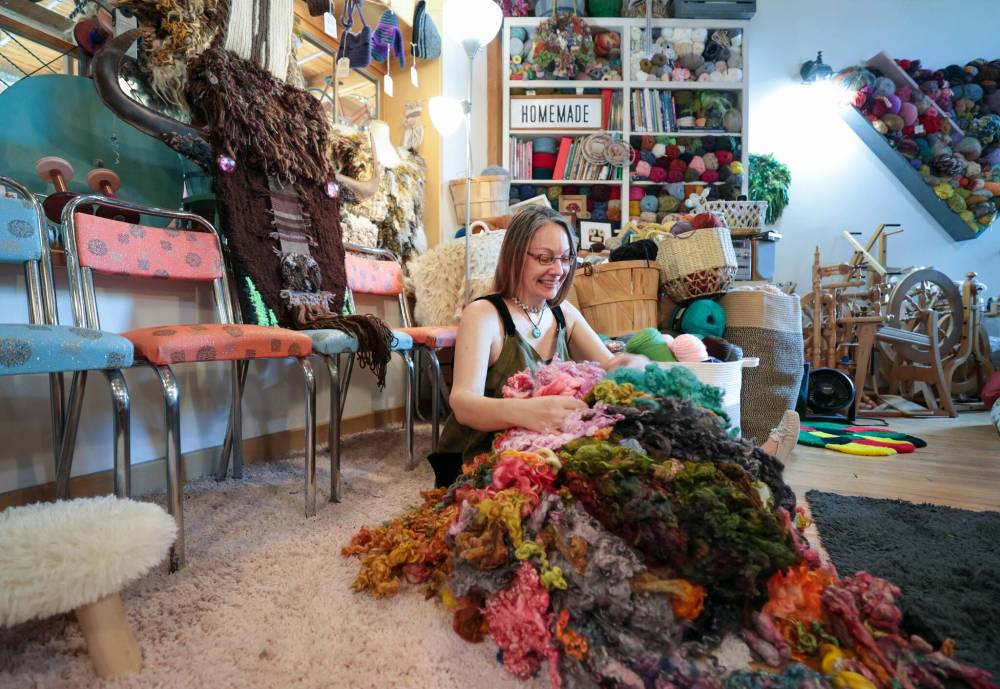
Maureen Lyons sorts through a bag of colourful wool at her Winnipeg studio. (Ruth Bonneville / Free Press)

Closer to home, she gets her Cotswolds and Wensleydale wool from Spirit Sands Shepherds in Carberry, Navajo Churro wool from White Spruce Heritage Farm in Pipestone and Shetland wool from Prairie’s Edge Wool Farm in Steinbach.

“I am the kind of person that gets very excited about things. There is just so much to learn about wool; all the different breeds and the things they are good for. It’s never stopped being exciting to me because every breed of sheep has its own fascinating history on how that breed came to be and one thing leads to the next and before you know it…” she trails off.

… And before you know it you end up with a house crammed to the rafters with wool, and 13 spinning wheels on your dining table?

Lyons laughs.

“I like to collect things! Textile arts is a rabbit hole and if you are like Alice in Wonderland, well it’s quite perfect.”
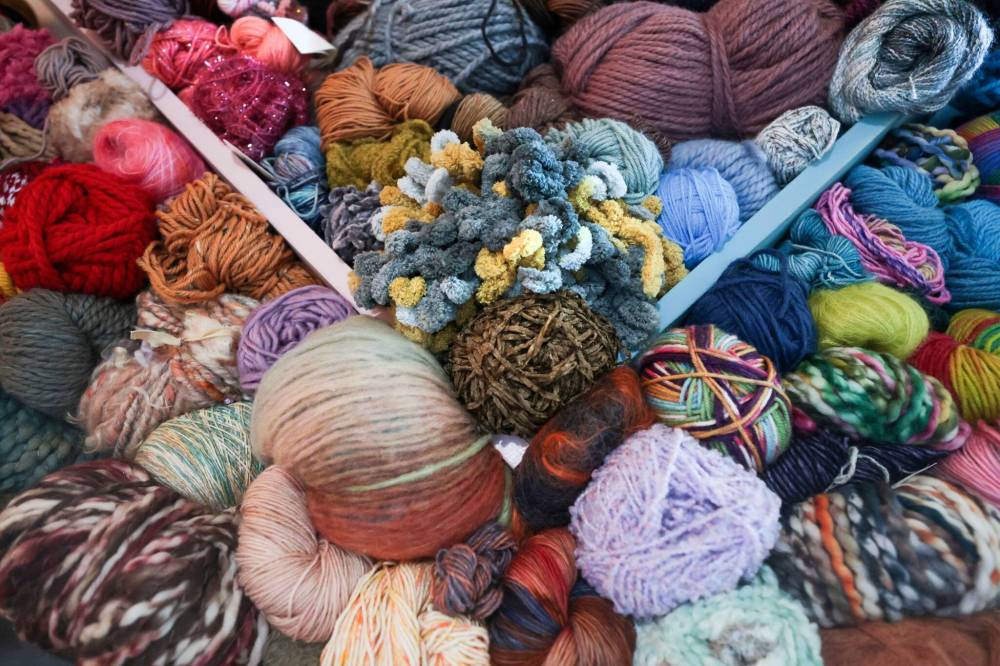
Wool and yarn from all over the world are in Maureen Lyons’ collection. (Ruth Bonneville / Free Press)

But it wasn’t always this way; wool isn’t Lyons’ first love.

Twenty-five years ago she was working with an altogether different raw material: clay.

“I could not have imagined life doing anything other than ceramics. Then, in April 2003, I woke up paralyzed. It was the onset of a rare neurological condition called transverse myelitis. It is similar to MS, and can morph into it. I was undiagnosed for two years and I lost the capacity to do everything,” she says.

The illness, which she continues to manage, signalled the end of ceramics for her.

“Pottery is an inherently strong-person job. To throw things on a wheel, to lift and carry, you need to have a bit of muscle to you. If you drop a ceramic vessel it is gone forever but you can drop a ball of yarn an infinite number of times and it will always forgive you,” she says.

“When the time came for me to find something to nurture my creative spark, I looked for something softer and more welcoming. Wool has opened up brand-new worlds to me and I haven’t looked back since.”

Lyons is currently putting the finishing touches on her three-dimensional mixed media sculpture — a life-size female bison head — which will be on display during the Winnipeg Folk Festival at the Prairie Outdoor Exhibition space.
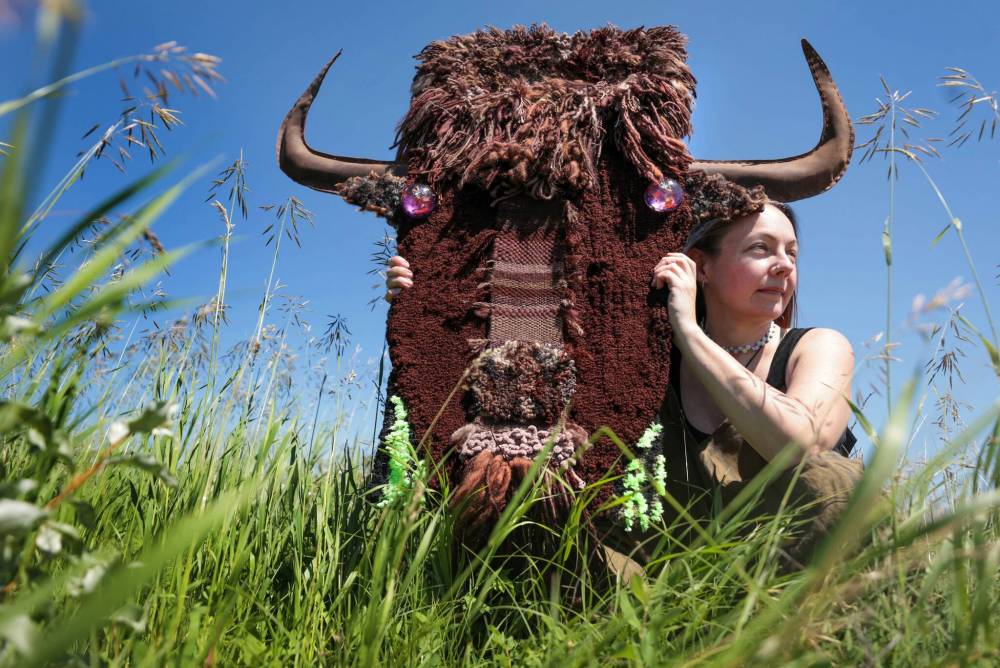
Fibre artist Maureen Winnicki Lyons shows off her life-size design of a bison head, made of wool, yarn and leather, in a grassy field at Living Prairie Museum. (Ruth Bonneville / Free Press)

“I love these big, grand-vision artistic endeavours but I am not disciplined enough to do it on my own, so to have a reason to do something a little more grandiose is really thrilling,” she says.

As well as creating her own art, Lyon also runs Mindfulness is in the Making classes and workshops where she teaches others how to work with natural textiles.

“There is something about the repetitive nature of textile arts, whether it is hand-spinning, hand-weaving or needle felting, which makes it very easy to find a sense of quiet and inner peace. In order to make something new you have to let go of the old. There is a whole amazing world we can reconnect to. Using our hands and minds to do something inherently useful never stops being exciting to me,” she says.

av.kitching@freepress.mb.ca

AV Kitching

AV Kitching
Reporter

AV Kitching is an arts and life writer at the Free Press. She has been a journalist for more than two decades and has worked across three continents writing about people, travel, food, and fashion. Read more about AV.

Every piece of reporting AV produces is reviewed by an editing team before it is posted online or published in print — part of the Free Press‘s tradition, since 1872, of producing reliable independent journalism. Read more about Free Press’s history and mandate, and learn how our newsroom operates.

Our newsroom depends on a growing audience of readers to power our journalism. If you are not a paid reader, please consider becoming a subscriber.

Our newsroom depends on its audience of readers to power our journalism. Thank you for your support.


Report Error Submit a Tip

More Stories

Near-future U.S. the setting for surreal dual-world storyline

Reviewed by Morley Walker 4 minute read Preview

Near-future U.S. the setting for surreal dual-world storyline

Reviewed by Morley Walker 4 minute read 2:01 AM CDT

It’s not every day you encounter a seriously intended literary novel that attempts to dramatize a mind-bending physics theory like quantum entanglement.

But then the B.C.-born-and-raised Emily St. John Mandel is not your everyday Canadian literary writer.

In her late 40s, she has lived in the U.S. for her entire writing career. She is best known for her 2014 dystopian novel Station Eleven, about a Shakespearean acting troupe navigating a pandemic-ravaged America.

Her new outing, her seventh, Exit Party, shares DNA with detective and sci-fi genres more than with conventional literary fiction.

Read
2:01 AM CDT

A life’s story: activist, educator, organizer knew the true meaning of community

Janine LeGal 7 minute read Preview

A life’s story: activist, educator, organizer knew the true meaning of community

Janine LeGal 7 minute read 3:00 AM CDT

Somewhere between a love for sharing stories and a love of community connections, Michael (Mike) Maunder lived his life. Giving voice to people and neighbourhoods was a passion for the natural-born community organizer.

An author, teacher and principal, Maunder lived in a one-bedroom apartment in West Broadway and devoted himself to community development, education and neighbourhood renewal.

He maintained a connection with Augustine United Church, whose commitment to social justice he appreciated, volunteered at the Sandy-Saulteaux Spiritual Centre, and found comfort in a Buddhist prayer community.

Maunder died on July 15 at the age of 80.

Read
3:00 AM CDT

Canada-U.S. trade relationship is broken, but the damage can — and will — be repaired

Tom Brodbeck 5 minute read Preview

Canada-U.S. trade relationship is broken, but the damage can — and will — be repaired

Tom Brodbeck 5 minute read Thursday, Sep. 17, 2026

Canada needs to get serious about diversifying its trade beyond the United States. But at the same time, Canadians should expect relations with the U.S. to normalize after Donald Trump is no longer in the White House.

For generations, Canada-U.S. trade was considered almost a fact of geography. The two countries share the world’s longest undefended border, deeply integrated supply chains and a century of commercial relationships.

Canadian manufacturers depend on American customers. American manufacturers depend on Canadian suppliers. Energy, agriculture, automotive production and countless other industries operate across the border as though it barely exists.

That isn’t going to change dramatically, even in the midst of a bitter trade war unleashed by the U.S. president.

Read
Thursday, Sep. 17, 2026

A Winnipeg lawyer has been disbarred after admitting to six counts of professional misconduct and two counts of providing incompetent service involving eight clients.

The career-ending decision marks the sixth time Gisele Champagne has been disciplined by the Law Society of Manitoba since she was called to the bar in 1992.

“Disbarment is the appropriate remedy when a lawyer has demonstrated a repeated pattern of conduct that violates professional standards,” a law society panel said in a written decision released Wednesday.

“A lawyer who has been unable to learn from past discipline proceedings to fulfill his or her obligation to provide ethical and high-quality legal services must at some point lose the privilege of practising law.”

Manitoba abandoning spring, fall clock changes

Carol Sanders 8 minute read Preview

Manitoba abandoning spring, fall clock changes

Carol Sanders 8 minute read Updated: Yesterday at 8:48 AM CDT

Time’s up for the time change in Manitoba.

Manitobans won’t be setting their clocks back an hour in November. The province has decided to permanently stay on daylight time after surveying residents on the twice annual clock adjustment.

“We heard from Manitobans loud and clear — no more changing the clocks in Manitoba,” Premier Wab Kinew said in a news release Thursday.

Most of the 72,000 votes submitted in an online EngageMB survey — 92 per cent — said they would like to see the practice end. The survey asked if they preferred earlier sunrises in winter with standard time or the later sunsets in summer with daylight time. More than half of survey participants (58 per cent) indicated a preference to stay on permanent daylight time; 34 per cent voted to eliminate the time change but stay on standard time.

Read
Updated: Yesterday at 8:48 AM CDT

United Way, other charities fight for dollars as donor base shrinks

Scott Billeck 8 minute read Preview

United Way, other charities fight for dollars as donor base shrinks

Scott Billeck 8 minute read Yesterday at 2:00 AM CDT

Winnipeg’s charitable sector is being squeezed from both sides: demand for help is growing while the pool of donors to meet that need is shrinking.

The imbalance is increasingly being carried by a relatively small group of deep-pocketed donors. Last year, 600 people — about three per cent of United Way Winnipeg’s individual donors — accounted for roughly $8 million, or 55 per cent of individual donations.

The fundraising pitch isn’t getting any easier.

Homelessness and public drug use have become increasingly visible, household budgets remain strained and the problems charities are trying to address can seem so entrenched that donors may reasonably wonder what difference another contribution can make.

Read
Yesterday at 2:00 AM CDT