Real Ones versus the pretendians
Winnipeg author’s latest novel tackles troubling phenomenon

Advertisement
Read this article for free:
or
Already have an account? Log in here »
To continue reading, please subscribe:

Digital Subscription
One year of digital access for only $205*
- Enjoy unlimited reading on winnipegfreepress.com
- Read the E-Edition, our digital replica newspaper
- Access News Break, our award-winning app
- Play interactive puzzles
*First annual payment billed as $205.00 + GST for one year. This annual subscription will automatically renew at $233.00 + GST every 52 weeks (10% off the regular annual price of $259.35). Offer available to new and qualified returning subscribers only. Cancel any time.
To continue reading, please subscribe:
Add Free Press access to your Brandon Sun subscription for only an additional
$1 for the first 4 weeks*
- Enjoy unlimited reading on winnipegfreepress.com
- Read the E-Edition, our digital replica newspaper
- Access News Break, our award-winning app
- Play interactive puzzles
*Your next Brandon Sun subscription payment will increase by $1.00 and you will be charged $17.95 plus GST for four weeks. After four weeks, your payment will increase to $24.95 plus GST every four weeks.
Read unlimited articles for free today:
or
Already have an account? Log in here »
Hey there, time traveller!
This article was published 09/09/2024 (734 days ago), so information in it may no longer be current.
The “pretendian” phenomenon — someone falsely claiming Indigenous heritage and appropriating Indigenous culture, often for their own benefit, financial or otherwise — has been making headlines recently.
And while Winnipeg Michif author katherena vermette’s new novel Real Ones might seem timely and “ripped from the headlines,” as it were, the pretendian phenomenon can be traced all the way back to 19th-century author Grey Owl — born Archibald Stansfeld Belaney in England in 1888 — and beyond.
In Real Ones, vermette (who doesn’t capitalize her name) follows two Michif (on their father’s side) sisters in present-day Winnipeg — June, an academic and lyn, a potter — as they grapple with the public fallout of the revelation their estranged artist mother, going by the name Raven Bearclaw, is in fact a white Mennonite woman named Renee.
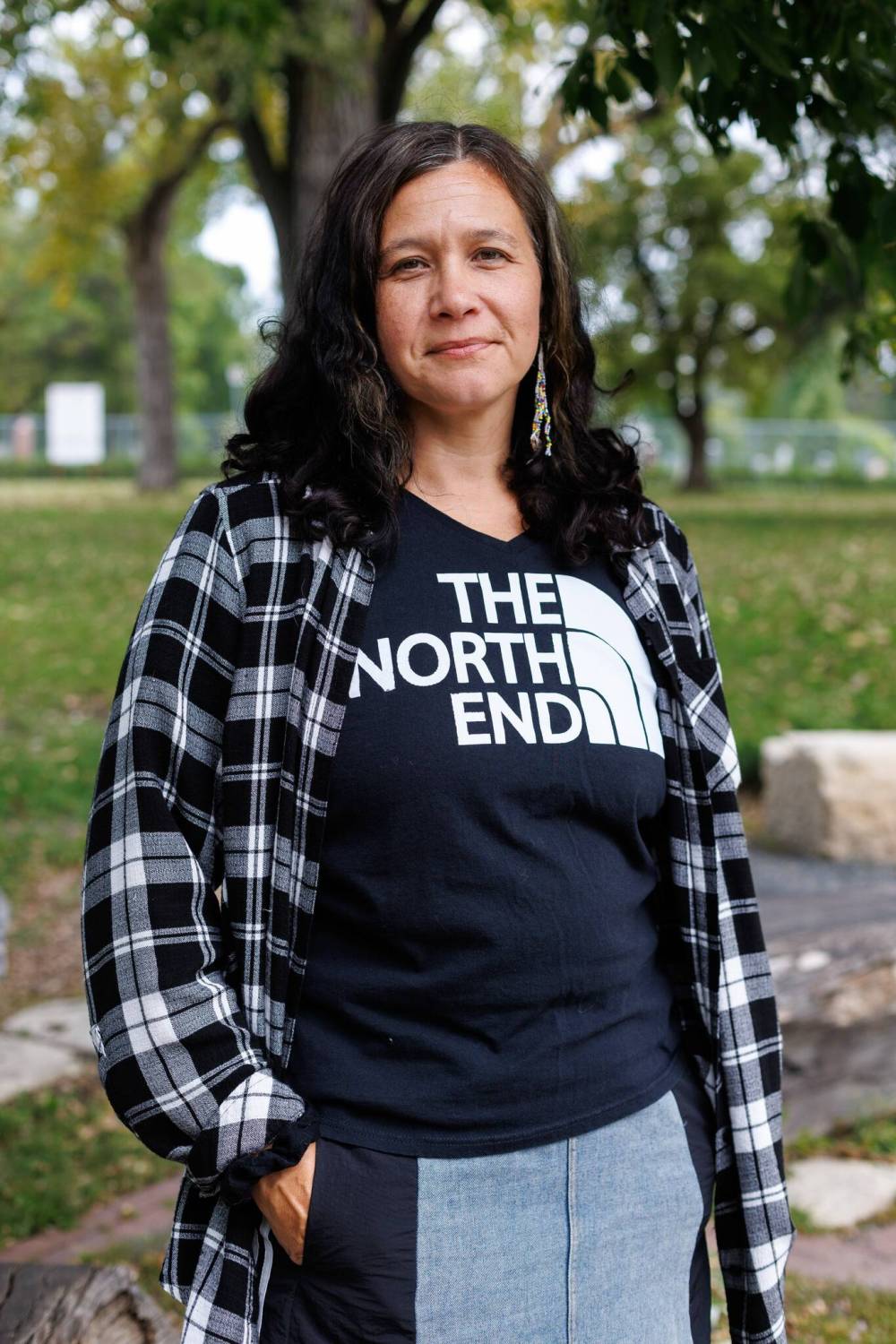
Métis author katherena vermette’s latest novel, Real Ones, focuses on two sisters whose mother was a pretendian.
MIKE DEAL / FREE PRESS
Real Ones is vermette’s fourth novel, following 2023’s The Circle, the third in a trio of interconnected novels detailing the fictional Stranger family that includes 2016’s The Break and 2021’s The Strangers. Vermette made the Giller Prize long list for The Strangers, an accolade she also received on Sept. 4 for Real Ones.
The narrative of Real Ones alternates between the sisters, the conversations they have and the ways in which Renee’s outing as pretendian impacts their lives. The 47-year-old author began writing Real Ones while working on her other novels as an exercise in dialogue between the characters that became June and lyn.
“It started off as a meditation around the race-shifting phenomenon and what effect I felt it had on me, but that was more of a launching pad,” she says. “It’s really about the reaction to it … our own sense of identity and what it means for us and how we’re affected, our emotional labour.”
The differences in the sisters’ personalities sees them move towards resolution from very different places.
“Lyn is a depressive, she’s quiet, she’s an artist. June is anxious, she’s an academic, a type A, a go-getter,” says vermette.
The siblings’ reactions to their mother’s outing also allowed vermette to explore notions of family, emotional identity and the ways in which the pair react to their past and present.
“It’s these two sisters and their bond and how they’re both responding in similar and different ways to their upbringing. It became all these different parts of identity — not only racial identity, but also emotional identity. It became about family and how we play off one another and also it became about taking ownership of their s—t as much as putting it on their mom,” she says.
In June and lyn, whose name also isn’t capitalized, vermette was also able to create characters who inhabit worlds about which she’s always been curious.
“I’m really fascinated by vocation, the paths I didn’t take and the vocations I wish I had,” she says.
In that spirit, vermette also tried her hand at pottery to try and get a feel for the art form while writing Real Ones.
“Lyn, as far as her art practice is concerned, is inspired by my friend K.C. Adams, a local prolific artist. She’s tried to teach me many times about how to make a vessel, but I’m a horrible potter. I have no patience for it,” says vermette.
“Anything I’ve ever finished is only because she went back and fixed it,” she adds, laughing.
Vermette also used pottery as lyn’s artistic vocation to explore the remnants of Indigenous culture in North America that continue to surface decades and centuries later.
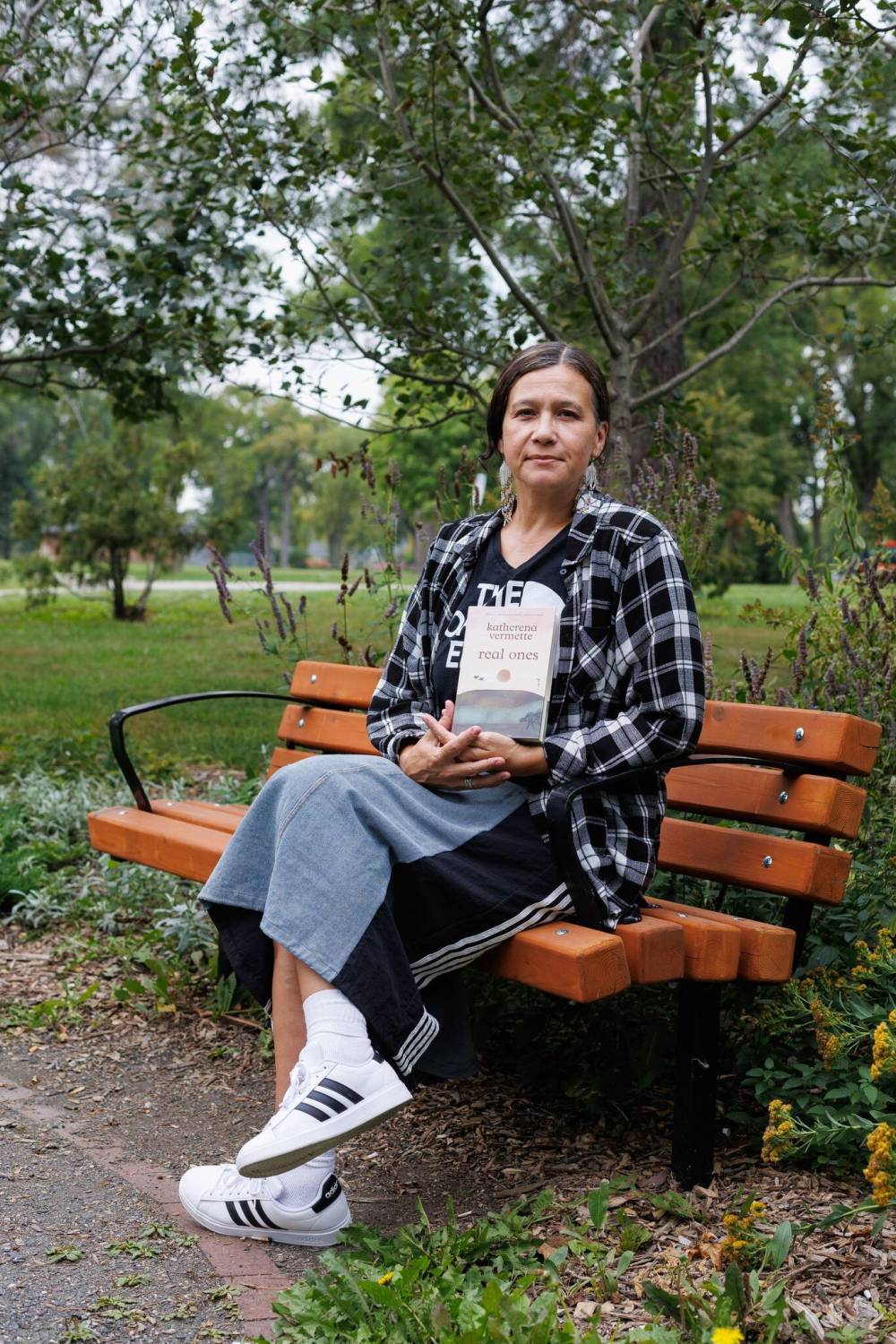
“Shards are found along waterways, absolutely everywhere,” she says. “We’ve been here from time immemorial — there’s evidence of our ancestors that reach back thousands of years. (Creating vessels) is a skill and a technique that not only we can recreate, but also connects us to them. I find that really magical and powerful and worthy of acknowledging.”
After considering giving Renee more of a presence in the novel, vermette instead decided to give the narrative crux of Real Ones to the sisters.
“Part of it was that I didn’t want to give her any more of a voice because the whole point of this, and the whole point of what she’s done, is that it’s taken up so much space. And therein lies the violence that she’s committed,” she says.
Vermette was also involved in aspects of Real Ones beyond its writing, including commissioning Vancouver artist Julie Flett to do the book cover as well as voicing lyn in the audiobook version of the novel.

“I loved doing it. I was so excited when (the publisher) said yes, I could do it,” Flett says. “They approached me with this idea of different voices. I thought I would do a bit part, you know, in the background. But they said, ‘Why don’t you do a sister? Pick a sister.’ And I’m like, ‘Oh I’m definitely lyn — definitely the more depressive artist type.’”
In addition to working on a collection of poems — her 2012 debut collection, North End Love Songs, won the Governor General’s Literary Award for poetry — vermette has been learning about the literary industry from a relatively new perspective as a senior editor for publisher Simon & Schuster, with a focus on Indigenous, LGBTTQ+ and other underrepresented authors.
“I’ve got a real job now, for the first time in many years,” she says, laughing.
“I’m learning a lot and I get to help others make books. So I still get to put the books out into the world that I want to, but I don’t have to do all the work.”
books@freepress.mb.ca
Ben Sigurdson
Literary editor, drinks writer
Ben Sigurdson is the Free Press‘s literary editor and drinks writer. He graduated with a master of arts degree in English from the University of Manitoba in 2005, the same year he began writing Uncorked, the weekly Free Press drinks column. He joined the Free Press full time in 2013 as a copy editor before being appointed literary editor in 2014. Read more about Ben.
In addition to providing opinions and analysis on wine and drinks, Ben oversees a team of freelance book reviewers and produces content for the arts and life section, all of which is reviewed by the Free Press’s editing team before being posted online or published in print. It’s part of the Free Press‘s tradition, since 1872, of producing reliable independent journalism. Read more about Free Press’s history and mandate, and learn how our newsroom operates.
Our newsroom depends on a growing audience of readers to power our journalism. If you are not a paid reader, please consider becoming a subscriber.
Our newsroom depends on its audience of readers to power our journalism. Thank you for your support.
Event preview
An evening with katherena vermette
Launching Real Ones in conversation
with Shelagh Rogers
- Tuesday, 7 p.m.
- McNally Robinson Booksellers, Grant Park (1120 Grant Ave.)
- Free
Ben Sigurdson
Literary editor, drinks writer
Ben Sigurdson is the Free Press‘s literary editor and drinks writer. He graduated with a master of arts degree in English from the University of Manitoba in 2005, the same year he began writing Uncorked, the weekly Free Press drinks column. He joined the Free Press full time in 2013 as a copy editor before being appointed literary editor in 2014. Read more about Ben.
In addition to providing opinions and analysis on wine and drinks, Ben oversees a team of freelance book reviewers and produces content for the arts and life section, all of which is reviewed by the Free Press’s editing team before being posted online or published in print. It’s part of the Free Press‘s tradition, since 1872, of producing reliable independent journalism. Read more about Free Press’s history and mandate, and learn how our newsroom operates.
Our newsroom depends on a growing audience of readers to power our journalism. If you are not a paid reader, please consider becoming a subscriber.
Our newsroom depends on its audience of readers to power our journalism. Thank you for your support.
Related Articles
Art, identity and indigeneity explored in vermette’s timely new novel
Advertisement Advertise With Us
Advertisement Advertise With Us
History
Updated on Monday, September 9, 2024 7:08 AM CDT: Changes tile photo