Organizing our organisms Manitoba Museum zoology curator’s role focuses on interpreting info about our province’s animals
Read this article for free:
or
Already have an account? Log in here »
To continue reading, please subscribe:

Digital Subscription
One year of digital access for only $205*
- Enjoy unlimited reading on winnipegfreepress.com
- Read the E-Edition, our digital replica newspaper
- Access News Break, our award-winning app
- Play interactive puzzles
*First annual payment billed as $205.00 + GST for one year. This annual subscription will automatically renew at $233.00 + GST every 52 weeks (10% off the regular annual price of $259.35). Offer available to new and qualified returning subscribers only. Cancel any time.
To continue reading, please subscribe:
Add Free Press access to your Brandon Sun subscription for only an additional
$1 for the first 4 weeks*
- Enjoy unlimited reading on winnipegfreepress.com
- Read the E-Edition, our digital replica newspaper
- Access News Break, our award-winning app
- Play interactive puzzles
*Your next Brandon Sun subscription payment will increase by $1.00 and you will be charged $17.95 plus GST for four weeks. After four weeks, your payment will increase to $24.95 plus GST every four weeks.
Read unlimited articles for free today:
or
Already have an account? Log in here »
Hey there, time traveller!
This article was published 30/12/2024 (586 days ago), so information in it may no longer be current.
Randall Mooi, 62, is the curator of zoology at the Manitoba Museum. He received his PhD from the University of Toronto, working on the evolutionary history of coral reef fishes. Following a postdoctoral fellowship in the Division of Fishes of the Smithsonian Institution, he was curator of fishes and section head of vertebrate zoology at the Milwaukee Public Museum.
Mooi joined the Manitoba Museum in 2004, focusing on fish evolution and post-glacial biogeography of snakes, toads and frogs in the province.
A zoology curator’s job… is to make sure there is a good representation of the animals we have in the area over time. The mandate for the Manitoba Museum is Manitoba. A lot of the work is baseline work to find out where organisms live in the province so we can monitor their populations and the impact of things like climate change. It’s amazing how little we really know about where organisms live in the province.
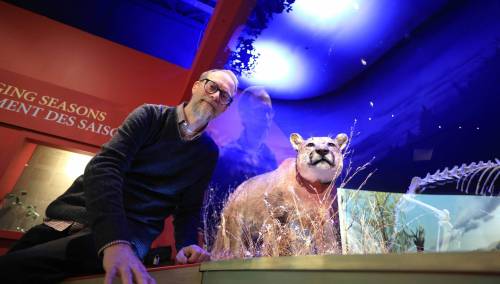
RUTH BONNEVILLE / FREE PRESS Mooi checks out the museum’s new cougar exhibit, which is a permanent part of the Parklands Gallery.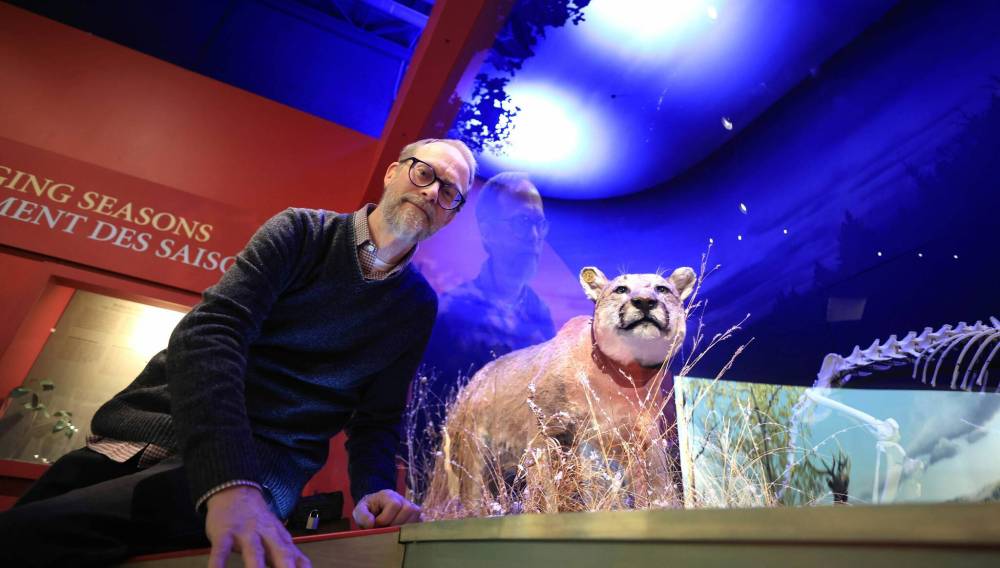
A curator has three main roles… One is looking after the collections. The second is conducting original research using the collections to try and answer certain questions. And third, once we have found new knowledge, is to share it with our academic colleagues and, as important, is to interpret that science for the public.
Collections are essentially libraries… they are there for everyone to use. Just like you can take books out of the library and read them, researchers can take specimens out of the collection and, if they know how to read the specimen — for instance if they can identify it or potentially dissect it and see what’s inside — they can learn a lot about the organism.
Our role is to interpret that knowledge… and we do that in a whole variety of ways. We might give presentations, we might write blogs, we might do social media posts, but the most obvious one for a lot of museum visitors is building the galleries themselves. The more we can learn about our collection, the better job we can do of informing the public about what is happening in the environment around them.
RUTH BONNEVILLE / FREE PRESS The Manitoba Museum’s curator of zoology, Randall Mooi, uncovers a buffalo specimen from 1912 in the collections area.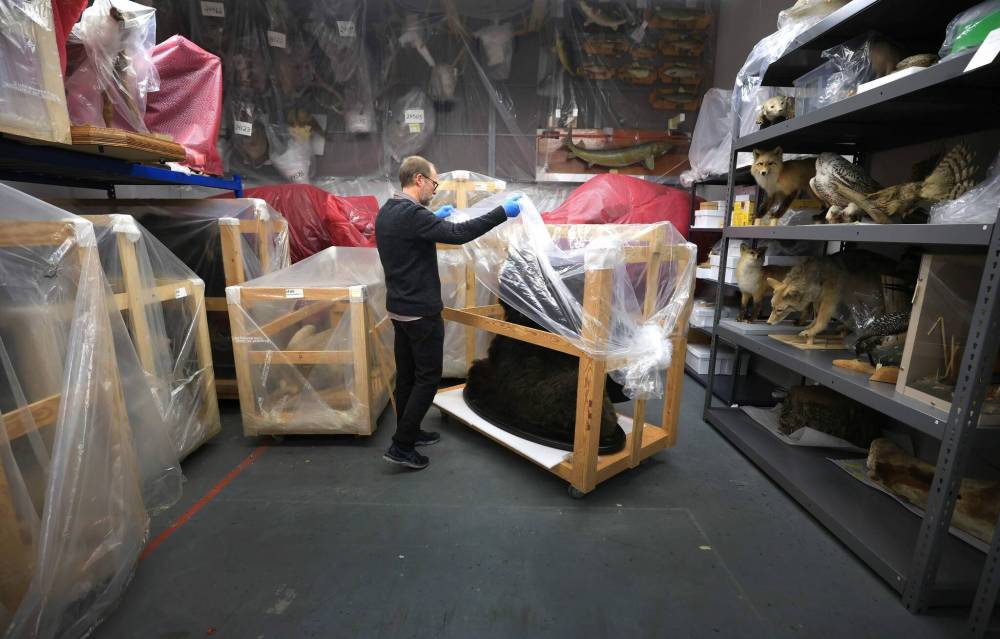
Only five per cent of our collection… is on exhibit within the museum galleries at any one time. The remainder is stored in special collection areas as research material, held in trust for the people of Manitoba. The collection materials are not really ours; we are looking after them for the people of Manitoba as a record of — in the case of zoology — the animals that live in the province.
The zoology collections span about 150 years… and so we can look at changes in the population of animals over time, from 150 years ago through to today. We can also use them to look at levels of heavy metals in the environment, we can take samples from animals from 150 years ago and compare them over time and see where there might be changes in some of those things.
The collections are very valuable… they are a historical record of what the environment was like over time. We have to build the collections — that can either be through our own research or through donations from people such as amateur insect collectors who donate specimens.
I receive more than 250 inquiries a year… somewhat less than half are academic, the remainder are public, including: identifications of insects, spiders, birds, mammals, frogs, skulls or other bones; questions about taxidermy specimens found in the attic; window-killed birds offered for donation — that is the primary way we add birds to the research collection (they should be picked up using the bag as a “glove” then double-ziplock-bagged and frozen ASAP with as little air as possible, with a label including location, date of collection, and collector); legal status of ivory — elephant, walrus — among many other topics.
RUTH BONNEVILLE / FREE PRESS The Manitoba Museum’s curator of zoology, Randall Mooi, looks through the museum’s collection of grey owls.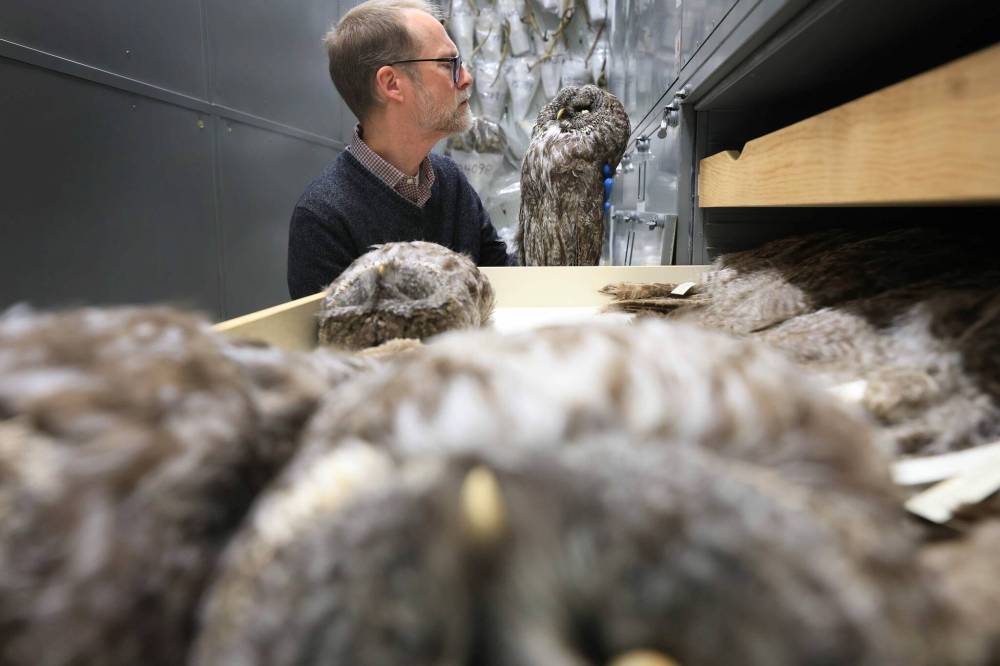
One of the odder ones was a… very serious offer to sell us a unicorn horn from Saudi Arabia; photos were included along with sighting and biology details. Some of the more exciting, genuine offers have involved donation of historically important or rare specimens, including a specimen of extinct passenger pigeon and — although really a paleontology specimen, I was involved in IDing the specimen — a lower jaw of a fossilized giant beaver that is the first and only record of that animal for Manitoba.
Science literacy is a hugely important aspect of the museum’s mandate… It’s an opportunity to show how science can help us understand our environment. Increasing science literacy and knowledge of biodiversity is our path to resolving sustainability and being responsible stewards of our planet and our fellow earthlings.
How we live impacts other organisms… understanding about biodiversity on Earth is critical for us to understand our place on the planet, what our role is, what we need to think about when we are using the environment and when we are exploiting it, and what effect does that have on biodiversity. What we know of the diversity of those other organisms — where they lived, how they are living — we may not only be saving them, but also ourselves in the long run.
It is critical to be monitoring what’s happening to the environment… our survival relies on the survival of organisms around us. We can’t live on Earth without other organisms here. We are seeing our fellow earthlings disappearing: that means there is something wrong with our environment. We are doing something that is eventually going to harm us.
RUTH BONNEVILLE / FREE PRESS The Manitoba Museum’s curator of zoology, Randall Mooi, holds a cougar skull specimen.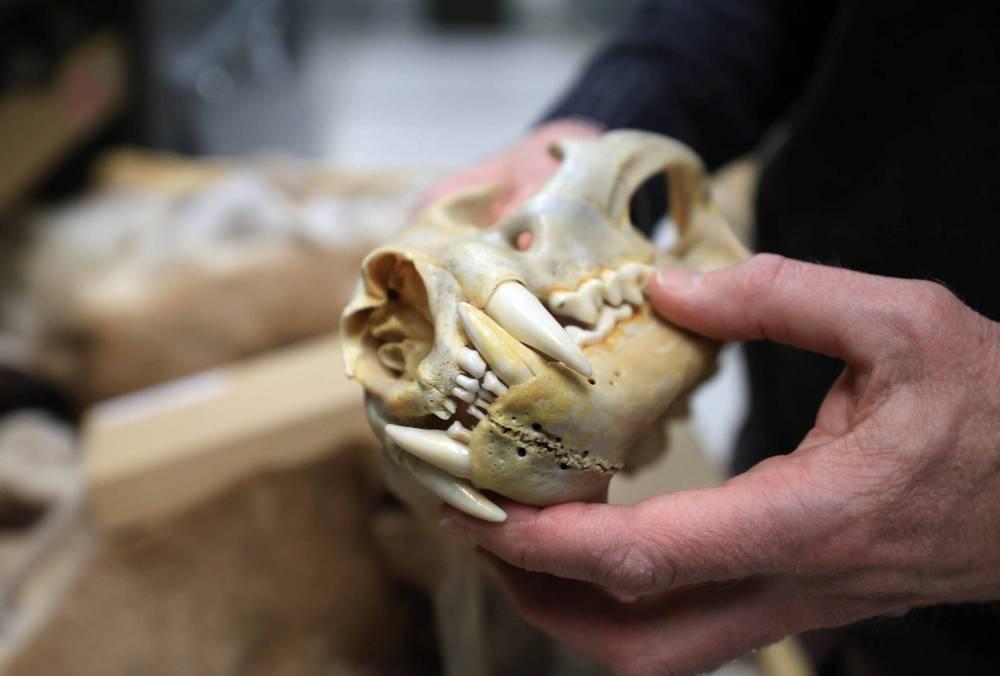
We probably shouldn’t be so selfish… we need to think about the world in a much broader context. Not necessarily just to think, “Oh what does that mean for us humans?” It isn’t just about you. We have these fellow earthlings that we happen to have a huge impact on and we should be looking after them and making sure that we have as little effect on their lives as possible. It will enrich our lives in the long run.
What drives me is… wanting to know. It’s the excitement and joy of discovery. What feeling is better than being the first to see or understand something no one else has before? And then to share it with colleagues or total strangers like museum gallery visitors. Seeing nose-prints on the glass of exhibit cases as kids experience the wonders and diversity of nature. To know that you have at least a small role inspiring the next generation of biologists and conservationists is gratifying.
Having that curiosity… wanting to know something just so you know, is an important part of being human. Knowledge for knowledge’s sake is a pretty fun thing to have.
I’ve been fortunate to land a career… where I’ve been able to survey coral reefs not previously studied, to discover fish species new to science, to find rare species of Manitoba fishes, birds and toads in places they weren’t known to occur. Even in the lab, looking down a microscope at a museum specimen to find a critical detail of an animal’s biology that wasn’t understood — it’s so exciting.
RUTH BONNEVILLE / FREE PRESS The Manitoba Museum’s curator of zoology, Randall Mooi, uncovers a buffalo specimen from 1912 in the collections area.
Being able to share these discoveries… or use what I’ve learned to identify mystery objects that people find at their cottage or on the beach, help students reach their academic goals, or help build museum galleries that introduce the amazing Manitoba outdoors is very satisfying. That some of my work has played a part in the conservation of endangered species or preserving ecological regions for future generations is rewarding and humbling.
For me one of the pleasures of the job… is inspiring people to want to know more. When you know something, you are more likely to care about it. We know that’s true for people; if we know more about the people around us, we care more. It’s exactly the same for the natural world. If we know more about the organisms that live in in our neighbourhood and how interesting they are and how they can add to our lives, then we will want to look after them.
Answers have been edited for clarity and length
av.kitching@freepress.mb.ca

AV Kitching is an arts and life writer at the Free Press. She has been a journalist for more than two decades and has worked across three continents writing about people, travel, food, and fashion. Read more about AV.
Every piece of reporting AV produces is reviewed by an editing team before it is posted online or published in print — part of the Free Press‘s tradition, since 1872, of producing reliable independent journalism. Read more about Free Press’s history and mandate, and learn how our newsroom operates.
Our newsroom depends on a growing audience of readers to power our journalism. If you are not a paid reader, please consider becoming a subscriber.
Our newsroom depends on its audience of readers to power our journalism. Thank you for your support.
History
Updated on Monday, January 6, 2025 9:48 AM CST: Corrects photo caption