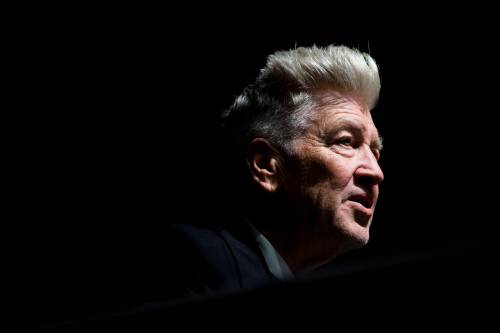
‘Everything to me’
For Guy Maddin and other Winnipeggers in the film industry, director David Lynch’s vision was truly life-changing

Advertisement
Read this article for free:
or
Already have an account? Log in here »
To continue reading, please subscribe:

Digital Subscription
One year of digital access for only $205*
- Enjoy unlimited reading on winnipegfreepress.com
- Read the E-Edition, our digital replica newspaper
- Access News Break, our award-winning app
- Play interactive puzzles
*First annual payment billed as $205.00 + GST for one year. This annual subscription will automatically renew at $233.00 + GST every 52 weeks (10% off the regular annual price of $259.35). Offer available to new and qualified returning subscribers only. Cancel any time.
To continue reading, please subscribe:
Add Free Press access to your Brandon Sun subscription for only an additional
$1 for the first 4 weeks*
- Enjoy unlimited reading on winnipegfreepress.com
- Read the E-Edition, our digital replica newspaper
- Access News Break, our award-winning app
- Play interactive puzzles
*Your next Brandon Sun subscription payment will increase by $1.00 and you will be charged $17.95 plus GST for four weeks. After four weeks, your payment will increase to $24.95 plus GST every four weeks.
Read unlimited articles for free today:
or
Already have an account? Log in here »
Hey there, time traveller!
This article was published 17/01/2025 (623 days ago), so information in it may no longer be current.
On Thursday, it was announced filmmaker and artist David Lynch had died. And like the cosmic cataclysm he created in Twin Peaks: The Return, his death, just prior to his 79th birthday, sent a pulse wave from Los Angeles all the way to Winnipeg.
“David Lynch was everything to me, the very reason I first picked up a movie camera,” says Winnipeg filmmaker Guy Maddin, 68, in an email interview.

Maddin recalled seeing Lynch’s first feature with some friends at the long-gone Festival Cinema at Sargent Avenue and Arlington Street.
“Until I saw his Eraserhead in 1980, I had no idea films could draw on the subconscious so powerfully, could speak to me directly,” Maddin says, adding some of his friends were impressed, while others were frustrated and even infuriated by the strangeness of the “arty and arbitrary” production.
“That anyone had made a movie like Eraserhead, a thing that could sear my senses and leave me unable to sleep that night, astonished me. He showed me a vast new region of possible film subjects and gave me the courage and even the compulsion to attempt my own forays into that region.
“I could never approach Lynch’s powers, but it’s been great trying. That’s all I’ve been trying to do. His death truly saddens me.”
Winnipeg-based writer and filmmaker George Godwin, 70, could relate to Maddin’s experience. As a film critic at the University of Winnipeg, Godwin also saw Eraserhead in its 1980 festival run, and was likewise thunderstruck by its dreamlike invention.
Godwin would go on to review the film for Cinefantastique and eventually write a whole book on the film, Eraserhead: The David Lynch File Vol. 1.
Lynch himself was so impressed with Godwin’s analysis, he hired Godwin to be a on-set diarist for his subsequent film Dune (1984), which turned out to be a disappointment for many. For Godwin, the experience was life-changing.
SUPPLIED Winnipeg-based writer and filmmaker George Godwin (left) served as an on-set video diarist during the making of David Lynch’s adaptation of the Frank Herbert science-fiction classic Dune.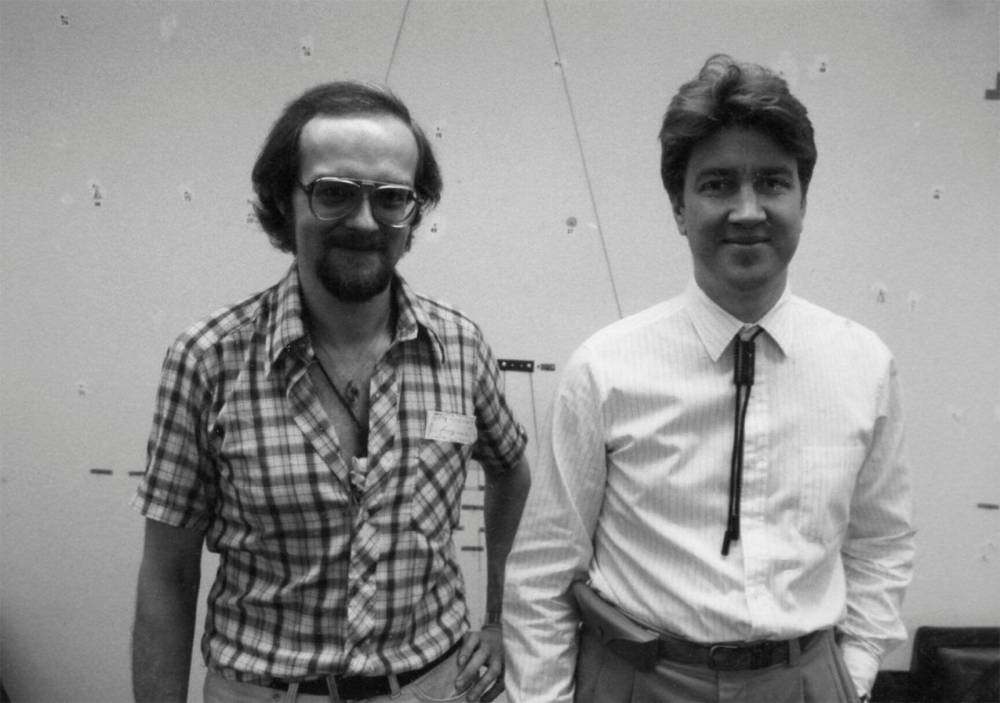
“But just in terms of getting out into the world and dealing with the studio, dealing with a big film production, dealing with all these pretty famous people, I sort of realized that, oh yes, I can actually function in this much larger context than I was used to,” he says.
“Being referenced in his autobiography really puffed up my ego a bit. He acknowledged what I’d written about Eraserhead was the most significant writing about the film. That feels really good.”
Los Angeles-based, Winnipeg-born actor-writer-showrunner Johanna Stein had a brief but memorable role in Lynch’s masterpiece Mulholland Drive (2001) as “The woman in #12,” a character with an apparent but unspoken connection to Naomi Watts’ character Betty.
“I had been such a fan of David Lynch. I was obsessed with Twin Peaks when it came out, I went to AFI film school mostly because he was an alum. So when I was cast in Mulholland Drive, I wasn’t just excited about booking it, I was totally starstruck,” she recalls.
“I don’t know if he could sense how nervous I was, but while the shot was being set up, he sat me in a chair next to him and we just chit-chatted. He asked me questions about my family and where I was from, and said things like ‘gosh-darn’ and ‘oh, that’s neat!’ He was so disarming and genuine, it really set me at ease.”
Stein affectionately recalls Lynch’s directing style.
“There’s a moment in one of the scenes where my character is skulking around outside an apartment. Sensing something bad has just happened, I’m supposed to walk quickly towards camera, which was being held by an operator who’s walking backwards,” Stein says. “David calls ‘Action!’ and because I’m new and don’t know any better, I run full-speed right into the camera, almost knocking the guy over.
“David yells ‘CUT!’ and then I hear him call out in his twangy, Midwestern-y voice, ‘Y’know Johanna, you’re not training for the Olympics here…’
“What a loss. He was such a uniquely talented artist and filmmaker, and such an authentic and fascinating person.”
randall.king.arts@gmail.com
Our newsroom depends on a growing audience of readers to power our journalism. If you are not a paid reader, please consider becoming a subscriber.
Our newsroom depends on its audience of readers to power our journalism. Thank you for your support.
Hollywood reacts
The death of David Lynch, the visionary filmmaker behind Twin Peaks and Blue Velvet, reverberated throughout the movie industry. Here are a few notable quotes collected from interviews and social media:
• “He’s one of those filmmakers who was influential but impossible to imitate. People would try but he had one kind of algorithm that worked for him and you attempted to recreate it at your peril. As non-linear and illogical as they often seemed, they were clearly highly organized in his mind.” — Director Steven Soderbergh
• “I am astounded and heartbroken I can’t express with any words the profound loss of the great David Lynch my friend.” — Director Francis Ford Coppola
• “Forty-two years ago, for reasons beyond my comprehension, David Lynch plucked me out of obscurity to star in his first and last big budget movie. He clearly saw something in me that even I didn’t recognize. I owe my entire career, and life really, to his vision.” — Actor Kyle MacLachlan
• “The world will not be the same without him. His creative mentorship was truly powerful. He put me on the map. The world I’d been trying to break into for ten plus years, flunking auditions left and right. Finally, I sat in front of a curious man, beaming with light, speaking words from another era, making me laugh and feel at ease. How did he even ‘see me’ when I was so well hidden, and I’d even lost sight of myself?!” — Actress Naomi Watts
• “#RIPDavidLynch, a gracious man and fearless artist who followed his heart & soul and proved that radical experimentation could yield unforgettable cinema.” — Director Ron Howard
• “Like Kafka, like Bacon, he dedicated his life to opening a portal. He was the first to show me another world, a beautiful one of love and danger I sensed but had never seen outside sleep. Thank you David your gift will reverberate for the rest of my life.” — Director Jane Schoenbrun
• “Across the decades, David’s impact on cinema proved indelible in his films and his art — and he always gave back to AFI — supportive of the storytellers who wrote their own rules and reached for something different.” — The American Film Institute
— The Associated Press
Our newsroom depends on a growing audience of readers to power our journalism. If you are not a paid reader, please consider becoming a subscriber.
Our newsroom depends on its audience of readers to power our journalism. Thank you for your support.
Related Articles
'Lynch was everything to me': How the surrealist icon inspired Canadian filmmakers


Advertisement Advertise With Us
Advertisement Advertise With Us