Art with heart
Exhibition focused on cardiac care pulses with personal expression and family impacts of medical intervention

Advertisement
Read this article for free:
or
Already have an account? Log in here »
To continue reading, please subscribe:
Digital Subscription
One year of digital access for only $1.44 a week*
- Enjoy unlimited reading on winnipegfreepress.com
- Read the E-Edition, our digital replica newspaper
- Access News Break, our award-winning app
- Play interactive puzzles
*Billed as $5.77 plus GST every four weeks. After 52 weeks, price increases to the regular rate of $19.95 plus GST every four weeks. Offer available to new and qualified returning subscribers only. Cancel any time.
To continue reading, please subscribe:
Add Free Press access to your Brandon Sun subscription for only an additional
$1 for the first 4 weeks*
- Enjoy unlimited reading on winnipegfreepress.com
- Read the E-Edition, our digital replica newspaper
- Access News Break, our award-winning app
- Play interactive puzzles
*Your next Brandon Sun subscription payment will increase by $1.00 and you will be charged $17.95 plus GST for four weeks. After four weeks, your payment will increase to $24.95 plus GST every four weeks.
Read unlimited articles for free today:
or
Already have an account? Log in here »
Hey there, time traveller!
This article was published 08/02/2025 (625 days ago), so information in it may no longer be current.
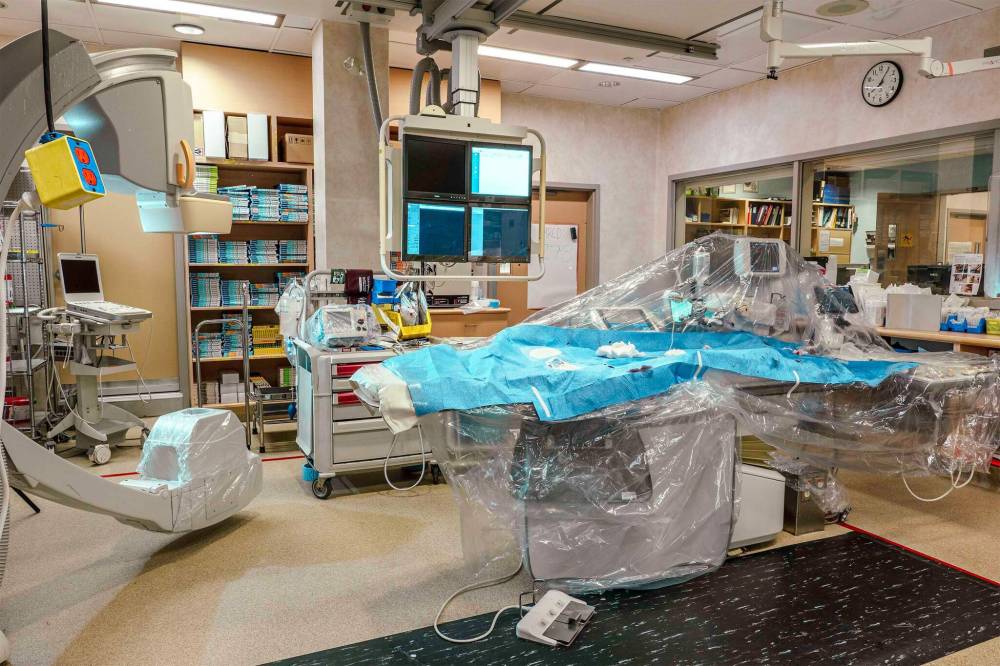
WHAT IT IS: Depicting two stages of a cardiac medical procedure, this pair of photographs is part of the exhibition Cardially Yours by Winnipeg artist Charles Romero Venzon, now on view at Galerie Buhler Gallery.
WHAT IT’S ABOUT: Located within the St. Boniface Hospital, Galerie Buhler Gallery often shows art that specifically speaks to this institutional context, addressing issues around medicine, healing and physical and mental health.
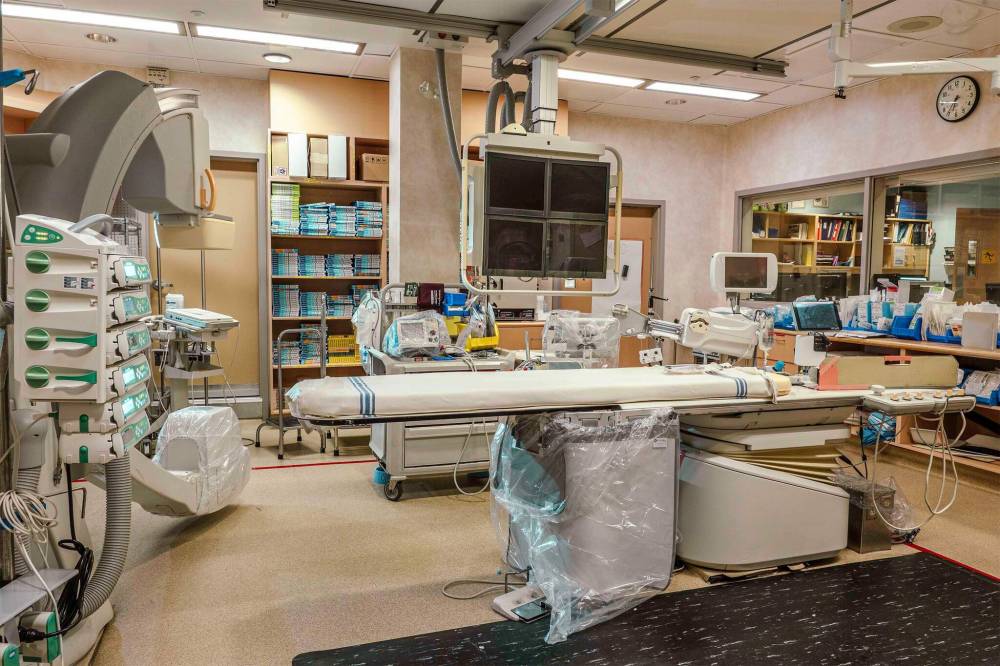
These large-scale digital prints, documenting before-and-after images of an angioplasty, get to the heart of the matter. Venzon’s show is centred around the Cardiac Sciences Manitoba program at St. B., and these images suggest the hidden labour and complex skills that keep this crucially important unit of the hospital ticking.
CHARLES ROMERO VENZON PHOTO
Cardially Yours by Charles Romero Venzon at Galerie Buhler Gallery
Angioplasty / Stent procedure — after (digital print, 2024)
In a months-long process, Venzon — who works across media but does a lot of lens-based art — was given close access to the cardiac-care program’s health professionals and their working environments. He photographed nurses, doctors, medical technicians, cleaners, clerks and Hero, the therapy dog.
His images convey a lot of objective information about the everyday work that goes on at the hospital. But Venzon also has a deeply subjective connection to this theme. In 1995, the artist’s father had a heart attack at age 56, and thanks to lifesaving surgery at St. Boniface, went on to have 21 more years with his family before his passing in 2016.
To protect patient privacy, Venzon’s working method strictly observed the Personal Health Information Act. This pair of angioplasty photographs allows him to “show” a medical procedure without showing a medical procedure. Looking at the before-and-after images of this crowded but carefully organized space, we can imagine the gap between.
Even without witnessing the actual operation, we get a sense of the labour, the knowledge and the meticulous prep involved in the process. We don’t need graphic, reality-TV-type images: A small spot of blood on the “after” image is enough to call up the human stakes of this story.
Venzon’s photos do function as documentary realism. There are the visual markers of a working hospital in these images — the white flannel sheet with blue stripes, the blinking machines, the electrical cords, the stacks of paper and files.
But the scale of the images expands their effect. Some of Venzon’s photos are printed on poly silk and hung from the ceiling. Some are conveyed through life-size video projections.
The larger context of Venzon’s show also affects how we relate to the photos. Taken by themselves, these images might seem at first, well, clinical. But Venzon weaves in his own experiences throughout the exhibition, adding layered emotional resonance.
Venzon puts his own body on the line, in a series of vulnerable images that show him undergoing a stress test, an echocardiogram and an EKG. There are family portraits and medical documents. There are lovely pencil and pastel drawings of objects important to Venzon’s late father, on which the artist has collaborated with his own children.
CHARLES ROMERO VENZON PHOTO
Depicting a cardiac operation, the paired images (Angioplasty / Stent procedure — before and after) are part of the exhibition Cardially Yours at Galerie Buhler Gallery at the St. Boniface Hospital.
With these added elements, Cardially Yours becomes Venzon’s poignant and personal expression of the intergenerational impact of the hospital’s work.
WHY IT MATTERS: The language around photography can sound aggressive or cold. People “take” or “shoot” or “capture” images. There’s an idea that the camera looks at the world as an impassive, distanced recorder.
Venzon’s art suggests something kinder, gentler, more co-operative. We can sense Venzon forming relationships and building trust, working with his subjects to convey the full human dimension of the health-care system.
These photographs convey the state-of-the-art technology and scientific expertise that go into 21st-century cardiac health care. (And remember, readers, February is Heart Month.) But they also touch on the timeless metaphorical connotations of the heart. Centuries of art, music and poetry have portrayed the heart as the locus of feeling, and in Venzon’s work, it is intimately bound up with love, grief, memory and hope.
alison.gillmor@freepress.mb.ca
Studying at the University of Winnipeg and later Toronto’s York University, Alison Gillmor planned to become an art historian. She ended up catching the journalism bug when she started as visual arts reviewer at the Winnipeg Free Press in 1992.
Our newsroom depends on a growing audience of readers to power our journalism. If you are not a paid reader, please consider becoming a subscriber.
Our newsroom depends on its audience of readers to power our journalism. Thank you for your support.
Studying at the University of Winnipeg and later Toronto’s York University, Alison Gillmor planned to become an art historian. She ended up catching the journalism bug when she started as visual arts reviewer at the Winnipeg Free Press in 1992.
Our newsroom depends on a growing audience of readers to power our journalism. If you are not a paid reader, please consider becoming a subscriber.
Our newsroom depends on its audience of readers to power our journalism. Thank you for your support.
Advertisement Advertise With Us
Advertisement Advertise With Us