Innocents project Epidemic of children being kidnapped in Nigeria focus of art exhibition
Read this article for free:
or
Already have an account? Log in here »
To continue reading, please subscribe:

Digital Subscription
One year of digital access for only $205*
- Enjoy unlimited reading on winnipegfreepress.com
- Read the E-Edition, our digital replica newspaper
- Access News Break, our award-winning app
- Play interactive puzzles
*First annual payment billed as $205.00 + GST for one year. This annual subscription will automatically renew at $233.00 + GST every 52 weeks (10% off the regular annual price of $259.35). Offer available to new and qualified returning subscribers only. Cancel any time.
To continue reading, please subscribe:
Add Free Press access to your Brandon Sun subscription for only an additional
$1 for the first 4 weeks*
- Enjoy unlimited reading on winnipegfreepress.com
- Read the E-Edition, our digital replica newspaper
- Access News Break, our award-winning app
- Play interactive puzzles
*Your next Brandon Sun subscription payment will increase by $1.00 and you will be charged $17.95 plus GST for four weeks. After four weeks, your payment will increase to $24.95 plus GST every four weeks.
Read unlimited articles for free today:
or
Already have an account? Log in here »
Hey there, time traveller!
This article was published 18/08/2025 (413 days ago), so information in it may no longer be current.
In the spring of 2014, 276 girls were abducted from their school in Chibok, Nigeria, by the Islamic extremist group Boko Haram.
It was a shocking story that made headlines all over the world and sparked the global #BringBackOurGirls movement. Many high-profile people, including American first lady Michelle Obama and actor/activist Angelina Jolie, raised awareness about the missing Nigerian girls.
And then, they faded from view.
MIKAELA MACKENZIE / FREE PRESS Artist Habeeb Andu doesn’t want people to forget the children being kidnapped in Nigeria. 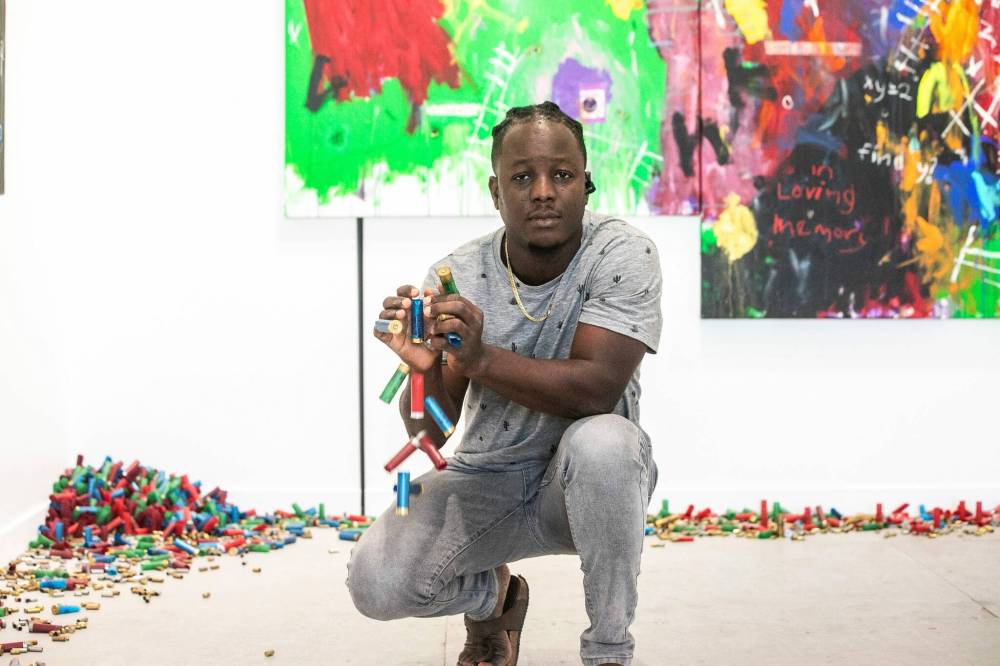
Nigerian-born, Winnipeg-based visual artist Habeeb Andu doesn’t want people to forget them, or the thousands of others who have been kidnapped in the 11 years since. Nor does he want people to ignore the fact that the mass kidnapping of school children continues to plague his home country.
Exhibition preview
Theatre of War
By Habeeb Andu
226 Main Street Gallery
To Aug. 30
The powerful large-scale mixed-media works that comprise his first solo exhibition in Canada, Theatre of War — on view at 226 Main Street Gallery until Aug. 30 — force the viewer to look head-on at an epidemic from which the rest of the world has mostly turned away.
On the gallery’s walls are large canvases that evoke classroom blackboards, giving the sense of lessons interrupted by violence. Some of them have bullet holes. Others have splatters of paint that look disconcertingly like blood.
A math problem is cut off by an urgent message, written in blue: “Run! Run!! Run!!!”
MIKAELA MACKENZIE / FREE PRESS Theatre of War is open at 226 Main Street Gallery until Aug. 30.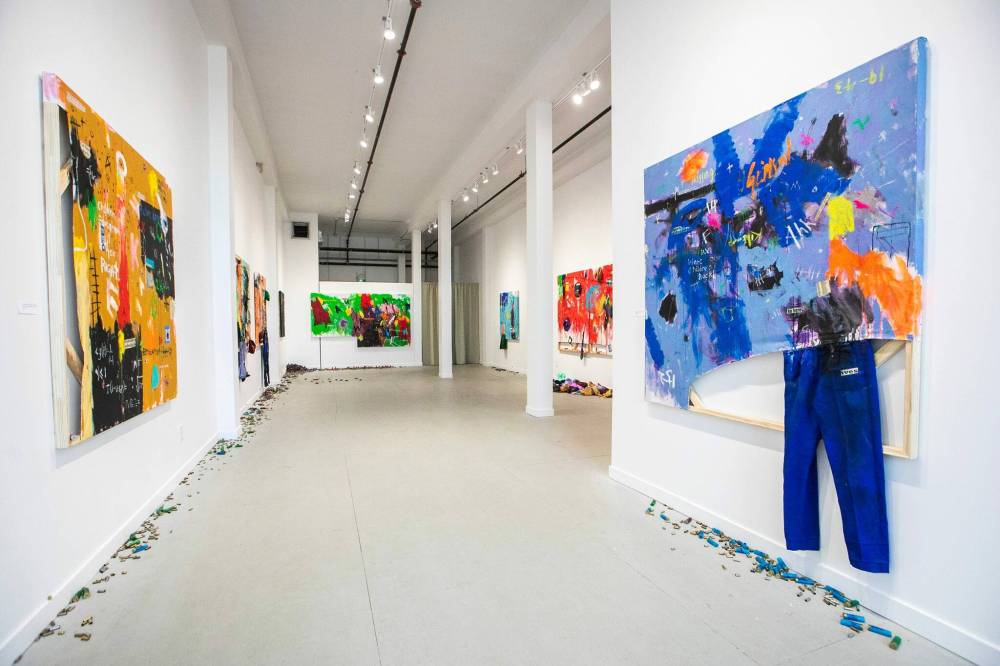
Andu’s art is not confined to the walls. On the floor below the canvases are mounds of clothing. A single shoe. A forgotten school cap. Left behind in the haste of escape, one hopes, though the reality is likely far more bleak.
“Anytime I’m painting, I try to put myself in the shoes of the victims. I should be able to express the way they feel. That’s why, sitting down before I paint, I try to meditate and try to make use of the best symbol for me to portray the story,” says Andu, 37.
One of the most visceral symbols in Theatre of War is also its most tangible: Andu’s use of spent bullet casings.
There are piles of them, littered all over the gallery floor. Seeing them scattered among the clothing, in particular, is a harrowing reminder of the terror these children have experienced in their young lives.
Using spent casings to tell this particular story is an idea he’s had for years, but would have been impossible in Nigeria. Andu picks up a single casing and turns it over between his fingers.
MIKAELA MACKENZIE / FREE PRESS Bullets and casings litter the ground at the Theatre of War exhibition.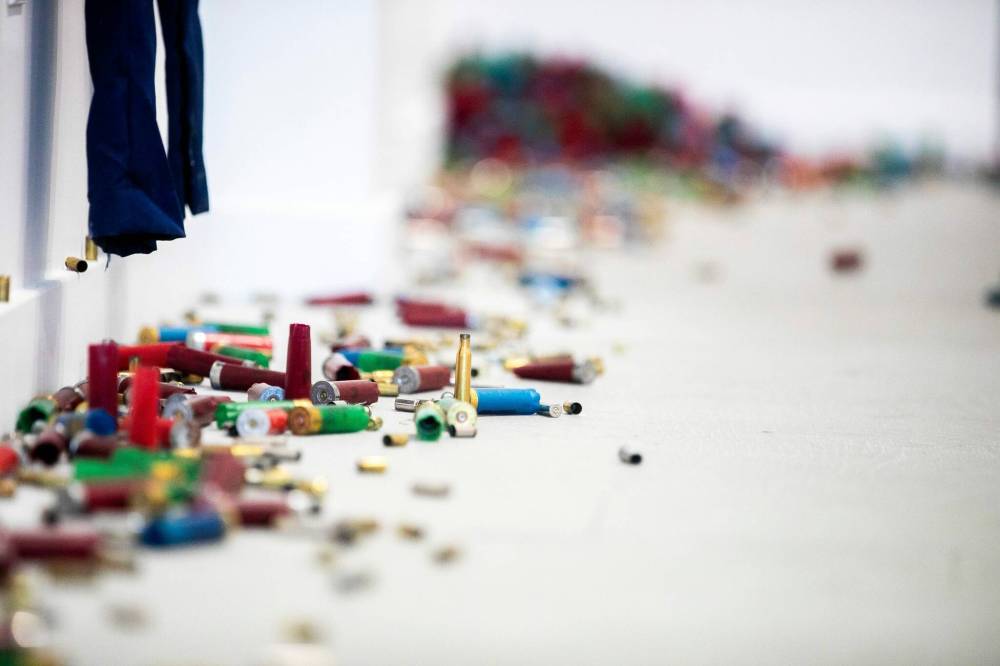
“In my country, you can’t have this. You can go to jail for this,” he says.
You could be labelled an armed robber or worse, even if you just found a casing on the ground, he explains.
It was too risky to make art with them.
“I still have a future to go.”
But in Winnipeg, where he has lived with his wife for the past three years, Andu marvelled that he could just ask for them — hundreds of them — sourcing the spent casings from a local shooting range.
“Even if these empty cases don’t come from my country, I was still able to portray my stories for the viewers to understand,” he says.
With support from both the Winnipeg Art Council and the Manitoba Art Council, Andu created most of these works in the past few months.
“It takes a lot of sleepless nights,” he says.
MIKAELA MACKENZIE / FREE PRESS Habeeb Andu’s Eyewitness III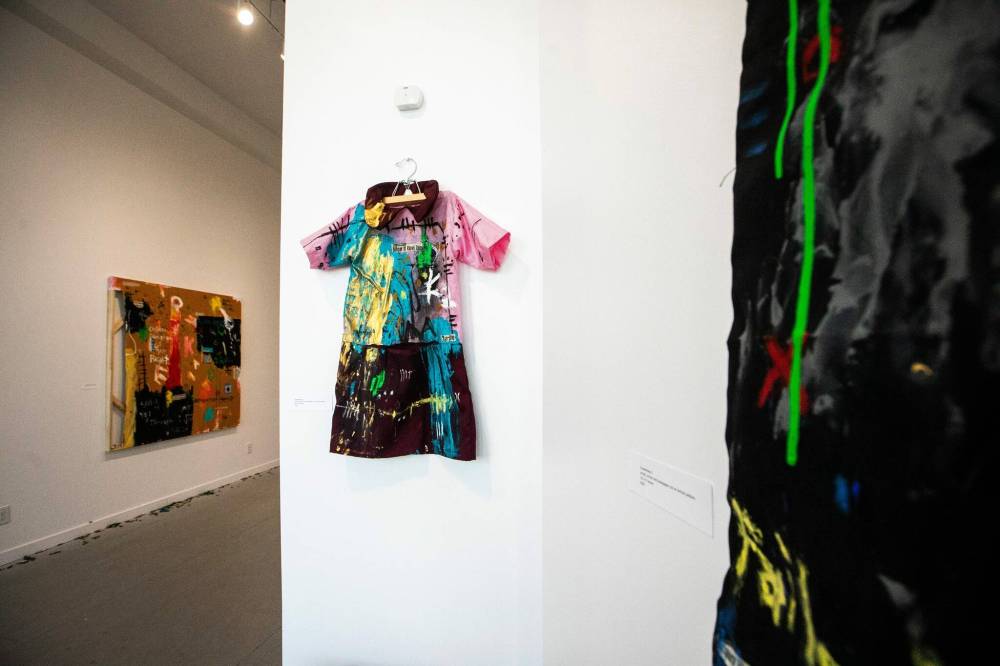
But the work is important. He sees it as a document of a time and place, and what he wants viewers to understand most of all is that kidnapping is a current national security crisis in Nigeria. This isn’t the past. It’s now.
And for the kidnappers, it’s lucrative.
“Kidnapping is now a business, a business venture where you can make money, and the government is not ready to take it seriously,” he says.
“Anytime I’m painting, I try to put myself in the shoes of the victims. I should be able to express the way they feel.”– Habeeb Andu
Bandits, as they are known, will kidnap people and demand high ransoms with few repercussions.
“Sometimes they kill some of them even after they receive the money,” Andu says.
According to a BBC analysis from 2021, children are targeted by kidnappers because their abductions are more high-profile and the government is more likely to get involved, which could mean bigger ransom payouts.
The Nigerian government insists it does not pay ransoms, but experts quoted in various international media outlets suggest that isn’t true.
That kidnapping so frequently happens to children at school, a place that is supposed to be a safe sanctuary for learning, adds a layer of violence.
MIKAELA MACKENZIE / FREE PRESS Habeeb Andu’s Missing Treasures II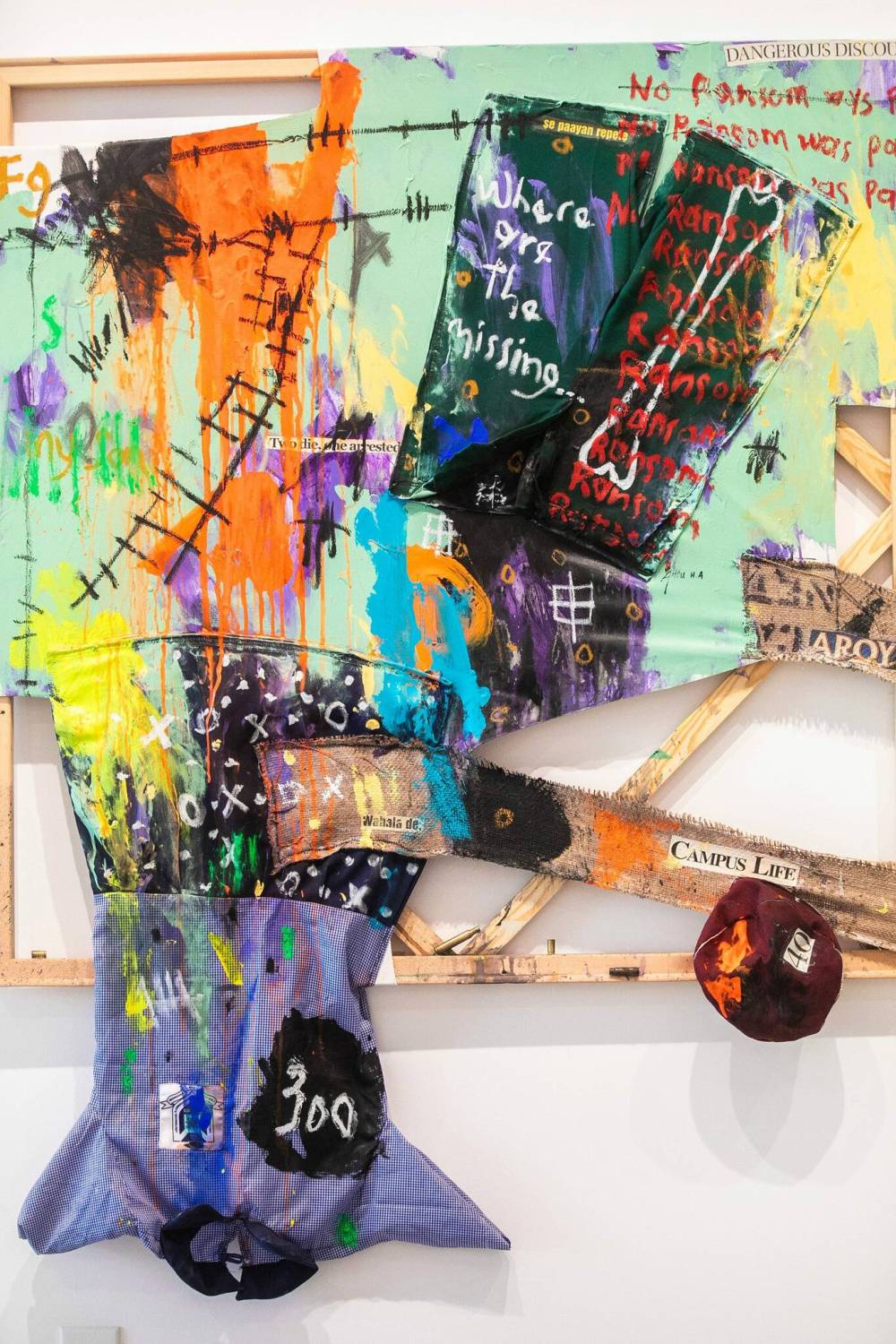
Andu points out that the spectre of kidnapping looms so large that kids are dropping out or are being withdrawn from schools — often dilapidated places with poor security — by their terrified parents.
Per UNICEF, about 10.5 million of Nigeria’s children aged five to 14 are not in school. Zooming out, one in every five of the world’s out-of-school children is in Nigeria.
“The reason I titled it Theatre of War is that it is a fight between insurgents and our educational system. The bandits see our children as a target for the government to respond to — and the government doesn’t take rapid action towards it,” Andu says.
“I believe through these works, my little impacts would make the government change and take its own security of the country more seriously.”
jen.zoratti@freepress.mb.ca

Jen Zoratti is a columnist and feature writer working in the Arts & Life department, as well as the author of the weekly newsletter NEXT. A National Newspaper Award finalist for arts and entertainment writing, Jen is a graduate of the Creative Communications program at RRC Polytech and was a music writer before joining the Free Press in 2013. Read more about Jen.
Every piece of reporting Jen produces is reviewed by an editing team before it is posted online or published in print – part of the Free Press‘s tradition, since 1872, of producing reliable independent journalism. Read more about Free Press’s history and mandate, and learn how our newsroom operates.
Our newsroom depends on a growing audience of readers to power our journalism. If you are not a paid reader, please consider becoming a subscriber.
Our newsroom depends on its audience of readers to power our journalism. Thank you for your support.
History
Updated on Monday, August 18, 2025 6:56 PM CDT: Adds detail in first paragraph.
Updated on Monday, August 18, 2025 7:18 PM CDT: Fixes typo