Home is where the art is WAG-Qaumajuq exhibit explores Canadians’ penchant for staycations
Read this article for free:
or
Already have an account? Log in here »
To continue reading, please subscribe:

Digital Subscription
One year of digital access for only $205*
- Enjoy unlimited reading on winnipegfreepress.com
- Read the E-Edition, our digital replica newspaper
- Access News Break, our award-winning app
- Play interactive puzzles
*First annual payment billed as $205.00 + GST for one year. This annual subscription will automatically renew at $233.00 + GST every 52 weeks (10% off the regular annual price of $259.35). Offer available to new and qualified returning subscribers only. Cancel any time.
To continue reading, please subscribe:
Add Free Press access to your Brandon Sun subscription for only an additional
$1 for the first 4 weeks*
- Enjoy unlimited reading on winnipegfreepress.com
- Read the E-Edition, our digital replica newspaper
- Access News Break, our award-winning app
- Play interactive puzzles
*Your next Brandon Sun subscription payment will increase by $1.00 and you will be charged $17.95 plus GST for four weeks. After four weeks, your payment will increase to $24.95 plus GST every four weeks.
Read unlimited articles for free today:
or
Already have an account? Log in here »
Hey there, time traveller!
This article was published 27/10/2025 (327 days ago), so information in it may no longer be current.
When the tariff wars with the United States started heating up and many Canadians decided to spend their summer vacations closer to home, Riva Symko, head of collections and exhibitions at the Winnipeg Art Gallery-Qaumajuq, started thinking about the idea of “staycations,” and being — seeing, experiencing, celebrating — where you are.
“The Canadian vibes of turning inward again, and looking local and looking for Canadian made, and not travelling to the States but staying in Canada to travel — I just thought this is a good opportunity to re-look at a show that I’d done during COVID, which nobody saw, called In Place that featured Manitoba artists,” Symko says.
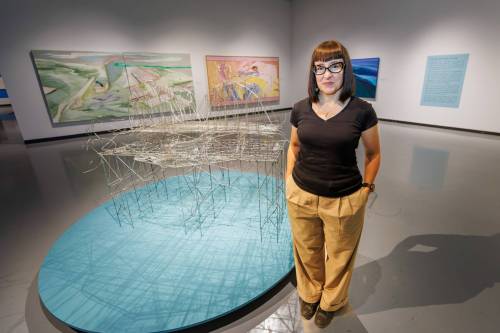
Symko has now curated Staycation: The Art Of Being Here, an exhibition opening Wednesday at WAG-Qaumajuq that features Manitoba-related artworks from the past 50 years from the gallery’s permanent collection. More than 100 works are on view, by artists such as Dee Barsy, Marcel Dzama, Cliff Eyland, Robert Houle, Daphne Odjig and Ione Thorkelsson.
MIKE DEAL / FREE PRESS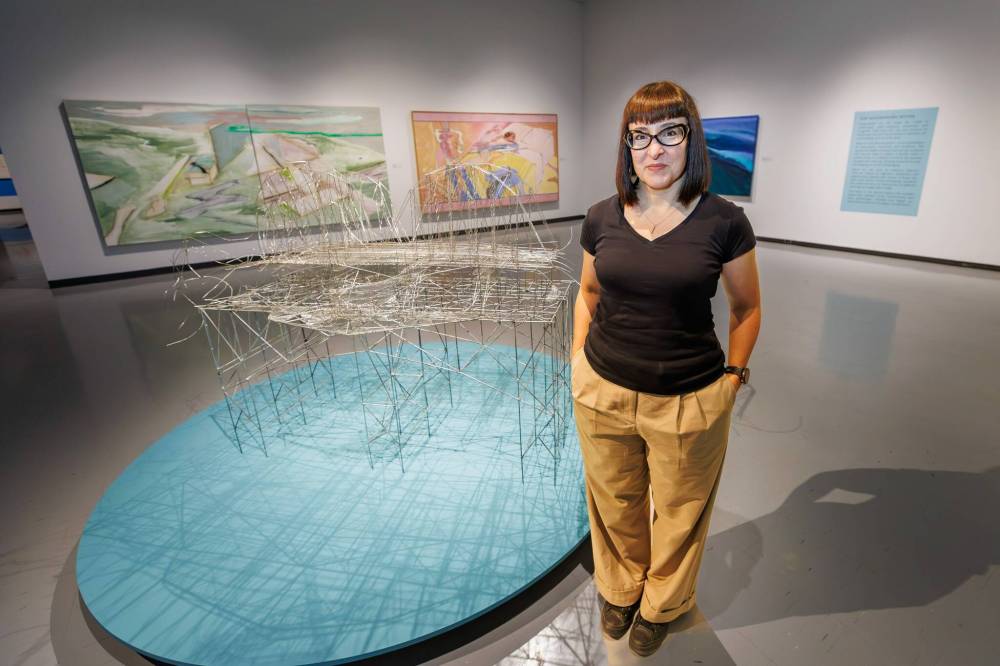
“I use the term ‘Manitoba artists’ super loosely in this exhibition, but it’s artists who have had some kind of connection to Winnipeg and Manitoba in a meaningful way,” Symko says.
“Staycations” invite people to explore their own backyards, to be reminded of what they have at home, and to perhaps see where they live through a new lens. Opportunities for cultural enrichment and discovery, after all, do not require getting on a plane. Symko liked that idea as it relates to Manitoba art and the people who choose to create here.
“We’re looking inward, but we’re not giving up on expanding our worldview.”
“The local scene is very much a national scene. And that’s what I kind of like about the idea of ‘staycation.’ We’re looking inward, but we’re not giving up on expanding our worldview.”
Symko herself came to understand Winnipeg and Manitoba through its art. She arrived at the WAG from Alaska, via Newfoundland, via Edmonton, and was born and raised in Alberta.
“The art scene we have — and I’m saying ‘we’ now, so that’s how far I’ve come — but the visual art scene in particular is really leading the way in terms of Canadian visual art, and has for several decades now. I was coming to the city already with that background of knowledge.
“So this was in some ways reaffirming, but it also opened me up to new artists who I hadn’t considered, but who are very valuable to the community here in particular, and I think that’s what visitors can take away from this show, too.”
Supplied William Pura’s View from the Bridge (1991)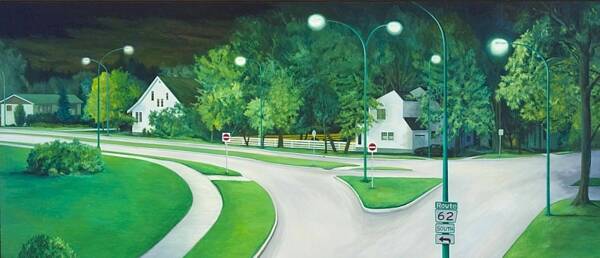
The exhibition is sorted into different sub-themes, exploring representation, collecting, signs and symbols, the physical body, spirituality and materiality — all of which affect our sense of place in the world.
Some pieces are of actual places, such as William Pura’s 1991 oil-on-canvas painting View from the Bridge, which is one of the first works gallery goers will encounter and is also used as the banner image in the exhibition materials.
It’s a large-scale painting of an intersection that looks very recognizably Winnipeg even if you don’t know the exact co-ordinates (though the Route 62 South sign might give a clue). But there’s something unsettling about it, too — an Edward Scissorhands-style suburbia with too-green grass. There are no people, no dogs, no wildlife.
Symko was attracted to the fact that it’s simultaneously regular and strange.
“It’s a monumental task to create a painting of this scale, and so why would you choose this rather odd snapshot view of nothing in particular?” Symko says.
Staycation features works from the permanent collection that haven’t been shown in the gallery in a long time — or, in some cases, ever.
Hymenal View of Lunacy, a 2003 work by Winnipeg visual artist Bev Pike, is one such piece.
“We’ve had this since 2008 and have never shown it,” Symko says.
It’s a commanding, wall-spanning work that looks like twisted rolls of fabric or scarves, but it could also be intestines and reproductive organs, or perhaps the ocean floor.
“It’s gouache which is a water-based paint process that is extremely difficult to work with, let alone on a scale like this,” Symko says. “I like the way she’s thinking about materials. She’s using this water-based, difficult medium to work with to create this image of textile that feels like textiles, but it also feels like something embodied.
“And for me, I just love how, far away, it looks almost hyper realistic. And the closer you get, the more of the painting just kind of falls apart.”
Supplied Bev Pike’s Hymenal View of Lunacy (2003)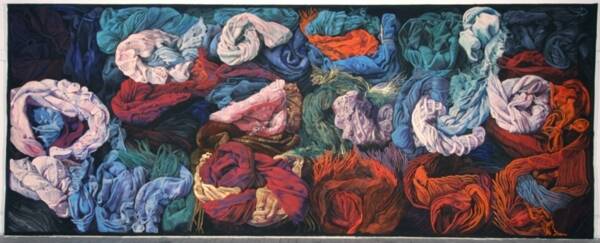
Vault exhibitions are also a useful exercise to see what’s in the permanent collection — and, crucially, which artists and perspectives are missing from it.
“We have definite gaps in the collection. For instance, we have nearly no representation of Black Manitoban artists — the one piece we have is in another show already. There are no Filipino Manitobans in our collection, which we’re still working towards,” Symko says.
“When I’m working on collection shows, because I’m simultaneously always working on acquisitions as well, I do start thinking about how the two can combine in a way.”
The exhibition features nine films on a loop — some borrowed from Winnipeg Film Group and Video Pool — that will include some of those absent voices.
“It’s a very flawed way of representing their communities. But it is a flaw that we need to address institutionally, that we’re trying to, but it just takes a lot of time,” Symko says.
Progress, however slow, is possible. Symko points to the work previous curators have done to ensure more gender representation in the permanent collection.
“When I go through the database records, I can see the work that curators before me, like Mary Reid and Helen Delacretaz especially, did to boost our quantity and quality of female artists, especially female Manitoban artists. They have left this great legacy of women artists in our collection. It’s not perfect, but they made a huge dent.”
Supplied Phyllis Green’s Boob Tree (1975)
Staycation visitors can view Phyllis Green’s iconic Boob Tree, a crochet sculpture from 1975 that is precisely what it sounds like.
That year, the WAG featured an exhibition purportedly about the Year of the Woman, except it was curated by a man and featured mostly male artists’ representations of women. So, Green and other women artists mounted a counter exhibition, called Woman as Viewer, and this humorous and incisive comment on the male gaze, using the stereotyped-as-feminine craft of crochet (in shades of pink, no less) was part of it.
This is a rare chance to see it in person, since Boob Tree doesn’t often staycation. It’s one of the most-loaned pieces in WAG-Qaumajuq’s permanent collection.
jen.zoratti@freepress.mb.ca

Jen Zoratti is a columnist and feature writer working in the Arts & Life department, as well as the author of the weekly newsletter NEXT. A National Newspaper Award finalist for arts and entertainment writing, Jen is a graduate of the Creative Communications program at RRC Polytech and was a music writer before joining the Free Press in 2013. Read more about Jen.
Every piece of reporting Jen produces is reviewed by an editing team before it is posted online or published in print – part of the Free Press‘s tradition, since 1872, of producing reliable independent journalism. Read more about Free Press’s history and mandate, and learn how our newsroom operates.
Our newsroom depends on a growing audience of readers to power our journalism. If you are not a paid reader, please consider becoming a subscriber.
Our newsroom depends on its audience of readers to power our journalism. Thank you for your support.
Related Articles
'Boob Tree' sculpture among WAG artwork reimagined at flower show