Getting to the grass roots
Exhibition digs into colonial ideas, societal pressures and resource use of lawns

Advertisement
Read this article for free:
or
Already have an account? Log in here »
To continue reading, please subscribe:

Digital Subscription
One year of digital access for only $205*
- Enjoy unlimited reading on winnipegfreepress.com
- Read the E-Edition, our digital replica newspaper
- Access News Break, our award-winning app
- Play interactive puzzles
*First annual payment billed as $205.00 + GST for one year. This annual subscription will automatically renew at $233.00 + GST every 52 weeks (10% off the regular annual price of $259.35). Offer available to new and qualified returning subscribers only. Cancel any time.
To continue reading, please subscribe:
Add Free Press access to your Brandon Sun subscription for only an additional
$1 for the first 4 weeks*
- Enjoy unlimited reading on winnipegfreepress.com
- Read the E-Edition, our digital replica newspaper
- Access News Break, our award-winning app
- Play interactive puzzles
*Your next Brandon Sun subscription payment will increase by $1.00 and you will be charged $17.95 plus GST for four weeks. After four weeks, your payment will increase to $24.95 plus GST every four weeks.
Read unlimited articles for free today:
or
Already have an account? Log in here »
Hey there, time traveller!
This article was published 06/02/2026 (197 days ago), so information in it may no longer be current.
Carrie Allison has thought a lot about lawns.
Specifically, the Halifax-based multidisciplinary artist thought about the time, money, resources and energy spent on the endless pursuit of the perfectly manicured, kelly-green squares in front of suburban houses; the colonial ideas about value, virtue, class and wealth lawns uphold; and the pressures exerted by societal expectations and full-on city bylaws to control what is a living thing.
It’s those ideas that inform we tend to care, a touring solo exhibition curated by Franchesca Hebert-Spence. The Winnipeg iteration of the show will be presented across two venues — Urban Shaman and within WAG-Qaumajuq’s permanent collection galleries — in collaboration with Marie-Anne Redhead, assistant curator of Indigenous and contemporary art at WAG-Qaumajuq.
Ruth Bonneville / Free Press
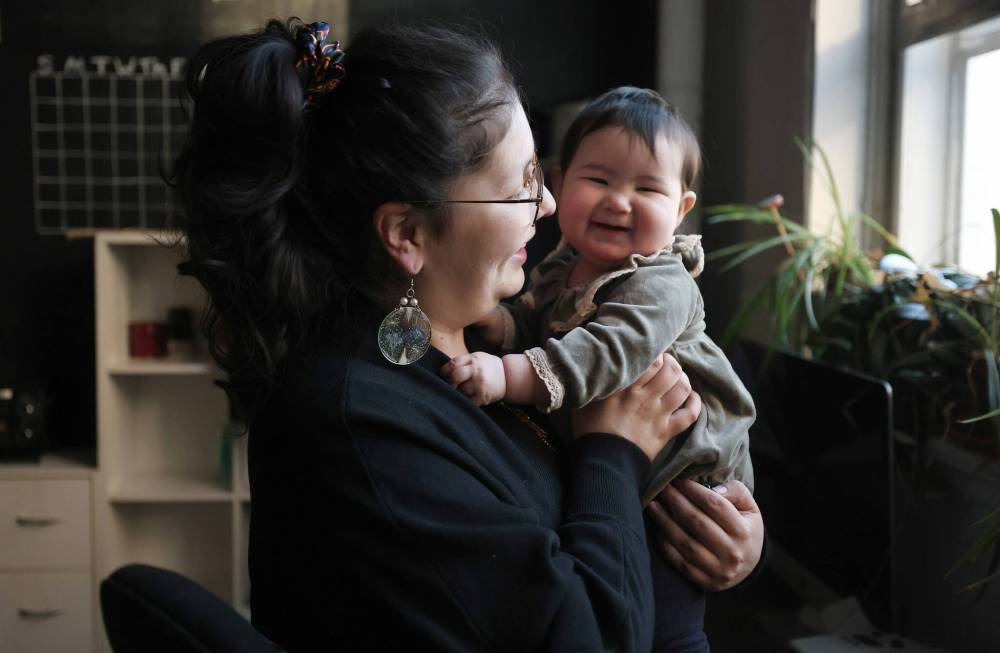
Franchesca Hebert-Spence holds her eight-month-old daughter, Ozhaawashko-Giizhig. The curator valued being able to work closely with another mother of young children.
“Lawns and grass are very much associated with that sort of, I would say, propaganda of what we value in society,” says Allison, 39, who is of nêhiýaw/Métis/mixed European descent. “They are used to tell people what they should value and how they should use their time.”
Not just their time, but also their space.
“This dictation of land is something that I was really interested in, through the lens of ‘productivity,’ quote-unquote. That’s very much within the framework of western colonialism and western ideas of value, that the land is only good if it can produce something for the economy,” she says.
“And then when it comes to lawns, it’s really just about what looks esthetically pleasing. In much of North America, the grass that we grow on lawns is not supposed to be growing here.”
The seeds for these works were planted when Allison was sitting on the rolling green of Citadel Hill in Halifax in the summertime and her friend made a comment about how weird it was that we still maintain lawns, which were status symbols of European royalty.
Ruth Bonneville / Free Press
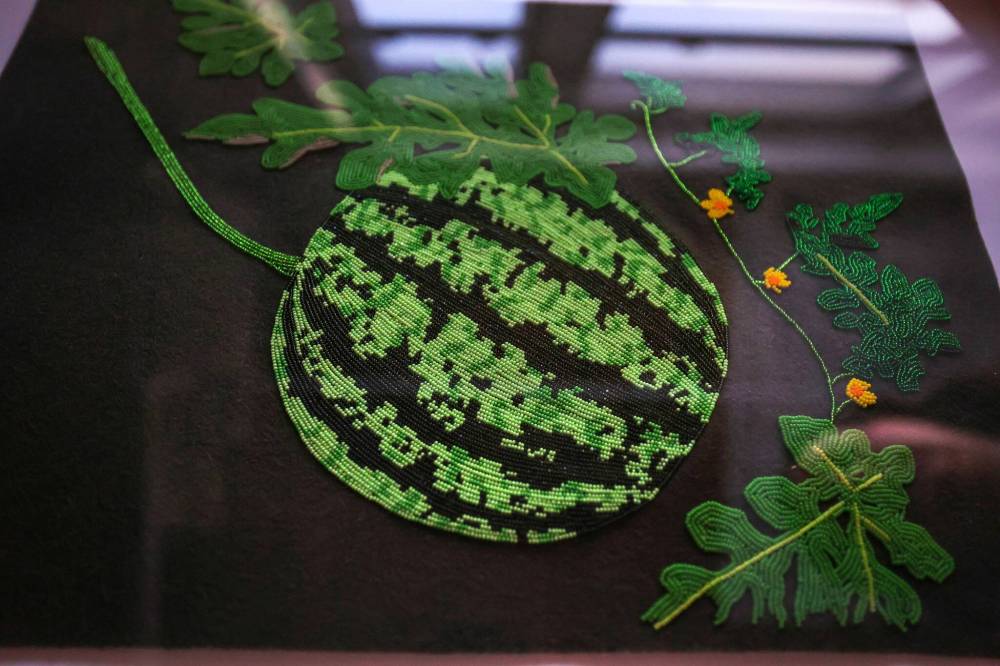
Creating the beadwork pieces is a labour-intensive process.
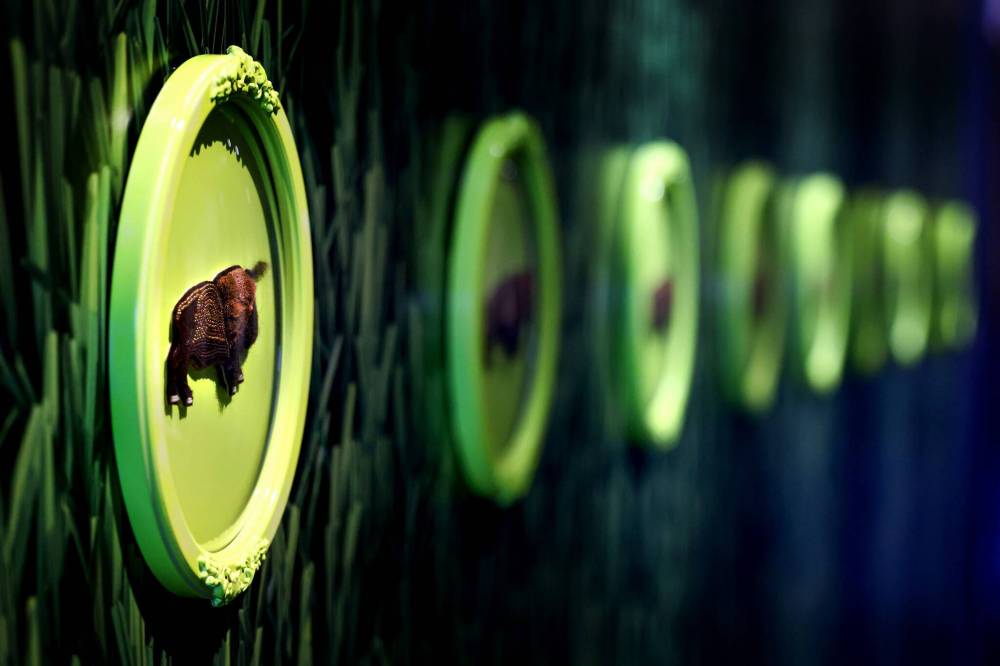
How fitting, then, that at the WAG, we tend to care has been mounted within European and North American Art, 1500-1900. Allison’s contemporary works quite literally interrupt the chronology of European Renaissance and early settler North American art, as both a critique and intervention.
Many of Allison’s pieces on view are beaded: meticulous, time-consuming, labour-intensive work — not unlike, she notes, that of maintaining a lawn.
“My neighbour, who I’m really close to, has a great lawn. Our lawn has since been defunct. It’s now all clover, essentially, and so we don’t really have to mow it very often. But my neighbour has this amazing lawn and I really enjoy going over there and sitting on it because it’s soft,” she says.
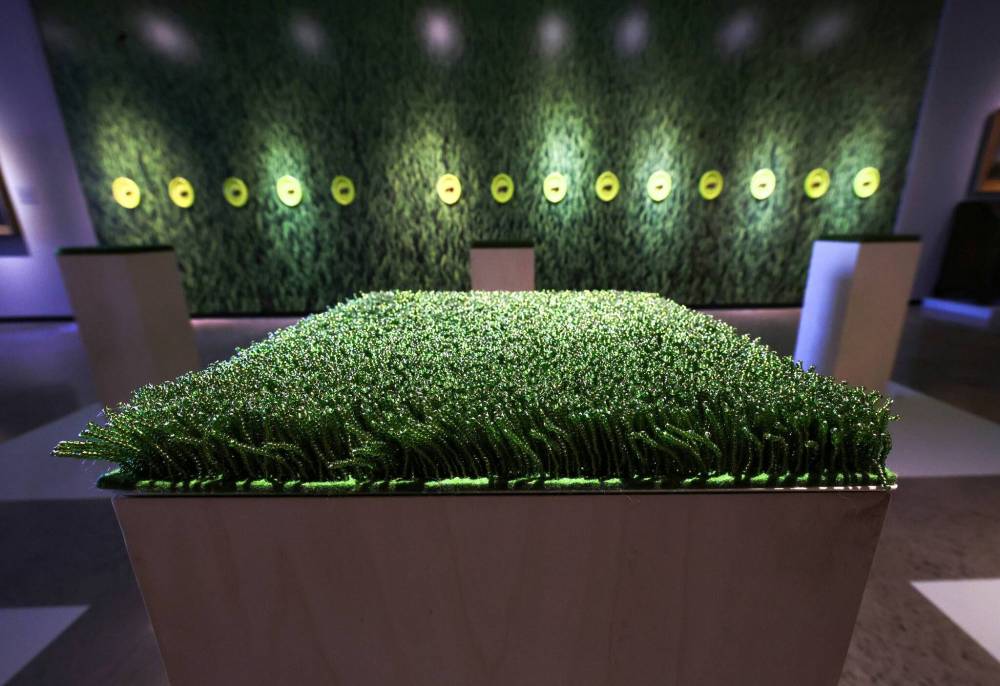
One day, her neighbour saw her beading what would become the sparkling plots of grass that top the poplar plinths that compose the large-scale installation they built fields of grass on sawdust: poplar, a comment on how trees are too often collateral in the development of “productive” land.
“He was essentially like, ‘That’s crazy. That’s a crazy use of your time, what are you doing?’ — and I think the exact same thing about him maintaining his lawn,” she says. “But that is deemed as being a productive use of your time and labour, whereas my labour as an artist, as an Indigenous woman, is not valued as much.”

Ruth Bonneville / Free Press
Curator Franchesca Hebert-Spence says the amount of care, research and time Carrie Allison puts into her work made her gravitate to it.
Hebert-Spence, the exhibition’s curator, sees tremendous value in it. The amount of care, research and time Allison, who has twice been long-listed for the Sobey Art Award, puts into her art is one of the things that attracted her to it.
“I feel really strongly about how that labour, overall, in the arts community and in art galleries and within arts markets, isn’t valued the way that it should be. I curate a lot of craft work, so those are kind of the things that make me gravitate to Carrie’s work,” she says during the installation at Urban Shaman, her eight-month-old daughter, Ozhaawashko-Giizhig, gurgling away on her lap.
The Winnipeg-born, Inuvik-based curator, who is Anishinaabe, also valued being able to work closely with another mother of young children. As they were developing we tend to care, both women had babies; Allison’s kids are four and almost two, while Hebert-Spence also has an almost two-year-old son.

“Fran and I have been friends and colleagues for a long time, so it’s been nice to share that with her,” Allison says. “I think it’s really important for parents to work together, especially if you’re the primary parent in the relationship. I think there’s a lot of sympathy and love and understanding, which you don’t always get in working relationships.”
Included in this show is also a work from Sîpîy (or “river” in Cree), a series honouring specific rivers. Allison’s beaded Red River will be on view at the WAG.
Ruth Bonneville / Free Press
The chronology of European Renaissance and early settler North American art at the WAG is deliberately interrupted by the new we tend to care exhibition as both a critique and intervention.
So how many beads does it take to get from The Forks to Lake Winnipeg?
“Everyone always asks me that,” she says with a laugh. “I have no idea.”
winnipegfreepress.com/jenzoratti
Ruth Bonneville / Free Press
In creating we tend to care, artist Carrie Allison was interested in how lawns and grass are associated with propaganda upholding societal values.
Ruth Bonneville / Free Press
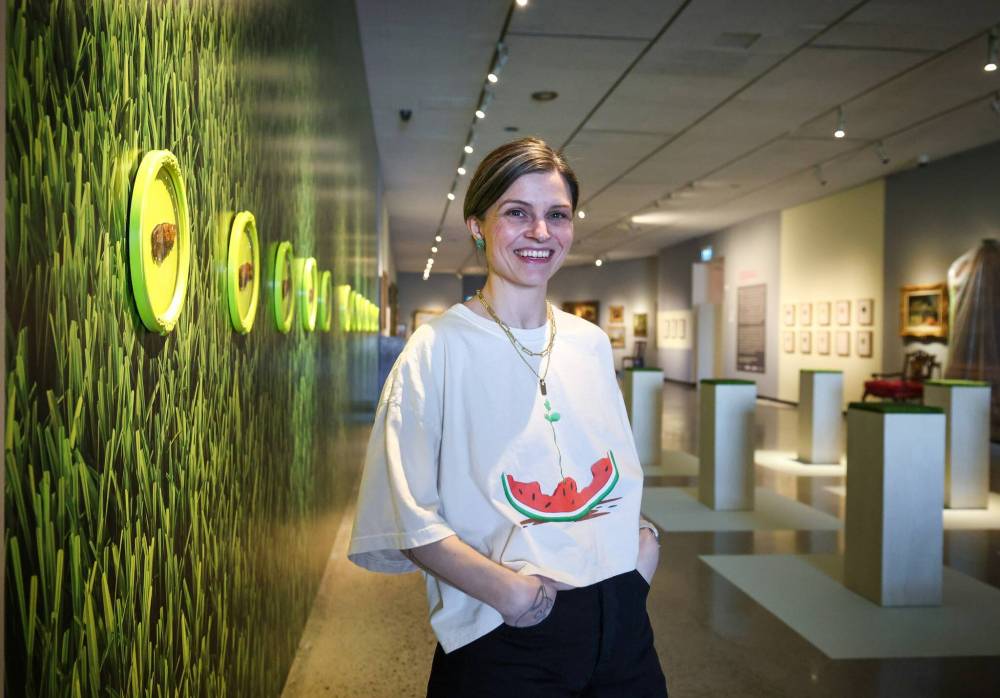
Nêhiýaw/Métis/European beadwork artist Carrie Allison’s new exhibition will be presented across both the WAG-Qaumajuq and Urban Shaman galleries.
Jen Zoratti is a columnist and feature writer working in the Arts & Life department, as well as the author of the weekly newsletter NEXT. A National Newspaper Award finalist for arts and entertainment writing, Jen is a graduate of the Creative Communications program at RRC Polytech and was a music writer before joining the Free Press in 2013. Read more about Jen.
Every piece of reporting Jen produces is reviewed by an editing team before it is posted online or published in print – part of the Free Press‘s tradition, since 1872, of producing reliable independent journalism. Read more about Free Press’s history and mandate, and learn how our newsroom operates.
Our newsroom depends on a growing audience of readers to power our journalism. If you are not a paid reader, please consider becoming a subscriber.
Our newsroom depends on its audience of readers to power our journalism. Thank you for your support.
Exhibition preview
Carrie Allison: we tend to care
● WAG-Qaumajuq and Urban Shaman, to March 28
● Opening reception tonight, 5-9 p.m., at Urban Shaman
● Artist talk at WAG-Qaumajuq: Feb. 11 at 7 p.m.
Free Sundays
WAG-Qaumajuq, in partnership with Canada Life, will continue to offer free admission and family programming on the second Sunday of every month for the next three years.
Since the program began in January 2020, more than 40,000 people have taken part in Canada Life Free Sundays at the gallery, which is open from 11 a.m. to 5 p.m. that day. From 2 p.m. until 4 p.m., visitors can enjoy complimentary, family-friendly activities including art making, games, tours, films and performances.
This Sunday is free and features Black History Month programming that includes Threads: A Fashion Demonstration hosted by Black Artists Winnipeg, themed art-making activities, as well as English and French drop-in tours.
Next month’s instalment will focus on we tend to care, featuring a guided meditative drawing exercise based on sound.
For more programming and the full calendar of 2026 Free Sunday dates, visit wag.ca.
Jen Zoratti is a columnist and feature writer working in the Arts & Life department, as well as the author of the weekly newsletter NEXT. A National Newspaper Award finalist for arts and entertainment writing, Jen is a graduate of the Creative Communications program at RRC Polytech and was a music writer before joining the Free Press in 2013. Read more about Jen.
Every piece of reporting Jen produces is reviewed by an editing team before it is posted online or published in print – part of the Free Press‘s tradition, since 1872, of producing reliable independent journalism. Read more about Free Press’s history and mandate, and learn how our newsroom operates.
Our newsroom depends on a growing audience of readers to power our journalism. If you are not a paid reader, please consider becoming a subscriber.
Our newsroom depends on its audience of readers to power our journalism. Thank you for your support.
Advertisement Advertise With Us
Advertisement Advertise With Us