Bead by bead Exhibit connects traditional and contemporary Métis beadwork artists
Read this article for free:
or
Already have an account? Log in here »
To continue reading, please subscribe:

Digital Subscription
One year of digital access for only $205*
- Enjoy unlimited reading on winnipegfreepress.com
- Read the E-Edition, our digital replica newspaper
- Access News Break, our award-winning app
- Play interactive puzzles
*First annual payment billed as $205.00 + GST for one year. This annual subscription will automatically renew at $233.00 + GST every 52 weeks (10% off the regular annual price of $259.35). Offer available to new and qualified returning subscribers only. Cancel any time.
To continue reading, please subscribe:
Add Free Press access to your Brandon Sun subscription for only an additional
$1 for the first 4 weeks*
- Enjoy unlimited reading on winnipegfreepress.com
- Read the E-Edition, our digital replica newspaper
- Access News Break, our award-winning app
- Play interactive puzzles
*Your next Brandon Sun subscription payment will increase by $1.00 and you will be charged $17.95 plus GST for four weeks. After four weeks, your payment will increase to $24.95 plus GST every four weeks.
Read unlimited articles for free today:
or
Already have an account? Log in here »
Hey there, time traveller!
This article was published 27/02/2026 (203 days ago), so information in it may no longer be current.
Suspended from the ceiling in Gallery 1C03 at the University of Winnipeg is an octopus bag, created by Métis visual artist Claire Johnston.
So called for the eight tabs on the bottom, octopus bags were traditionally worn by Métis men and beaded by Métis women and held everything one would need to make a fire.
Johnston’s bag is adorned with meticulously beaded floral motifs in soft pinks and lipstick reds and powder blues, done in the tradition that has been preserved and passed on for generations despite existential threats from colonialism.
RUTH BONNEVILLE / FREE PRESS Métis visual artist Claire Johnston’s beaded octopus bag includes messages protesting the use of AI. 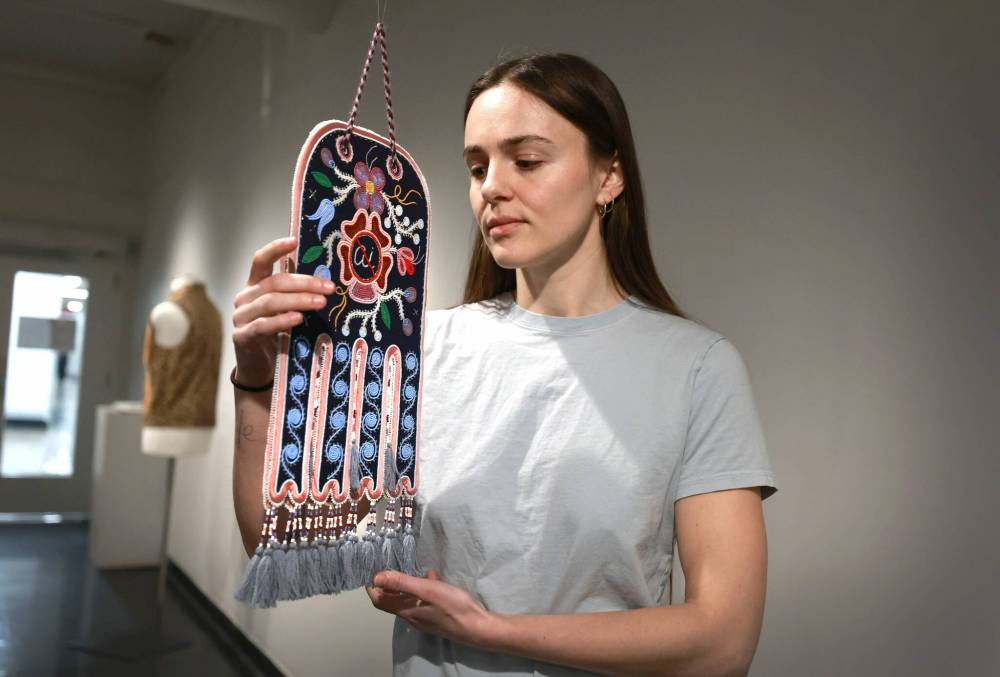
But if you look closer, there’s also a modern message of resistance, beaded vertically in cursive: “f—- AI.”
Stop Using AI is one of two works by Johnston, 29, featured in Beading Métis Resurgence, a group exhibition that gives contemporary Red River Métis beadwork its due.
Co-curated by Jennifer Gibson, Gallery 1C03’s director/curator, and Cathy Mattes, associate professor of history at the University of Winnipeg, the show, on view until April 17, also features works by Métis beadwork artists Jennine Krauchi, David Heinrichs, Vi Houssin and Brianna Oversby.
“I think what was interesting to us with this group is that they became this special cohort that would meet on Sundays, and they were really there for each other. They seemed to really push one another in experimentation and encourage one another,” Mattes says.
Exhibition preview
Beading Métis Resurgence
Curated by Jennifer Gibson and Cathy Mattes
Featuring Jennine Krauchi, David Heinrichs, Vi Houssin, Claire Johnston and Brianna Oversby
Gallery 1C03, University of Winnipeg
Now to April 17
“The relationality between all of them, and the encouragement — the reciprocal encouragement — really shows through in this particular exhibition. That’s what was exciting to us, to really present what relationality and kin-making can look like within our communities and nations.”
At the centre of Beading Métis Resurgence is Krauchi. The exhibition honours the master Métis beadwork artist’s legacy as a matriarch and mentor who has dedicated her artistic practice to amplifying and advocating for the rich tradition and passing it on to subsequent generations of artists — including the other artists in this show.
Johnston says the way Krauchi approaches her work made a big impression on her and has informed her own work, particularly Stop Using AI; she singles out the ethics of beadwork as particularly meaningful.
“The materiality, where it comes from, the people whose hands made it — every single one of those things is important. We’re spending hundreds of hours focusing and contemplating and working on something. It’s a slow process,” Johnston says.
For the artist, artificial intelligence stands in stark opposition to that notion.
“It’s like, we need quickness. It doesn’t matter where it comes from. It can exploit people. It can exploit the land,” she says. “The messaging and ways that I’ve been thinking about AI are very much connected to the ethics that I’ve been able to learn in our beadwork.”
SARAH FULLER PHOTO Beading Métis Resurgence features Jennine Krauchi’s piece The Lady (at centre), as well as work by Claire Johnston, David Heinrichs, Vi Houssin and Brianna Oversby.
For Krauchi’s part, seeing all these works together in Gallery 1C03 is powerful.
“It’s actually really amazing to see all these young people doing what they’re doing. I never, ever thought it would get to the point that it is now, compared to, say, even 15, 20 years ago,” says Krauchi, 69.
The last two decades have seen greater visibility of Métis beadwork in art gallery settings — recognizing that it is, indeed, art — as well as more young Métis artists taking up beading as an artistic practice. In the past few months alone, many of Winnipeg’s galleries have hosted beadwork-focused shows, including Vi Houssin’s Landfear at Aceartinc. and Carrie Allison’s we tend to care at WAG-Qaumajuq and Urban Shaman.
“There’s so many people that were involved in this whole sort of resurgence of our beadwork, especially in the Métis community,” Krauchi says, pointing to Christi Belcourt’s Walking With Our Sisters — the 2012 commemorative art installation composed of more than 1,700 moccasin vamps to remember missing and murdered Indigenous women and girls — as one example.
“But, you know, it was also a lot of people getting back to their roots and finding out about their culture.”
RUTH BONNEVILLE / FREE PRESS Johnston’s beaded vest is part of the Beading Métis Resurgence exhibit at Gallery 1C03.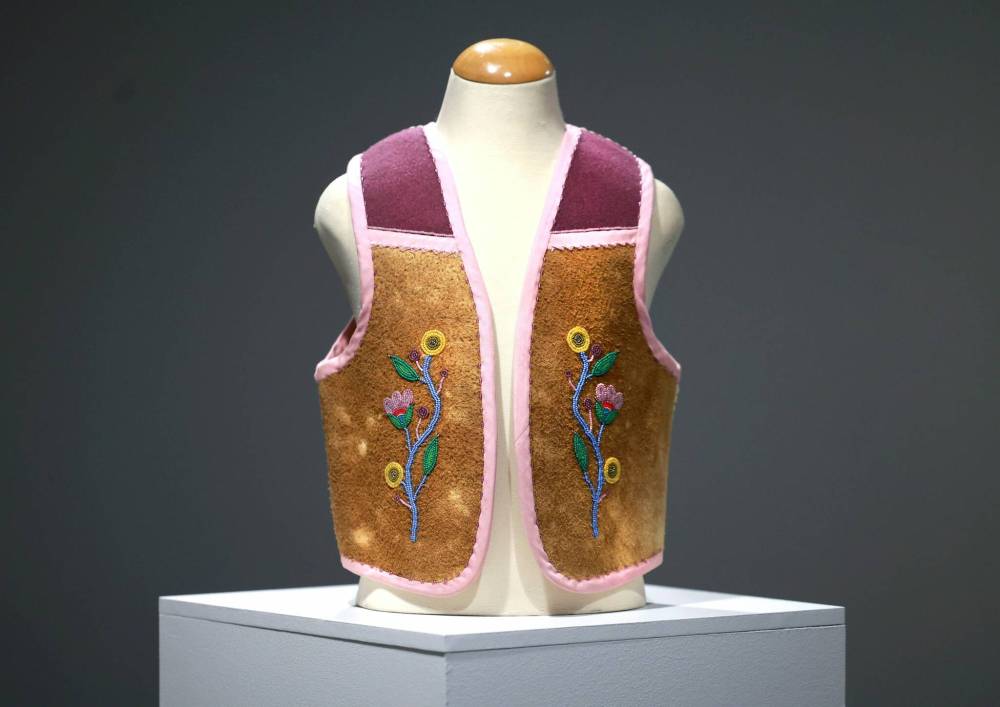
The artists in this show are pushing Métis beadwork forward into contemporary directions, but their works also honour their culture, history and ancestors.
“Every one of them has learned and gotten to know our history of beadwork,” Krauchi says. “They know the old style, and they all know the old colours that were used at that time. But now, it’s like you see it rising into this contemporary work.
“I do love the old, but I love seeing the contemporary work.”
SARAH FULLER PHOTO Krauchi is an acclaimed artist, matriarch and mentor in the Métis beading community. 
Krauchi’s own piece in the show, The Lady — a commanding 2022 work composed of an intricately beaded coat, hat, muff and boots — stands in the centre of the gallery. The Lady has spent the last few years touring across the country as part of Radical Stitch, a landmark exhibition of contemporary Indigenous beading; this is actually the first time the piece has been shown in the homeland of the Red River Métis.
“It’s kind of surreal,” Krauchi says. “When it left here, it was like it was done and then it was gone. So to have it back here, knowing it’s not mine anymore, it’s kind of bittersweet in some ways.”
The Lady was a project she’d wanted to do for a long time. It was during the height of the pandemic lockdowns that she could finally spend the hundreds of hours required on it.
Beadworking is solitary, contemplative and meditative. But it’s also communal.
“When I’m doing a piece and I’m going to get involved in it, then I’m at home by myself,” Krauchi says. “But you also have this big club that is spread across Canada and it doesn’t matter where you go, especially in Indigenous communities, there’s a beader.
“And we all connect, whether it’s First Nations or Métis beaders, we connect somehow by what we do. It brings us together. It brings us back to our culture. It brings us back to our ancestors, the grandmothers’ pieces that are in the museums. It brings us back to that and we have that connection.
“You wouldn’t think, by looking at these little, tiny beads, that they could do that.”

winnipegfreepress.com/jenzoratti
Feeding the need to bead
There are several events associated with Beading Métis Resurgence:
• Beading Workshop with Jennine Krauchi for the University of Winnipeg Community: Monday, 12:30-2:30 p.m, Indigenous Student Services Centre at U of W.
• Critique and Conversation for Intermediate to Advanced Beaders with Katherine Boyer, Jennine Krauchi and Dr. Sherry Farrell Racette: Sunday, March 15, 1-4 p.m., Wii Chiiwaakanak Learning Centre (511 Ellice Ave.). Pre-registration required.
• Conversation with the artists: Monday, March 23, at 2:30 p.m. in EG Hall (third floor of Centennial Hall) at U of W
• Find Your Stitch workshop with Cathy Mattes: Date TBA
Visit uwinnipeg.ca for more information.

Jen Zoratti is a columnist and feature writer working in the Arts & Life department, as well as the author of the weekly newsletter NEXT. A National Newspaper Award finalist for arts and entertainment writing, Jen is a graduate of the Creative Communications program at RRC Polytech and was a music writer before joining the Free Press in 2013. Read more about Jen.
Every piece of reporting Jen produces is reviewed by an editing team before it is posted online or published in print – part of the Free Press‘s tradition, since 1872, of producing reliable independent journalism. Read more about Free Press’s history and mandate, and learn how our newsroom operates.
Our newsroom depends on a growing audience of readers to power our journalism. If you are not a paid reader, please consider becoming a subscriber.
Our newsroom depends on its audience of readers to power our journalism. Thank you for your support.