Fellowship of the ring Hands-on workshop guides process of making unique, custom silver jewellery
Read this article for free:
or
Already have an account? Log in here »
To continue reading, please subscribe:
Digital Subscription
One year of digital access for only $1.44 a week*
- Enjoy unlimited reading on winnipegfreepress.com
- Read the E-Edition, our digital replica newspaper
- Access News Break, our award-winning app
- Play interactive puzzles
*Billed as $5.77 plus GST every four weeks. After 52 weeks, price increases to the regular rate of $19.95 plus GST every four weeks. Offer available to new and qualified returning subscribers only. Cancel any time.
To continue reading, please subscribe:
Add Free Press access to your Brandon Sun subscription for only an additional
$1 for the first 4 weeks*
- Enjoy unlimited reading on winnipegfreepress.com
- Read the E-Edition, our digital replica newspaper
- Access News Break, our award-winning app
- Play interactive puzzles
*Your next Brandon Sun subscription payment will increase by $1.00 and you will be charged $17.95 plus GST for four weeks. After four weeks, your payment will increase to $24.95 plus GST every four weeks.
Read unlimited articles for free today:
or
Already have an account? Log in here »
I know things aren’t going well when cracks keep forming on my clay — but not to worry. I’d been paying attention when instructors Jillian Sheedy and Joanne Roberts told me how to deal with this problem.
So I confidently dip my brush into the water and start moistening my clay to smooth it out. Except I’ve added a bit more water than I should have, and now the clay is wet and extremely sticky.
Beside me, Roberts smiles reassuringly.

MIKAELA MACKENZIE / FREE PRESS
AV Kitching and and Shae-Lynn Murray mould their rings as instructor Jillian Sheedy (centre) looks on.
“It’s a task that requires a little bit of patience,” she says, carefully removing the brush from my hand.
“It takes time and some trial and error at first, but you’ll soon get the hang of it. You just have to be…”
“Patient. Yes,” I nod, sighing in such a resigned manner that Sheedy and Roberts, as well as Free Press photographer Mikaela Mackenzie and Shae-Lynn Murray, who is also taking a class today, can’t help but laugh.
Patience is a virtue I do not possess.
I’m at a workshop at the Silver Studio in the Exchange (213-93 Lombard Ave.), an extension of local ready-to-wear jewelry business Jillian Leigh Jewelry, where I’m learning how to craft a silver ring for myself from material that looks very much like modelling clay and not at all like the precious metal I was expecting.
But while it may seem grey and rather unremarkable to the naked eye, the little slab I’m shaping and moulding is composed of 99.9 per cent fine silver particles.

MIKAELA MACKENZIE / FREE PRESS
From left: Joanne Roberts, AV Kitching, Jillian Sheedy and Shae-Lynn Murray work on moulding and smoothing the clay rings around their mandrels.
“It’s a speciality clay manufactured only in Japan, made of pure silver held together with water and binder,” Sheedy explains. “What we’re going to do is shape the clay by hand and with some tools, then fire it in our beehive kiln, where it will turn to solid silver.
“The experience is as much about exploring the material as it is about the finished product.”
During the three-hour workshop, Murray and I will learn how to shape, add texture to and refine our designs before our pieces are fired and finished in the studio, ready for us to wear that very day.
It’s a hands-on, fully guided session, with step-by-step instructions throughout.
The format has not previously been on offer in the province, Sheedy says, adding that she teamed up with Roberts earlier this year to launch the workshops.
“I took Jillian’s workshop and enjoyed it so much I made two that day,” Roberts says with a laugh.

MIKAELA MACKENZIE / FREE PRESS
Ring-making tools
“And every time I’m here teaching a workshop, I feel like making another one for myself. It’s really addicting and it’s really achievable. You just need to take your time; don’t rush the process.”
I try to take Roberts’ advice to heart.
While the duo could likely make their own rings while blindfolded, I — very much the novice when it comes to any kind of craft — need all my powers of concentration.
All the tools I need are neatly laid out beside me, including the mandrel — a spindle used to support and shape material — various shaping tools and brushes, different grits of sandpaper, burnishing brushes and polishing mats.
There are also boxes of cubic zirconia gems and tiny clay embellishments in various shapes I can add, depending on how fancy I want it to be.
I wear a size 7 on my ring finger but to allow for shrinkage during the firing process, I go up to a 9.
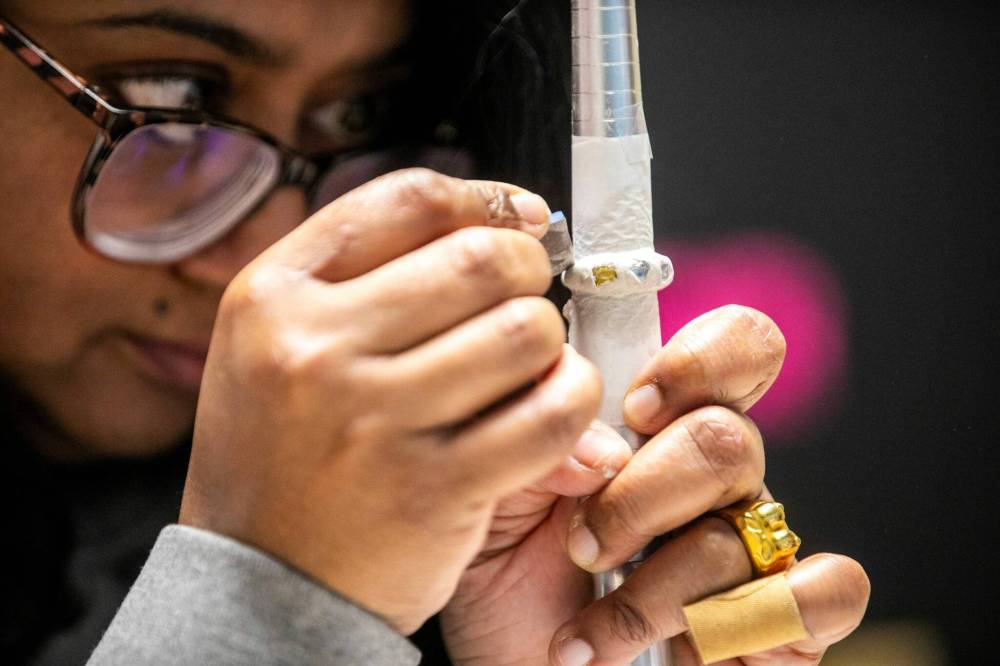
MIKAELA MACKENZIE / FREE PRESS
AV Kitching sands her ring on the mandrel.
Removing the clay from the bag, I roll it out into the shape of a noodle.
Working swiftly and gently, Roberts shows me how to gently wrap the noodle-shaped piece around the mandrel, which has parchment paper taped onto it to stop the clay from sticking.
I then have to attach both ends of the clay to form a hoop before sealing the join with judiciously placed dabs of water.
Using a combination of shapers, paintbrushes and finally my littlest finger, I smooth both sides of the join and say a prayer that the ring doesn’t come apart when fired in the kiln.
But I’m not working quickly enough and cracks keep appearing all across the surface.
“Don’t panic, it’s going to be OK. Just dab water, a little at a time and be patient,” Roberts advises as Sheedy, who is helping Murray across the table, looks on.

MIKAELA MACKENZIE / FREE PRESS
Jillian Sheedy takes AV’s ring off of the mandrel and parchment paper.
“The moisture level of the clay is really important. We don’t want to overwater, because it dilutes the consistency and the composition of the clay, but we also don’t want it to be too dry that cracks keep forming,” Sheedy says.
It takes a few more tries before I am allowed to progress to the next stage, when I can place my chosen gems on the band.
I gently press the aquamarine, alexandrite and topaz I’ve chosen into the clay.
Then it’s time to thoroughly dry out the ring, a process that requires blasting hot air from a hair dryer onto the surface of the mandrel for 10 minutes before sanding the ring with the different grades of sandpaper.
“This is definitely a trust-the-process step,” Roberts says. “You have to rotate the mandrel every few minutes to make sure the ring dries evenly. And when you’re sanding, you just want to make a pass around the ring with the paper, keeping clear of the area around the gems and the gems themselves so you don’t scratch them.”
Then it’s time for a second round of sustained hot air drying, this time for 15 minutes. When the ring is cool to touch, I gently remove it from the mandrel before sanding it again, this time concentrating on the inner part of the band as well as the outer area.

MIKAELA MACKENZIE / FREE PRESS
The rings are fired in a kiln.
Sparks literally fly as Sheedy and Roberts place the rings in the kiln and the hoops catch fire for a few seconds before the flames fizzle out.
The 35-minute process, known as sintering, is when the binder burns and the water evaporates and the clay ring is transformed into a solid silver piece.
The rings are then cooled for approximately 10 minutes before they can be worked on with burnishing brushes to remove the oxidization and reveal the shiny silver beneath. I then am then offered the choice between a matte or polished finish
“The ring is pure silver now,” Sheedy says in assurance, as I hesitate. “There’s no crushing it. You will have to be a little bit careful around the gemstones but we’re in the clear now; you won’t be damaging it by giving it a bit of a shine.”
I opt for polished, rubbing the surface of the ring to make it gleam.
My finished ring is unique, reflecting all the decisions and choices I made while creating it. The surface is bumpy and textured, the gems are wonky from my inelegant pressing and, if you look closely, you’ll notice the cracks I didn’t smooth away.

MIKAELA MACKENZIE / FREE PRESS
AV Kitching (left) and Shae-Lynn Murray show off their finished products.
Honestly, it’s not the loveliest piece of jewelry I own, but, besides my wedding ring, it certainly is the most precious. It’s something I wear every day with pride.
winnipegfreepress.com/avkitching
Make your own silver ring workshop
213-93 Lombard Ave.
Various times
Workshop fees range from $125-$150 based on the design, with additional customizable options. A non-refundable $50 deposit is required when booking and will go towards the final cost of the ring.
Book online at jillianleigh.ca or email silverstudiowinnipeg@jillianleigh.ca for more information.

AV Kitching is an arts and life writer at the Free Press. She has been a journalist for more than two decades and has worked across three continents writing about people, travel, food, and fashion. Read more about AV.
Every piece of reporting AV produces is reviewed by an editing team before it is posted online or published in print — part of the Free Press‘s tradition, since 1872, of producing reliable independent journalism. Read more about Free Press’s history and mandate, and learn how our newsroom operates.
Our newsroom depends on a growing audience of readers to power our journalism. If you are not a paid reader, please consider becoming a subscriber.
Our newsroom depends on its audience of readers to power our journalism. Thank you for your support.