Pieces with presence

Exhibition offers fresh perspective on history of Indigenous representation in art

Advertisement

Advertise with us

A new exhibition at WAG-Qaumajuq invites viewers to grapple with two simultaneous histories of Indigenous presence in art.

Read this article for free:


or

Already have an account? Log in here »

To continue reading, please subscribe:

Subscribe and receive a limited-edition Free Press branded hat or tote.

Digital Subscription

One year of digital access for only $205*

  • Enjoy unlimited reading on winnipegfreepress.com
  • Read the E-Edition, our digital replica newspaper
  • Access News Break, our award-winning app
  • Play interactive puzzles

*First annual payment billed as $205.00 + GST for one year. This annual subscription will automatically renew at $233.00 + GST every 52 weeks (10% off the regular annual price of $259.35). Offer available to new and qualified returning subscribers only. Cancel any time.

To continue reading, please subscribe:

Add Free Press access to your Brandon Sun subscription for only an additional

$1 for the first 4 weeks*

  • Enjoy unlimited reading on winnipegfreepress.com
  • Read the E-Edition, our digital replica newspaper
  • Access News Break, our award-winning app
  • Play interactive puzzles
Start now

*Your next Brandon Sun subscription payment will increase by $1.00 and you will be charged $17.95 plus GST for four weeks. After four weeks, your payment will increase to $24.95 plus GST every four weeks.

A new exhibition at WAG-Qaumajuq invites viewers to grapple with two simultaneous histories of Indigenous presence in art.

Reframed, which opened Wednesday, takes settler art of Indigenous people shaped by colonial perspectives of the time and contrasts it with modern-day contemporary work from Indigenous artists who challenge those perspectives.

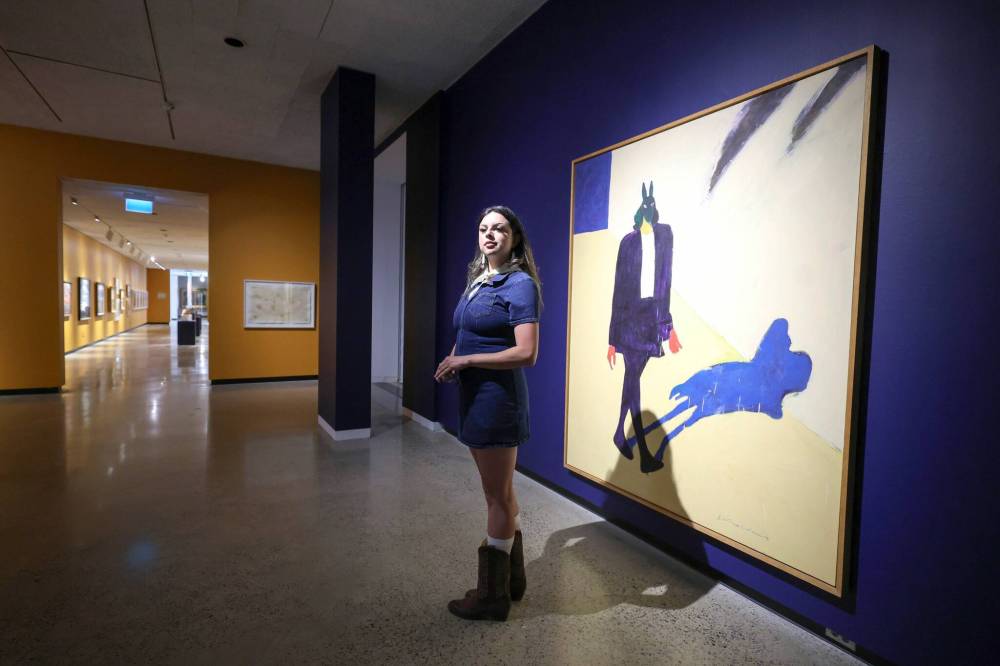
Many historical paintings create a vague representation of Indigenous people by homogenizing the culture and erasing historical presence, says Marie-Anne Redhead, assistant curator of Indigenous and contemporary art.
Ruth Bonneville / Free Press
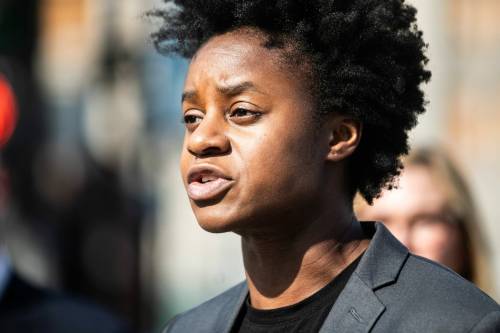
                                Marie-Anne Redhead, assistant curator of Indigenous and contemporary art at Winnipeg Art Gallery-Qaumajuq says she ‘wanted to highlight Indigenous perspectives on these artworks to really see these people as people,’ with Reframed.

Ruth Bonneville / Free Press

Marie-Anne Redhead, assistant curator of Indigenous and contemporary art at Winnipeg Art Gallery-Qaumajuq says she ‘wanted to highlight Indigenous perspectives on these artworks to really see these people as people,’ with Reframed.

“I wanted to highlight Indigenous perspectives on these artworks to really see these people as people,” she said.

Redhead said the idea came to her in 2021, while working on a project to rename historic Indigenous settler art with racist titles.

Through this process, she realized that less than one per cent of the WAG-Qaumajuq’s collection is by First Nations or Métis artists.

“In our collection (we) actually have more of these ethnographic representations of us rather than artwork by us,” Redhead says.

This is when she decided to expand the scope of the original project and pair the historical paintings with modern work that resists colonial stereotypes and brings forward Indigenous presence.
photos by Ruth Bonneville / Free Press
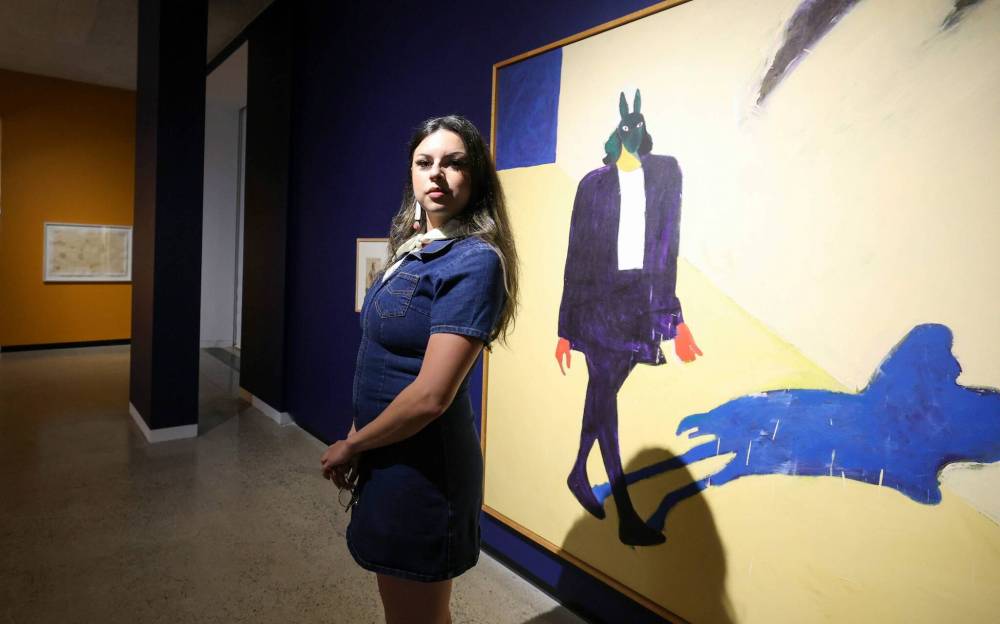
                                Marie-Anne Redhead, assistant curator of Indigenous and contemporary art at Winnipeg Art Gallery-Qaumajuq, wanted to highlight Indigenous perspectives with Reframed.

photos by Ruth Bonneville / Free Press

Marie-Anne Redhead, assistant curator of Indigenous and contemporary art at Winnipeg Art Gallery-Qaumajuq, wanted to highlight Indigenous perspectives with Reframed.

“I looked around at what a lot of contemporary First Nations and Métis artists were doing, and I found that a lot of them were already sort of doing the work Reframed was doing, which is to speak against those stereotypes and representations of us,” Redhead says.

One example of her pairings is a painting from Quebec expressionist artist Jean-Paul Riopelle, who is well known for his abstract paintings.

Riopelle’s paintings are usually placed with his contemporaries, who are also white settlers, but by placing his work next to Indigenous artist Rita Letendre, whose work comes from the same artistic movement, Redhead wanted to show that racialized artists have been using these practices for just as long without the same recognition.

“I’m reframing the way that we engage with not only Indigenous art but also art history,” she says.

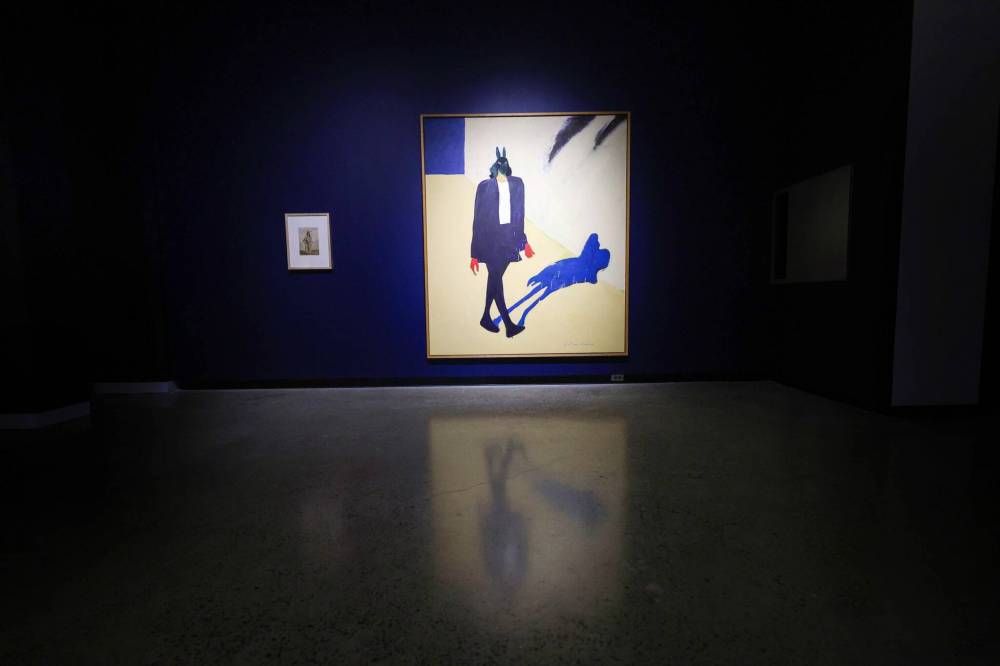
Reframed presents an unsanitized version of Indigenous and settler relations that the curator admits could be hard for some to take in and reckon with.
Ruth Bonneville Free Press
                                Artwork by American Indigenous artist Fritz Scholder, right, juxtaposed against work by William Armstrong at the Reframed exhibit.

Ruth Bonneville Free Press

Artwork by American Indigenous artist Fritz Scholder, right, juxtaposed against work by William Armstrong at the Reframed exhibit.

“I think people walking through this exhibit may be dealing with a little bit of discomfort,” she says. “I want people to sit with that discomfort and understand where it might be coming from. I also want people to learn more about the history of Indigenous presence and resistance as well.”

Redhead says representation in places such as the Winnipeg Art Gallery plays a big role in breaking down colonial views, because Indigenous work was never historically considered fine art.

Vi Houssin, one of the emerging artists featured in the exhibition, says beadwork has been the “flagship artistic medium” of the Métis people, but hasn’t been considered high art until the last 10 to 15 years.

“It has been undervalued, it has been sold for ridiculously low amounts of money and it has been treated as ethnographic items rather then works of fine art,” she says.

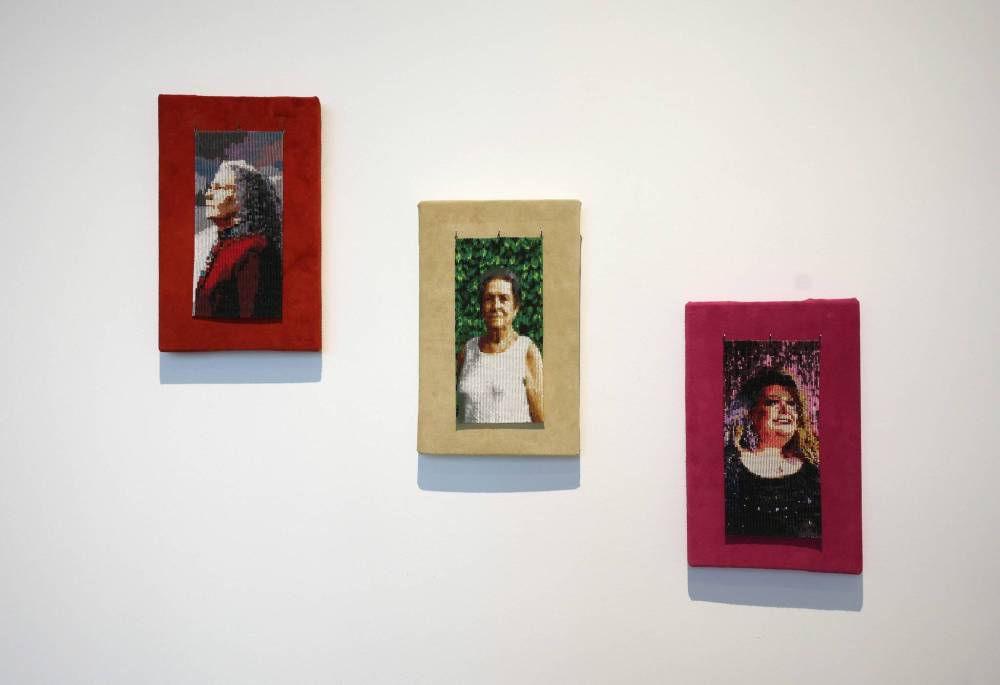
Houssin’s beadwork in the exhibit consists of three separate pieces that depict the most influential women in her life.
Ruth Bonneville / Free Press
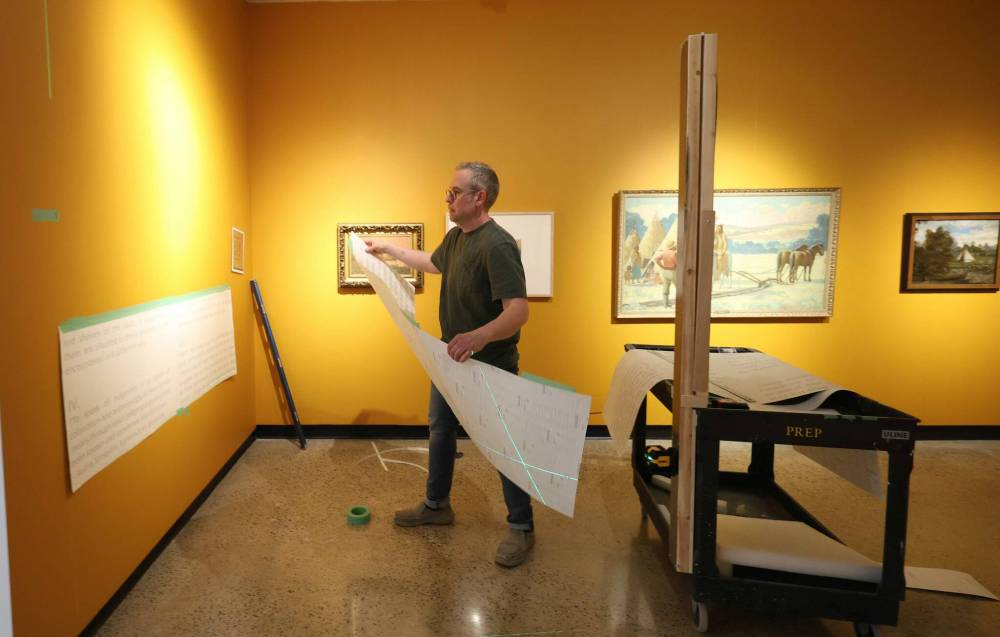
                                Galleries installation technician Andrew Lodwick places new signage up in the new exhibit.

Ruth Bonneville / Free Press

Galleries installation technician Andrew Lodwick places new signage up in the new exhibit.

She says many historical portrayals of Métis people depict them as a patriarchy, when they were a matriarchal society.

“So many of our communities are guided by women and the knowledge of women,” Houssin says.

“I hope people see these portraits and see the love that I poured into them and realize that Indigenous women are valuable, Indigenous women are loved, Indigenous woman are deserving of our reverence.”

Houssin says the beadworks took hundreds of hours to complete and were made between 2023 and 2024. She was recently asked by Redhead to add the pieces to the gallery.

tiago.resko@freepress.mb.ca
Ruth Bonneville / Free Press
                                Beaded artwork by Red River Métis artist Vi Houssin. From left: Anita (2024, seed beads, nylon thread, silver guardians, hide); Elma, (2023, seed beads, nylon thread, silver guardians, hide); Jennine (2023, seed beads, nylon thread, silver guardians, hide).
Ruth Bonneville / Free Press

Beaded artwork by Red River Métis artist Vi Houssin. From left: Anita (2024, seed beads, nylon thread, silver guardians, hide); Elma, (2023, seed beads, nylon thread, silver guardians, hide); Jennine (2023, seed beads, nylon thread, silver guardians, hide).
Report Error Submit a Tip

More Stories

Puzzles Palace

1 minute read Monday, Jul. 27, 2026

To solve our puzzles, please subscribe with this special offer: |

Trailblazing Western Scrap Metals heavy-equipment operator relishes role at massive crane’s control

David Sanderson 7 minute read Preview

Trailblazing Western Scrap Metals heavy-equipment operator relishes role at massive crane’s control

David Sanderson 7 minute read Yesterday at 10:15 AM CDT

Less than five per cent of heavy-equipment operators in the country are women but that number is trending upward, according to a study conducted by trade magazine Crane & Hoist Canada.

It was reported that in Ontario roughly eight per cent of jobs in the transport and heavy-equipment field are currently held by women. Furthermore, in 2024 almost 20 per cent of graduates at an Edmonton-based heavy-equipment operator training school were female, the article stated.

That brings us to Harmony Guspodarchuk, the first female crane operator in the 70-year history of Western Scrap Metals, a family-owned business at 18 Sutherland Ave.

Three years ago, Guspodarchuk literally stepped into the driver’s seat of a 27,500-kilogram, Liebherr C 924 Heavy Lift Litronic crane. The 29-year-old hasn’t looked back much since.

Read
Yesterday at 10:15 AM CDT

PCs say Hutterite colonies singled out by Bill 21

Alex Lambert 4 minute read Preview

PCs say Hutterite colonies singled out by Bill 21

Alex Lambert 4 minute read Yesterday at 2:01 AM CDT

SOURIS — Members of Hutterite colonies in the province took aim at the NDP government’s proposed changes to drinking water legislation during a public meeting Thursday in Souris.

The meeting was hosted by Progressive Conservative MLA Colleen Robbins (Spruce Woods) to hear from rural residents about their concerns over Bill 21, which the government says will improve oversight on wells and other water systems in the province.

“There’s not enough clarity, but I feel that the overreach that this bill will bring is not clearly defined, and it could have a lot of negative consequences,” attendee Gilbert Hofer, a member of Green Acres colony near Wawanesa, said after the meeting, which drew about 20 people.

The legislation would allow public health officers to designate the type of water source based on its intended use, water quality and use duration rather than solely the number of connections it has.

Read
Yesterday at 2:01 AM CDT

Manitoba supports MAID delay: Asagwara

Carol Sanders 5 minute read Preview

Manitoba supports MAID delay: Asagwara

Carol Sanders 5 minute read Yesterday at 2:00 AM CDT

The number of Manitobans receiving medical assistance in dying in 2026 is on track with previous years while the plan to extend it to those suffering from mental illness is delayed indefinitely by the federal government — a move Manitoba’s health minister supports.

“There’s so much more work that needs to be done,” Uzoma Asagwara said.

The parliamentary committee that issued its recommendation in June was the third special committee of Parliament struck to assess the eligibility of people with mental illness since 2021, when MAID eligibility was expanded to include people who were not at the end of their lives.

A key condition for MAID eligibility is that a patient must be suffering from a grievous and irremediable medical condition.

Read
Yesterday at 2:00 AM CDT

A Life's Story: Woman fought for better outcomes for others amid cancer fight

Janine LeGal 7 minute read Preview

A Life's Story: Woman fought for better outcomes for others amid cancer fight

Janine LeGal 7 minute read 3:00 AM CDT

Catherine Mary Burke was strong and motivated in ways many of us could never imagine.

She was known for fighting the good fight, and she fought as hard as she could for as long as she could. But something set her apart. Even when it was too late for her, she insisted cancer survival rates had to be better for other women. And they are today because of her fierce determination.

Burke died on Nov. 29, 2025, at age 67 after courageously facing breast cancer for more than a decade.

“Cathy was born happy,” said her husband, Patrick Burke. “She was a glass-half-full person. What a gift this attitude was to me and the boys. She never once said ‘Why me?’ or complained. She was just so happy to be alive.

Read
3:00 AM CDT

‘Disrespectful’: residents frustrated after Wyatt arrives hour late to committee meeting

Joyanne Pursaga 3 minute read Preview

‘Disrespectful’: residents frustrated after Wyatt arrives hour late to committee meeting

Joyanne Pursaga 3 minute read Updated: Yesterday at 1:00 PM CDT

Several Winnipeggers attending a city development hearing on Thursday expressed frustration that one councillor arrived about an hour late, delaying the matter from being heard.

Coun. Russ Wyatt, who continues to attend city hall while facing criminal charges, began participating in the 9:30 a.m. East Kildonan-Transcona community committee meeting at 10:35 a.m.

A resident who hoped to speak at the meeting about a development plan in south Transcona noted the tardiness led the committee to bump the topic down on its agenda, while dozens waited to speak on it.

Christina Pyra eventually opted to leave city hall instead of waiting for her turn to make a presentation, to avoid missing a work commitment.

Read
Updated: Yesterday at 1:00 PM CDT