Epic performance, but Shakespeare in the Ruins’ The Iliad suffers from identity crisis
Advertisement
Read this article for free:
or
Already have an account? Log in here »
To continue reading, please subscribe:

Digital Subscription
One year of digital access for only $205*
- Enjoy unlimited reading on winnipegfreepress.com
- Read the E-Edition, our digital replica newspaper
- Access News Break, our award-winning app
- Play interactive puzzles
*First annual payment billed as $205.00 + GST for one year. This annual subscription will automatically renew at $233.00 + GST every 52 weeks (10% off the regular annual price of $259.35). Offer available to new and qualified returning subscribers only. Cancel any time.
To continue reading, please subscribe:
Add Free Press access to your Brandon Sun subscription for only an additional
$1 for the first 4 weeks*
- Enjoy unlimited reading on winnipegfreepress.com
- Read the E-Edition, our digital replica newspaper
- Access News Break, our award-winning app
- Play interactive puzzles
*Your next Brandon Sun subscription payment will increase by $1.00 and you will be charged $17.95 plus GST for four weeks. After four weeks, your payment will increase to $24.95 plus GST every four weeks.
Read unlimited articles for free today:
or
Already have an account? Log in here »
War is hell. But it’s also, as playwrights Lisa Peterson and Denis O’Hare pointedly remind us in their stage adaptation of Homer’s The Iliad (translated by Robert Fagles), all too sadly predictable; bloodlust has run in the veins of humankind from time immemorial.
Shakespeare in the Ruins opened its 10-show run of An Iliad Thursday in the burned-out shell of the Ruins at Trappist Monastery Provincial Heritage Park, with the two-hour (including intermission) briskly paced production directed by Christopher Brauer. The show runs repertory style with this year’s mainstage offering, Shakespeare’s comedy As You Like It, through July 5.
For their contemporary spin on Homer’s 3,000-year-old epic poem (composed of 24 books), Peterson and O’Hare distil its key battles and characters to a whirlwind tour of duty that skips between antiquity and modern times. They also wisely tell their tale not in its original dactylic hexameter, but in modern vernacular laced with F-bombs, making the narrative more palatable to 21st-century sensibilities.
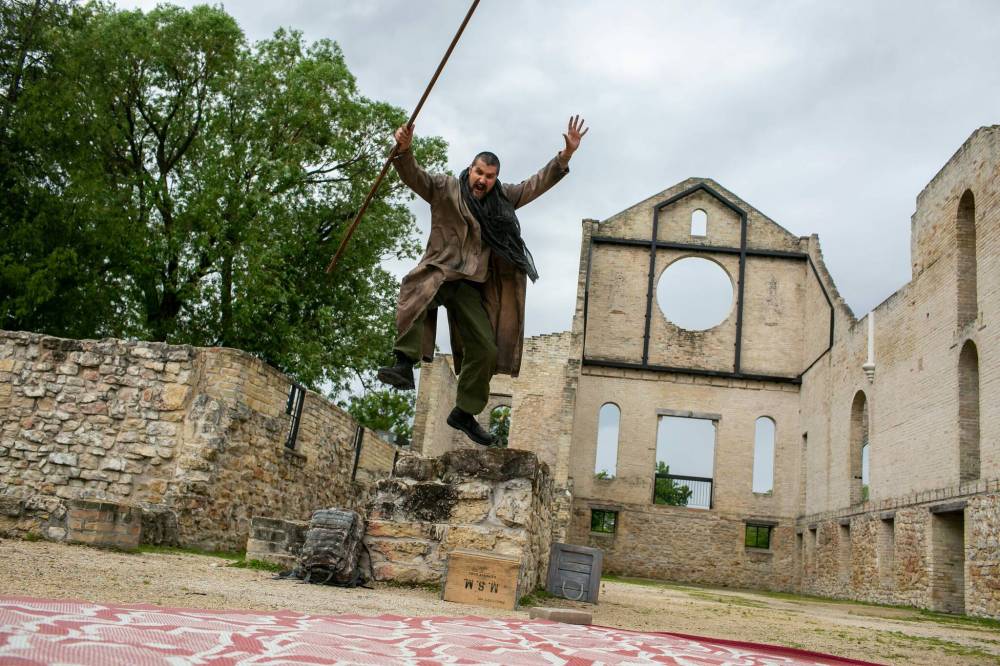
BROOK JONES / FREE PRESS
Rodrigo Beilfuss’s Poet conveys the violence of the Trojan War in An Iliad.
Kudos to SiR artistic director Rodrigo Beilfuss, head shorn and costumed in Rachel Baziuk’s ragtag overcoat and trousers, for undertaking the impressive, Herculean task of delivering an all-guns-blazing monologue as the Poet with nary a stumble.
Winnipeg-based musician/composer Daniel Roy underscores the text with effective guitar stings, cymbal rolls and drumming effects (his udo lending an exotic touch), as well as several spooky, heavily reverbed voiceovers, conjuring the gods, that add further sonic texture.
The play begins with Beilfuss’s dramatic intoning in Greek, before he confesses, “Every time I sing this song; every time I hope it’s the last time.” He then launches into his story of the Trojan War, immortalized by Homer in The Iliad. The legendary conflict between the Greeks (Achaeans) and Trojans features key players: the “greatest warrior that ever lived” Achilles, sceptre-wielding king Agamemnon and “man-killing” Trojan prince Hector, among others.
But here’s the rub. In its quest for relevance and an emotional connection with audience members, the play often falls into a no-man’s land between comedy and tragedy, never really finding its footing or dog-tag identity in this theatrical tug of war.
Several of its weightier moments, ripe with dramatic punch, fall uncomfortably flat, eliciting awkward chuckles instead of horror. The Poet’s abrupt flip from narrating the ancient battle to listing recognizable, contemporary locales — including Ohio, Nebraska and South Dakota, as well as such closer-to-home references as Shilo and Winnipeg’s own Valour Road — as origins of fallen soldiers is a missed opportunity.
His searing point that war is still very much in our own backyards in 2026 feels missing in action, as the text fascinatingly blends Greek ideologies of “kairos” (the critical time for action) and “chronos” (quantitative time).
Many other moments deserve a beat, such as Beilfuss — now portraying Hector — telling his long-suffering wife Andromache, “Don’t cry, pray,” speaking to the power of faith as a shield for slaughter. The latter character telling their baby boy “someday you will need a helmet just like your father” underscores the cyclical thirst for war as history inevitably repeats — and will undoubtedly continue to do so for generations to come.
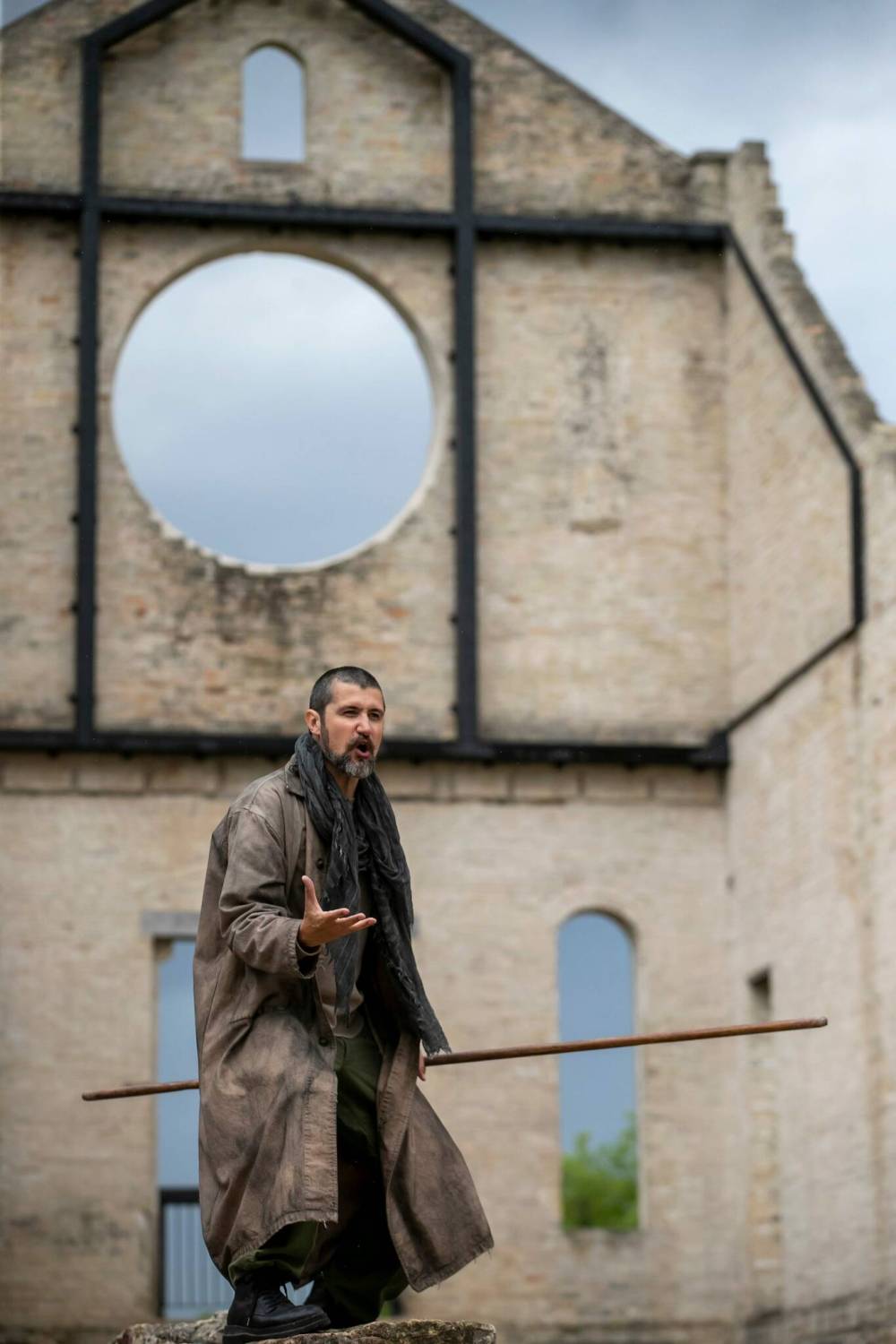
Rodrigo Beilfuss gives a powerful and physical performance as the Poet in An Iliad.
One longs for this poet, chugging back tequila and lugging a beat-up backpack (the sack is later dragged around the stage to represent the murdered Hector) to be more world- and war-weary. More silences and pregnant pauses would allow audience members to fully digest his at times overly glossed and glibly told story.
However, the way Beilfuss seamlessly, kaleidoscopically morphs among roles, including Achilles, Agamemnon, Hector, Patroclus and Paris (the latter’s portrayal could have been pushed further) is a virtuosic showcase of theatrecraft, infused with appropriate mannerisms and physicality befitting his army of characters.
Brauer’s keen direction ensures full use of the monastic setting, with its crumbling, inner walls standing in for the stony ramparts of Troy.
Despite the play’s wordiness and tendency towards didacticism, several scenes chill to the bone.
Beilfuss’s violent hurling of an empty folding chair from the audience shocks in its volatility, as he depicts the brutal murder of Patroclus while also breaking the fourth wall. His sardonic, lip-smacking cry, “It feels good,” when describing the adrenaline rush of killing another human being — prefaced by his fleshing out the all-too-familiar roots of anger, including road rage — rings with a despairing truth that cannot be denied.
The climax arrives when the Poet bursts into a chronological listing of wars and battles fought over millennia, from Troy to today, a volcanic eruption further driving home his point that warfare has been part of “civilization’s” DNA since cave people first banged together rocks and sticks.
When he finally catches his breath, overcome at the sheer magnitude of his recitation, his grief becomes palpable, infusing the production with a deeper emotional resonance.

Brook Jones / Free Press
Daniel Roy (left) is muse to Rodrigo Beilfuss’s Poet in An Iliad.
An Iliad arguably ends not with a bang, but a whimper, as the Poet recounts the burying of Hector before a traditional feast.
His final utterance to the audience — “You see?” — punctuates his war-torn tale with a question that ultimately has no answer, as the drum beat of battle, past, present and surely future, rages on.
winnipegfreepress.com/hollyharris
Holly Harris writes about music for the Free Press Arts & Life department.
Our newsroom depends on a growing audience of readers to power our journalism. If you are not a paid reader, please consider becoming a subscriber.
Our newsroom depends on its audience of readers to power our journalism. Thank you for your support.
Theatre review
An Iliad
Shakespeare in the Ruins
● Trappist Monastery Provincial Park, St. Norbert
● To July 5
★★★½ out of five
Holly Harris writes about music for the Free Press Arts & Life department.
Our newsroom depends on a growing audience of readers to power our journalism. If you are not a paid reader, please consider becoming a subscriber.
Our newsroom depends on its audience of readers to power our journalism. Thank you for your support.
Related Articles
SiR’s production of An Iliad explores war, in Troy and beyond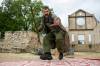


Advertisement Advertise With Us
Advertisement Advertise With Us