Pairing plays with pages
Bookman brings roving kiosk of literary treasures to fringe

Advertisement
Read this article for free:
or
Already have an account? Log in here »
To continue reading, please subscribe:

Digital Subscription
One year of digital access for only $205*
- Enjoy unlimited reading on winnipegfreepress.com
- Read the E-Edition, our digital replica newspaper
- Access News Break, our award-winning app
- Play interactive puzzles
*First annual payment billed as $205.00 + GST for one year. This annual subscription will automatically renew at $233.00 + GST every 52 weeks (10% off the regular annual price of $259.35). Offer available to new and qualified returning subscribers only. Cancel any time.
To continue reading, please subscribe:
Add Free Press access to your Brandon Sun subscription for only an additional
$1 for the first 4 weeks*
- Enjoy unlimited reading on winnipegfreepress.com
- Read the E-Edition, our digital replica newspaper
- Access News Break, our award-winning app
- Play interactive puzzles
*Your next Brandon Sun subscription payment will increase by $1.00 and you will be charged $17.95 plus GST for four weeks. After four weeks, your payment will increase to $24.95 plus GST every four weeks.
Read unlimited articles for free today:
or
Already have an account? Log in here »
Every superhero has a true identity: Superman is Clark Kent, Captain Canuck is Tom Evans and Wonder Woman is Diana Prince.
In Winnipeg — on university campuses, at craft markets and at flea markets — the Bookman is John Thompson.
Each July since the mid-1990s, the denim-clad seller has peddled perused pages to fringe festival goers in the Exchange District, setting up his bookshop — a movable feast of literary diversion — on the periphery of Old Market Square. Inside his shelved kiosk, the Bookman offers a broad selection that encourages expansive search and sudden summertime discovery. He takes credit, debit and cash.

MIKAELA MACKENZIE / FREE PRESS
John Thompson at his pop-up Bookman stand on Friday. Fringe veterans often like to take a book along to shows so they can read while waiting for the curtain to lift.
While the annual theatre festival’s core curriculum is centred on its paperback program — containing snapshots from 160 indoor theatre productions — fringe veterans understand the value of having other reading options available in their back pocket for prolonged sidewalk waits.
“It’s just the usual — somebody’s been murdered and they have to figure out who did it,” Allison Wilcox says Friday morning, taking a break from Kate Ellis’s crime novel Serpent’s Point while sitting beside the John Hirsch Mainstage, waiting to see a tribute concert to Céline Dion and Cher.
“If I have to wait, I prefer to read. I’d rather be doing something productive with my time.”
In the 1980s, Thompson got into bookselling to avoid a more tedious career path in the financial sector.
“In university, the plan was to become a chartered accountant. I figured, well, they make good money. I did an accounting course (at Westwood Collegiate), so I thought, ‘Well, that’s what I’ll do.’ And then I discovered, you know what: I really hate accounting,” says Thompson, 66.
Thompson found courses at the University of Manitoba gruelling, though he did persevere to complete his undergraduate studies. In his early 20s, he says he “bounced around and goofed off.” Needing money, he would sell textbooks on consignment to the university’s student book exchange, visiting garage sales during his abundant spare time to supplement his growing collection with dog-eared volumes about B.F. Skinner and Marie Curie.
Many of those sales were in his neighbourhood, where as a child he would visit Bigelow’s Drugstore — now Westwood Pharmacy — to scan the comic-book racks. Among his childhood friends is cartoonist Kevin Fraser Mutch, with whom he is still close; Mutch’s work has been anthologized in The Best American Comics and his most recent graphic novel, The Moon Prince, was published last year by Fantagraphics.
A few months into a hobby that became a career, Thompson learned tricks to the used-book retail trade that still guide his pricing pencil more than 40 years later.
“Literature never goes out of style,” says Thompson, who’s been a book section volunteer at the Goodwill store on Princess Street for over a decade.
MIKAELA MACKENZIE / FREE PRESS
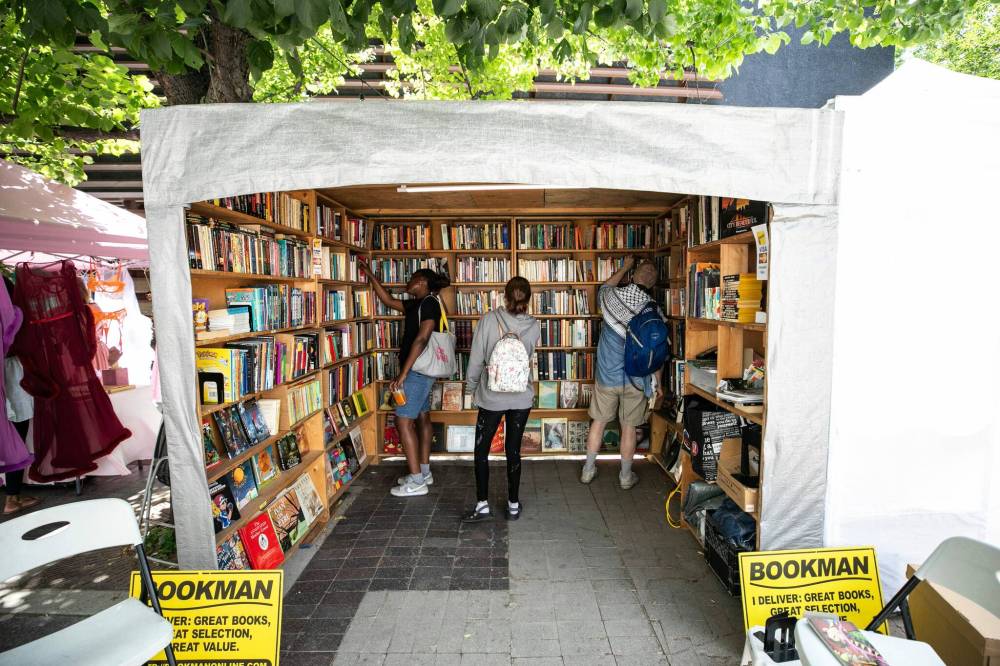
John Thompson’s Bookman stand offers a literary feast to fringe fest-goers.
“When you sell textbooks, they have a very limited lifespan — nobody wants them after about two or three years — so I no longer bother with those. Plus, they’re heavy.”
At his Old Market Square kiosk, readers will find a heady mix of young adult literature, classic novels, memoirs and books on subjects of local interest.
“The fringe is good for business,” says Thompson, who pops up 10 to 12 times per year, down from about 30 markets at his career peak. “Lots of people down here, always glad to see me there. It would be hard to quit. Summertimes are usually my off season, so fringe helps to perk things up a bit, absolutely.”
That’s also the case at Red River Book Store, where the Boyko family has been selling all manner of used literature for 50 years on Arthur Street.
“Since I was born,” says Jeffrey Boyko with a laugh when asked when his employment began.
As it does for Thompson, bookselling provides joy for Boyko, who works closely with his father, Dennis. And like Bookman, Jeffrey Boyko’s medium of choice is the graphic novel, singling out the Image Comics series Invincible and its ongoing spinoff Battle Beast as favourite titles.
Do people walk into the Red River Book Store — famous for its teetering stacks and dusky alcoves — knowing what they want to pick out next?
“We like to think of it as a treasure hunt — people come in to browse, to look up and down, and then, whatever catches their eye catches their eye,” Boyko says.
Over at the Bookman’s kiosk, Edward Chubb’s fascination was captured by a well-travelled copy of All Quiet on the Western Front, by Erich Maria Remarque, who wrote the definitive, gruellingly realistic cost-of-war novel in 1927 — less than a decade after the end of the First World War — amid the rise of the Nazi party.
MIKAELA MACKENZIE / FREE PRESS
Vince Litardi buys two books at the fringe fest on Friday.
“It’s about (the First World War), but it’s really about how the brutality of war can transform someone into a shell themselves,” says Chubb, who belongs to the Manitoba Writers’ Guild.

“I love stories like that — they’re tragic, but they tell you how human people are. And it relates to how I feel right now living in Winnipeg, where all these people are shells of themselves, too.”
Might Chubb’s work — including a piece of speculative sci-fi he’s currently working on — some day appear for sale on the Bookman’s shelf?
“I refuse to sell my stories. I’d rather give them up for free,” says the 25-year-old from Thompson. “I believe stories are an escape, offering a grand adventure. It’s beautiful when I write to imagine someone reading my stories and thinking, ‘Wow, that was a good story.’ And you know what, life is full of them.’”
For All Quiet, Chubb paid $12 and ventured off into the Exchange District, ready to be transported through time, place and page.
ben.waldman@winnipegfreepress.com
Ben Waldman is a National Newspaper Award-nominated reporter on the Arts & Life desk at the Free Press. Born and raised in Winnipeg, Ben completed three internships with the Free Press while earning his degree at Ryerson University’s (now Toronto Metropolitan University’s) School of Journalism before joining the newsroom full-time in 2019. Read more about Ben.
Every piece of reporting Ben produces is reviewed by an editing team before it is posted online or published in print — part of the Free Press‘s tradition, since 1872, of producing reliable independent journalism. Read more about Free Press’s history and mandate, and learn how our newsroom operates.
Our newsroom depends on a growing audience of readers to power our journalism. If you are not a paid reader, please consider becoming a subscriber.
Our newsroom depends on its audience of readers to power our journalism. Thank you for your support.
Read alert
This year’s fringe shelves are well-stocked by productions in the literary tradition, including Grimm’s Fairer Tales (Kids Fringe), Chekov Shorts (Venue 6), A Woman’s Guide to Romance Novels (Venue 8) and the Jane Austen-adjacent Promise and Promiscuity (Venue 1). In Book Lovers, by Winnipeg’s Liz Farler (Venue 1), Jill and Derek host the inaugural meeting of their book club meeting, with the course of events quickly deviating from the planned agenda.
Elsewhere, Venue 13, the debut novel by Free Press web editor David Jón Fuller, received a strong review in last week’s paper by frequent fringer Craig Terlson. “Venue 13 is like one of those plays that you wander into, watch for 10 minutes and suddenly become entranced,” writes Terlson. “This is the magic of theatre — except here it’s a book, that’s like a play, that is a book.”
Ben Waldman is a National Newspaper Award-nominated reporter on the Arts & Life desk at the Free Press. Born and raised in Winnipeg, Ben completed three internships with the Free Press while earning his degree at Ryerson University’s (now Toronto Metropolitan University’s) School of Journalism before joining the newsroom full-time in 2019. Read more about Ben.
Every piece of reporting Ben produces is reviewed by an editing team before it is posted online or published in print — part of the Free Press‘s tradition, since 1872, of producing reliable independent journalism. Read more about Free Press’s history and mandate, and learn how our newsroom operates.
Our newsroom depends on a growing audience of readers to power our journalism. If you are not a paid reader, please consider becoming a subscriber.
Our newsroom depends on its audience of readers to power our journalism. Thank you for your support.
Related Articles
Winnipeg Fringe Festival: 2026 show reviews














Advertisement Advertise With Us
Advertisement Advertise With Us
History
Updated on Wednesday, July 22, 2026 6:39 AM CDT: Adds links