Time-travel mystery Rose of Nevada a hallucinogenic trip

Advertisement
Read this article for free:
or
Already have an account? Log in here »
To continue reading, please subscribe:

Digital Subscription
One year of digital access for only $205*
- Enjoy unlimited reading on winnipegfreepress.com
- Read the E-Edition, our digital replica newspaper
- Access News Break, our award-winning app
- Play interactive puzzles
*First annual payment billed as $205.00 + GST for one year. This annual subscription will automatically renew at $233.00 + GST every 52 weeks (10% off the regular annual price of $259.35). Offer available to new and qualified returning subscribers only. Cancel any time.
To continue reading, please subscribe:
Add Free Press access to your Brandon Sun subscription for only an additional
$1 for the first 4 weeks*
- Enjoy unlimited reading on winnipegfreepress.com
- Read the E-Edition, our digital replica newspaper
- Access News Break, our award-winning app
- Play interactive puzzles
*Your next Brandon Sun subscription payment will increase by $1.00 and you will be charged $17.95 plus GST for four weeks. After four weeks, your payment will increase to $24.95 plus GST every four weeks.
Read unlimited articles for free today:
or
Already have an account? Log in here »
Here’s a spooky premise: A fishing boat, the Rose of Nevada, that disappeared along with its crew 30 years ago, makes a mysterious return — empty but unchanged — to a small village in Cornwall, on England’s southwest coast.
“She’s back,” the boat’s owner says ominously. Even more ominously, he doesn’t sound particularly surprised. It feels as if this has happened before.
There’s something unsettling going on in this strange and singular film. Cornish writer-director Mark Jenkin (Bait, Enys Men) has crafted a ghostly time-travel tale that collapses past and present, leaving his characters — and the audience — in haunting emotional and moral quandaries.
If the film’s sense of time can be deliberately hazy, its sense of place is very clear. All three of Jenkin’s features have been set in Cornwall, and there’s an intimate, immediate sense of connection to this coastal town, which is depressed and dwindling, its inhabitants beset by economic precarity. The harbour is deserted, the pub is empty, shop windows are boarded up and the young people are leaving. It seems as if the disappearance of that boat and crew broke not just the men’s grieving families but the whole community.
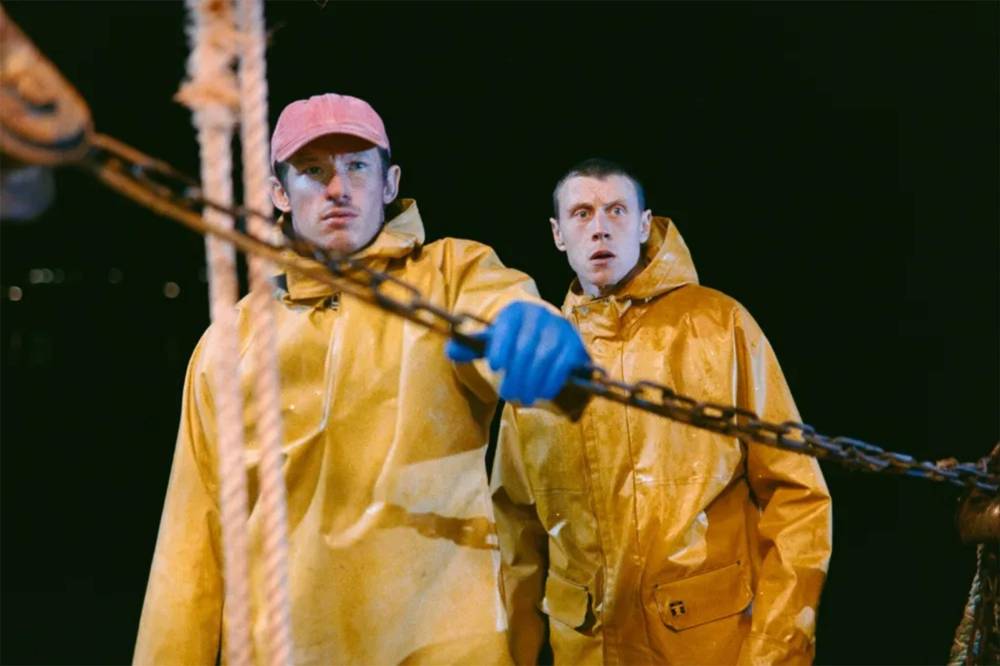
Maybe that’s why, after surreptitiously stripping the boat’s name off the hull, the owner has no trouble finding two young men who really need work. Nick (1917’s George MacKay) wants money to take care of his wife (Emily Daglish-Laine) and young daughter, and Liam (One Night Only’s Callum Turner) is a drifter who’s been sleeping rough. Along with a vaguely sinister skipper (played by Francis Magee, a fisherman before he became an actor), they head out to sea.
Three days later the men return to the same harbour, but they are — somehow — three decades in the past. Even more unnerving, the townspeople greet Nick and Liam as the men who went missing all those years ago.
Jenkin has set the men adrift in time. The 1990s harbour is now crowded with people and trucks, the pub packed, the main street lined with businesses. Liam, who has nothing to return to in the 2020s, is happy to claim a new identity that includes a readymade home with Tina (Slow Horses’ Rosalind Eleazar). Nick, though, has left behind his family, and he’s desperate to get back, even as it’s unclear whether that future still exists.
Time-travel stories, from Back to the Future to The Terminator to Groundhog Day, have always played around with temporal paradoxes and crazy causal loops. And this is art-house time-travel, so we get all those head-busting difficulties, along with an austere insistence on not explaining much.

Jenkin combines passages of hallucinatory eeriness with kitchen-sink working-class realism, especially around the hard labour of catching, gutting and icing fish. His debut feature, Bait, also took place in a hollowed-out Cornish fishing village, and one senses that much of the horror in Rose of Nevada is economic and social, an undertow of submerged grief at the loss of a way of life.
This is underlined by the look of the film. Jenkin uses an old-school spring-wound Bolex camera that delivers a grainy, textured analogue feel. He concentrates closely on physical evidence of time passing and the town becoming more impoverished, tracking signs of corrosion and decay, of peeling paint, rusting metal and weathered wood. These sequences — often using extreme closeups — feel hyper-real but also dreamy and weird.
BOSENA
From left: Callum Turner and George MacKay star in Rose of Nevada.
Jenkin’s approach can be obstinately oblique. The narrative is understated — you need to work to figure out who everyone is and how they are related across time — and there is very little dialogue.
But MacKay and Turner anchor things with minimalist but moving performances, and a story that begins as confounding becomes more and more compelling, even as we move to an uncertain tomorrow.
arts@winnipegfreepress.com
Studying at the University of Winnipeg and later Toronto’s York University, Alison Gillmor planned to become an art historian. She ended up catching the journalism bug when she started as visual arts reviewer at the Winnipeg Free Press in 1992.
Our newsroom depends on a growing audience of readers to power our journalism. If you are not a paid reader, please consider becoming a subscriber.
Our newsroom depends on its audience of readers to power our journalism. Thank you for your support.
Movie Review
Rose of Nevada
Starring: George MacKay and Callum Turner
● Dave Barber Cinematheque, 100 Arthur St.
● Today to Aug. 12
● 114 minutes, PG
★★★★ out of five
Other voices
Rose of Nevada is so uniquely its own thing, I strain for any comparison at all. Jenkin works the aforementioned technical restraints of his chosen vintage technology to extraordinary effect.
— Kimberley Jones, Austin Chronicle
Jenkin has suggested his latest is a commentary on sacrifice and community, but any concrete theory of Rose of Nevada risks allowing his enigmatic puzzle to lose its shattering spell of mystery and foreboding.
— Tim Grierson, Los Angeles Times
The result is a film that is haunting and singular – a furnace-blast of the past reshaped and refashioned for our modern times. All aboard.
— Barry Hertz, Globe and Mail
As a story of time and tide waiting for no man, Rose of Nevada is haunting, bittersweet, and a little scary. As a filmed object, it’s even more fascinating.
— Justin Chang, The New Yorker
Studying at the University of Winnipeg and later Toronto’s York University, Alison Gillmor planned to become an art historian. She ended up catching the journalism bug when she started as visual arts reviewer at the Winnipeg Free Press in 1992.
Our newsroom depends on a growing audience of readers to power our journalism. If you are not a paid reader, please consider becoming a subscriber.
Our newsroom depends on its audience of readers to power our journalism. Thank you for your support.
Advertisement Advertise With Us
Advertisement Advertise With Us